
The AI Paradox: High Adoption. Low Business Impact.
Artificial intelligence is supposed to transform companies, cut costs, and automate processes. Yet the reality in 2026 looks sobering.
According to IBM, up to 75% of all AI solutions fail to deliver the expected ROI. An MIT study goes even further: roughly 95% of AI projects generate no measurable economic return.
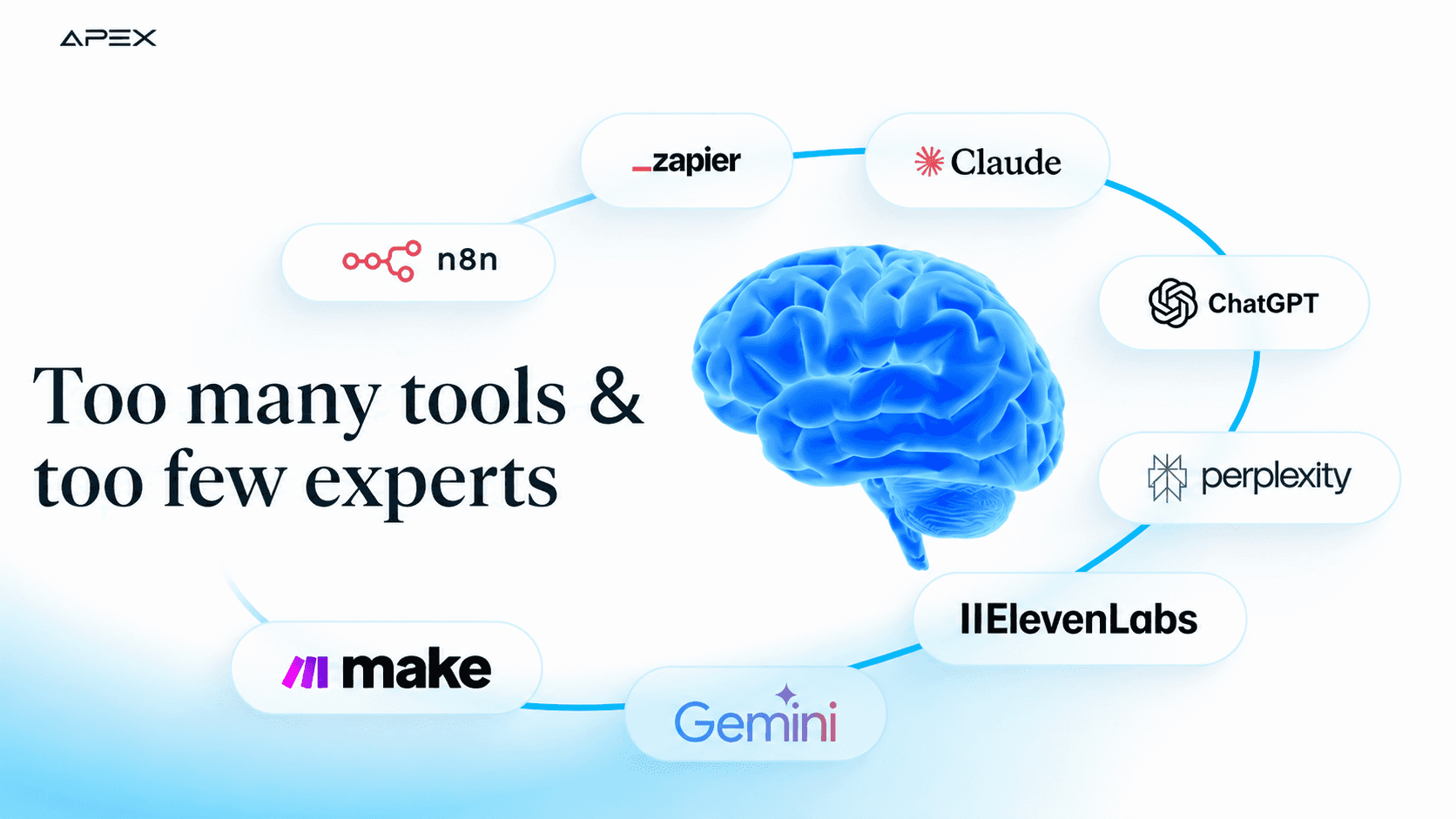
Too many AI tools promise efficiency, but without clear integration and ownership, the impact falls short. What matters is not the number of systems, but the expertise that connects and operates them effectively. Only specialists can turn tools into measurable business impact.
At the same time, new tools, platforms, and "all-in-one" solutions appear every day. The industry talks about disruption, scaling, and efficiency gains. Yet for many agencies, service providers, and SMEs, the breakthrough never arrives.
The central question is therefore no longer: What can AI do? Instead it is: Why does it so rarely create real impact in practice, particularly in service-driven business models?
This short article shows which three factors determine whether AI delivers genuine results or merely creates additional complexity. And why agencies, SMEs, consultancies, and service companies in particular hold a structural advantage here.
The AI Paradox: High Adoption. Low Business Impact.
The numbers paint a clear picture. While consumers use AI tools such as ChatGPT as a matter of course, adoption within organizations often fails at the implementation stage. According to MIT, only around 5% of all AI pilot projects reach production readiness. Deloitte shows that merely 15% of companies measure significant ROI improvements. PwC reports that 76% have seen no measurable profit impact so far.
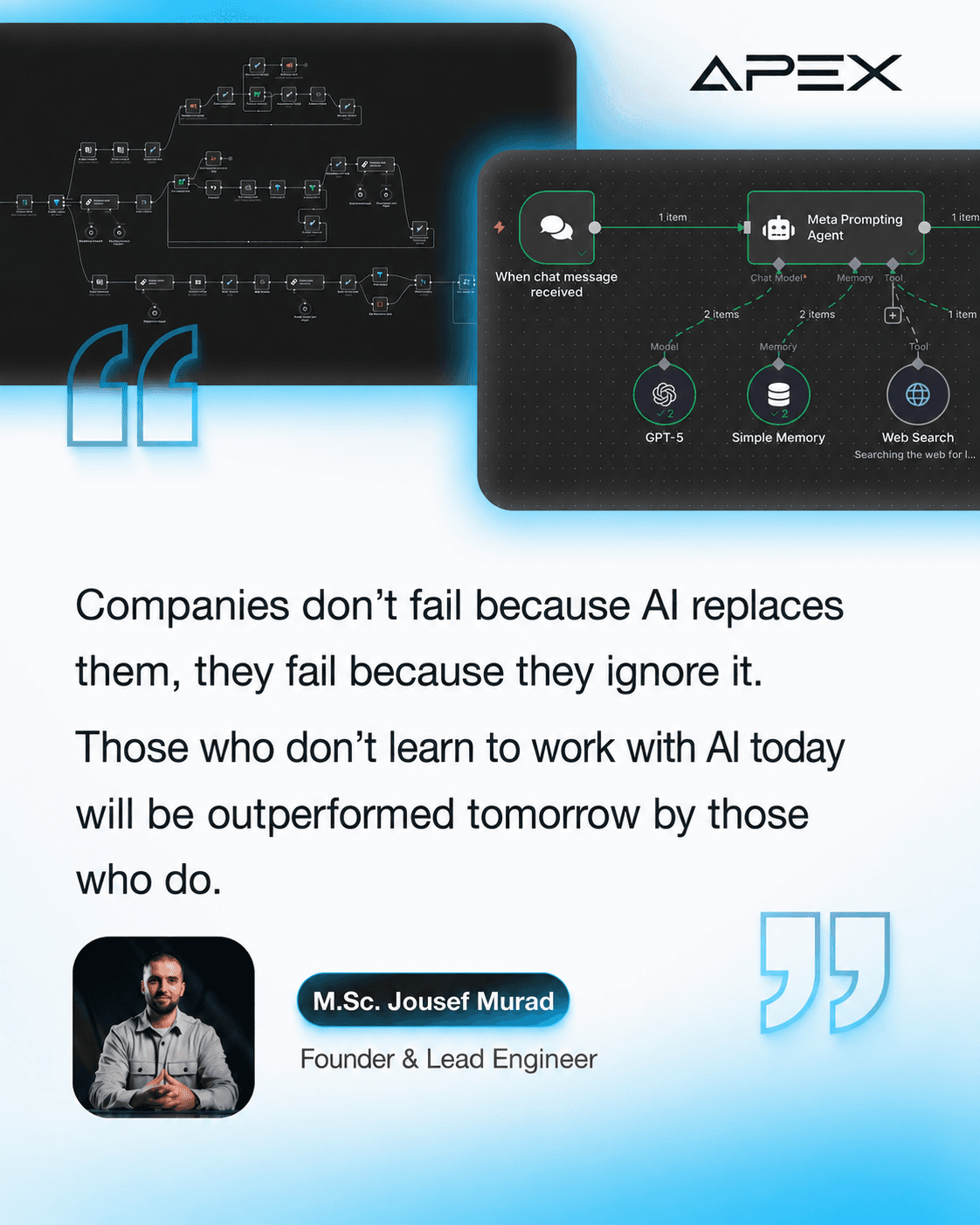
Companies don’t fail because AI replaces them, but because they miss the turning point. AI is no longer a topic for the future, but a structural shift. Those who don’t learn to work with AI today will experience their own personal Nokia moment tomorrow.
And yet there are counterexamples, particularly in the service environment:
Our client Bildungsfabrik reduced its costs in customer service and marketing fulfilment by more than 200,000 euros within six months
A recruiting organization reduced manual work by 40% through AI assistants, saving around 30,000 euros within a few weeks
A marketing agency automated core processes so effectively that roughly 20 hours per week were freed up within 90 days
These cases are not exceptions because of better technology. They follow a different implementation and operating model.
Three Factors That Determine Success or Standstill
1. Integration Beats Tool Collection
AI does not unfold its value as yet another isolated tool in the already overloaded stack of many agencies and SMEs. The economic effect only emerges once AI is deeply integrated into existing workflows.
Service companies in particular work in a strongly process-driven way: proposal creation, fulfilment, communication, quality assurance. AI only takes effect here when it works within these workflows rather than alongside them.
That often means:
Adaptation to existing data structures
Handling of special cases, client logics, and quality standards
Redesign of roles and handover points
McKinsey confirms it: of 25 influencing factors examined, the redesign of workflows has the greatest effect on real EBIT impact through GenAI.
2. AI Changes the Logic of Work, Not Just Its Speed
A common mistake is treating AI like conventional software. Yet AI is probabilistic rather than deterministic. Results vary, quality has to be assessed, and outputs have to be put into context.
This is decisive in agencies, consultancies, and coaching contexts. Anyone who discards the entire system after a single flawed output misunderstands the nature of the technology.
Successful organizations therefore invest not only in tools but in enablement:
How do I assess AI results in a meaningful way?
When is an output "good enough"?
Where is human oversight required?
Several real-world cases showed the same pattern: even technically mature solutions failed when teams were not trained in working with AI at the same time. Adoption is a question of capability rather than a tool problem.
3. AI Needs Operations, Not Just Implementation
AI promises results, not only efficiency. Yet results only materialize when someone takes responsibility.
Processes change. Client requirements change. Models evolve further. Without continuous support, even a good AI system slowly degenerates into an unused relic.
A new role profile is therefore emerging in service companies: the AI operator. This can be an internal employee or an external specialist who monitors, adapts, and further develops the systems.
Gartner shows that regular reviews and optimizations increase the likelihood of high business value many times over.
Why Specialized Agencies Hold the Advantage Here
These three factors have one thing in common: they require consulting, enablement, and ongoing operations, which means they require services.
This is precisely where the advantage arises for specialized agencies, consultancies, and service-oriented companies. Not because they build better models, but because they take responsibility for results.
Forward-Deployed Expertise Instead of Tool Handover
More and more companies work with so-called forward deployed engineers or AI solution engineers. These profiles combine technical understanding with process and industry knowledge. They integrate AI into real workflows instead of merely providing software.
Agencies as Their Own AI Operators
Another model involves agencies that deploy AI primarily internally in order to deliver their services more efficiently. Content production, research, outreach, or reporting are automated, while strategy and client management remain with people.
The client receives results rather than technology. Training and adoption risks largely disappear.

Through its collaboration with APEX, Navasto was strategically repositioned and established as a truly omnipresent brand in the market. The completely revamped marketing and visibility strategy laid the foundation for sustainable growth. The result: Navasto was successfully acquired by a U.S. corporation.
Long-Term Automation Partnerships
AI automation agencies that combine consulting, implementation, and enablement increasingly act as long-term partners. Providers who connect business understanding, technical delivery, and communication are especially valuable.
Many agencies only learn this through experience: implementation alone is rarely enough. Only the combination of strategy, training, and operations leads to sustainable ROI.
Product or Service? A False Opposition
The hope for a fully self-running AI product is understandable. Yet the reality in 2026 is more nuanced.
Products and services form a continuum rather than an either-or choice:
Fully self-service SaaS offerings are rare
Purely individual transformations are hard to scale
The most successful models sit somewhere in between
Even heavily productized AI solutions invest massively in onboarding, enablement, and support. Experts come to the conclusion that service-driven AI business models achieve faster product-market fit and more stable revenues, despite initially lower margins.
For agencies and consultants, a clear logic follows from this: services are often the path toward productization rather than its opposite.
What This Means Concretely for Service Companies
For agencies, SMEs, coaches, and consultants, the result is a strategic rather than a technological framework for action:
AI has the strongest effect where processes are clearly defined
The greatest leverage lies in integration rather than in tool selection
Specialization beats generalism
Responsibility for results is worth more than technology promises
AI Impact Comes From Operations, Not From Tools
The decisive point is this: AI rarely fails because of the technology. It fails because of missing integration, insufficient enablement, and absent responsibility.
For service-oriented companies, this represents an opportunity rather than a threat. Anyone who understands AI as an operational system rather than a product can deliver genuine value, both for clients and for their own business model.
The gap between what is technically possible and what is actually implemented in practice remains enormous in 2026. Demand for specialized partners arises precisely there, for partners who do not merely talk about AI but produce real impact.
The decisive question is therefore not: which tool do I use? Instead it is: who makes sure that it actually works?
Anyone who can answer that question will remain relevant in the AI era as well.
About APEX Consulting
APEX Consulting is an AI automation and growth consulting firm supporting B2B organizations with intelligent workflows, AI agents, CRM automation, and scalable operating systems. The firm focuses on practical, implementation-driven solutions that reduce manual effort and enable sustainable growth.
More information: https://apex-consulting.ai/