


When Does AI Pay Off?
You are facing the decision to invest in artificial intelligence, and you want to know whether it truly makes sense. A recent McKinsey survey shows that 40% of companies are planning major AI investments, driven above all by the potential of generative AI. At the same time, 62% of executives are convinced that AI literacy is now part of everyday work. Before you invest thousands or even millions, you should answer one central question:
How do you actually measure the return on investment (ROI) of AI, and which factors really determine whether your investment pays off?
In this guide, you will learn which drivers determine AI ROI, which metrics you should keep an eye on, and which pitfalls may be waiting for you along the way. This allows you to make well-founded decisions and get the most out of your AI projects.

Savings of more than €200,000 in six months show that with the right strategy and experts by your side, AI becomes a real driver of value.
Watch the case study.
What Drives the ROI of AI Investments?
Before you dive into metrics, it is worth taking a look at the three most important levers that decide whether your AI projects end up in the black.
Cost Savings Through Automation
AI-driven automation is one of the fastest ways to achieve measurable savings. By automating labor-intensive processes in areas such as customer service, marketing, procurement, or back office, you reduce personnel costs, lower error rates, and free up resources for more strategically important tasks.
A striking example from agency practice shows how marketing teams now use AI to automatically summarize campaign reports, create audience analyses, or produce social media posts within minutes, a job that used to take hours.
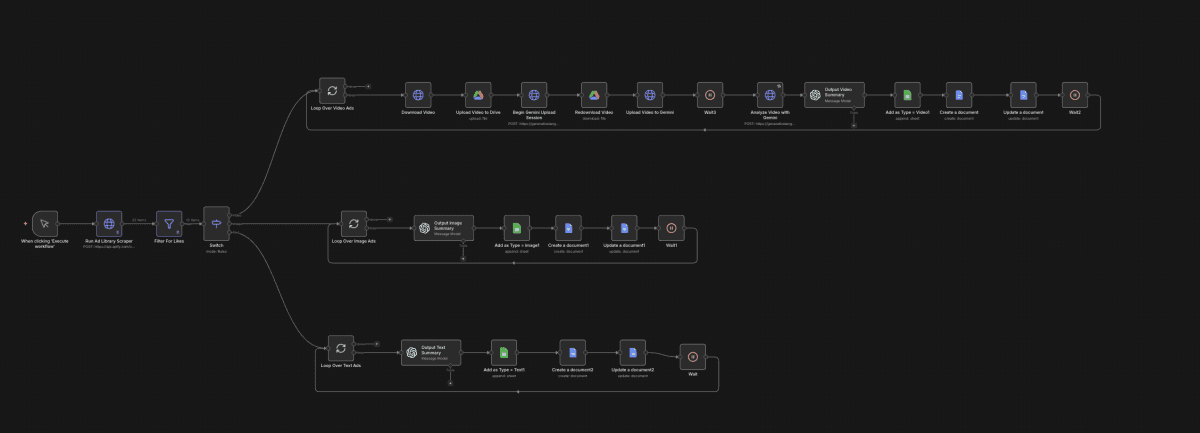
A well-known recruiter commissioned us to automatically extract competitors' ads and analyze them with AI in order to gain data-driven insights and fresh ideas for their own marketing.
What once took half a working day can now be completed by an AI assistant in just a few minutes, with greater consistency and quality at the same time.
The picture is similar among mid-sized companies. In service and manufacturing businesses, AI-powered predictive maintenance ensures that machines are serviced according to their actual condition and need, which replaces rigid fixed intervals. This reduces downtime, lowers costs, and improves planning reliability, all without any additional personnel resources.
Your takeaway: Think about which recurring manual processes in your company cost the most time and money, because that is exactly where you should start with AI.
Revenue Growth Through AI-Powered Personalization
In a highly competitive market, personalization has become a real revenue driver and is far more than a nice-to-have. AI analyzes customer data in real time and delivers tailored product recommendations, copy for websites and social media, and customized offers.
The result is higher customer satisfaction, stronger loyalty, and more revenue.
A concrete example from mid-sized businesses shows how companies now deploy AI-powered chat and voice agents to answer customer inquiries around the clock. Prospects receive qualified answers immediately via website chat, phone, or WhatsApp, which removes long waiting times entirely.
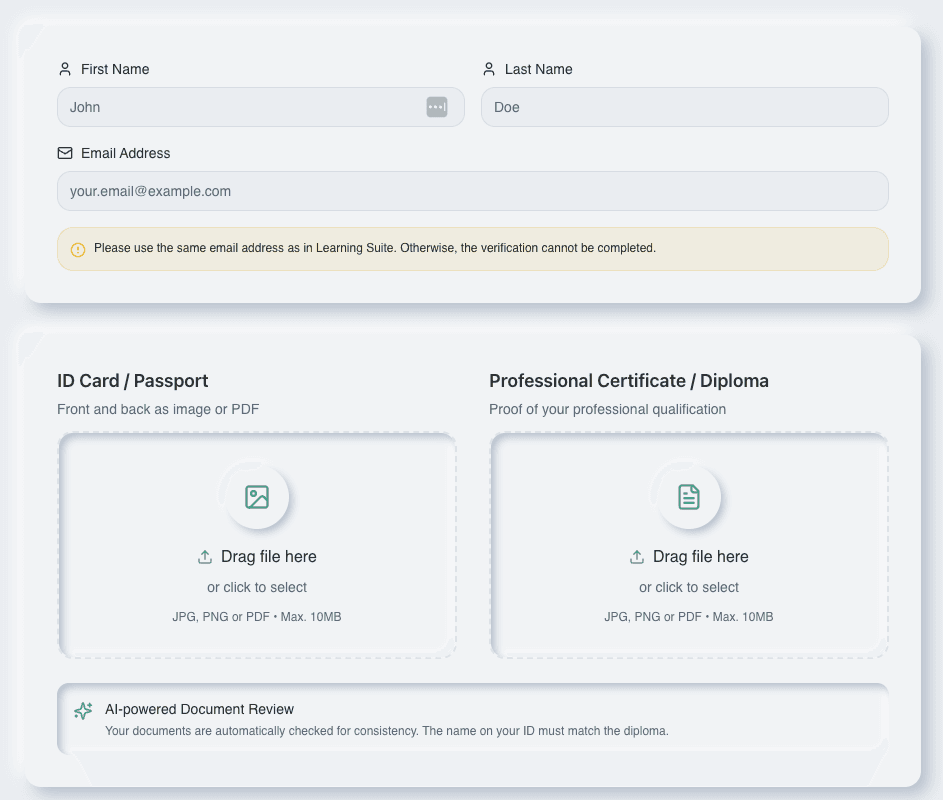
Built by our team at APEX in 3 weeks: a custom interface with AI integration for the automated verification of identity and qualification documents.
This pays off especially in the B2B environment, where AI agents pre-qualify leads, answer standard questions automatically, and hand over only the truly relevant conversations to the sales team. This increases closing rates, shortens sales cycles, and improves customer satisfaction at the same time.
Your takeaway: Use AI to truly understand your customers and offer them exactly what they need before they even ask for it.
Faster Time to Market and Greater Efficiency
Time is money, and AI saves you a great deal of it. Through faster data analysis and intelligent decision support, AI shortens product development cycles considerably. Processes that used to take weeks or months can now be completed in days.
Generative AI tools, for example, create marketing content or prototypes in record time. This makes your company more agile, innovative, and responsive, and it gives you a decisive competitive advantage because you can pick up on market trends faster and meet customer needs more quickly.
How to Measure the ROI of Your AI Investments Correctly
Now it is time to get specific about which key performance indicators (KPIs) you should track to evaluate the success of your AI projects.
The Most Important KPIs at a Glance
Cost savings: Record all savings resulting from reduced personnel costs, automation, and optimized processes.
Revenue impact: Measure how AI influences your lead generation, conversion rates, and overall revenue.
Engagement and customer satisfaction: Monitor click-through rates, Net Promoter Scores, and other engagement metrics that show how well your AI solutions resonate with customers.
These KPIs give you a clear picture of where AI creates real added value and where adjustments may be needed.
The ROI Formula: Looking Beyond the Percentage
The classic ROI calculation is simple:
(Gain from investment - Cost of investment) / Cost of investment
With AI projects in particular, however, it pays to go deeper.
Also take the Net Present Value (NPV) and the Internal Rate of Return (IRR) into account so that you include the timeline and the changing value of money. This gives you a more realistic picture of the long-term profitability of your AI investment.
What counts as a good ROI? According to a global IDC study supported by Microsoft, companies achieve an average return of $3.50 for every dollar invested.
The top 5% of companies even achieve $8 for every dollar.
Most companies (92%) deploy their AI systems within 12 months, and 40% do so in as little as six months.
The average ROI is reached after about 14 months.
For agencies, the reality looks considerably better. Thanks to short decision-making paths, lean structures, and clearly measurable processes, they can usually realize the ROI of AI investments much faster.
While large corporations often need months for alignment, compliance, and complex integrations, agencies can put AI solutions to work in their daily business right away, whether in content creation, campaign management, reporting, research, or client communication. Every hour saved has a direct effect on margin and productivity.
As a result, AI investments in many agencies often pay for themselves within a few weeks to a few months, well ahead of the 14-month average. This very speed makes AI one of the most effective levers for agencies in recent years.
Short-Term vs. Long-Term ROI: Finding the Right Balance
One of the biggest challenges with AI projects is that the initial investment is often high, covering technology, infrastructure, and qualified specialists. An AI engineer in the US earns an average of $145,080 per year, and for an entire team, that adds up quickly.
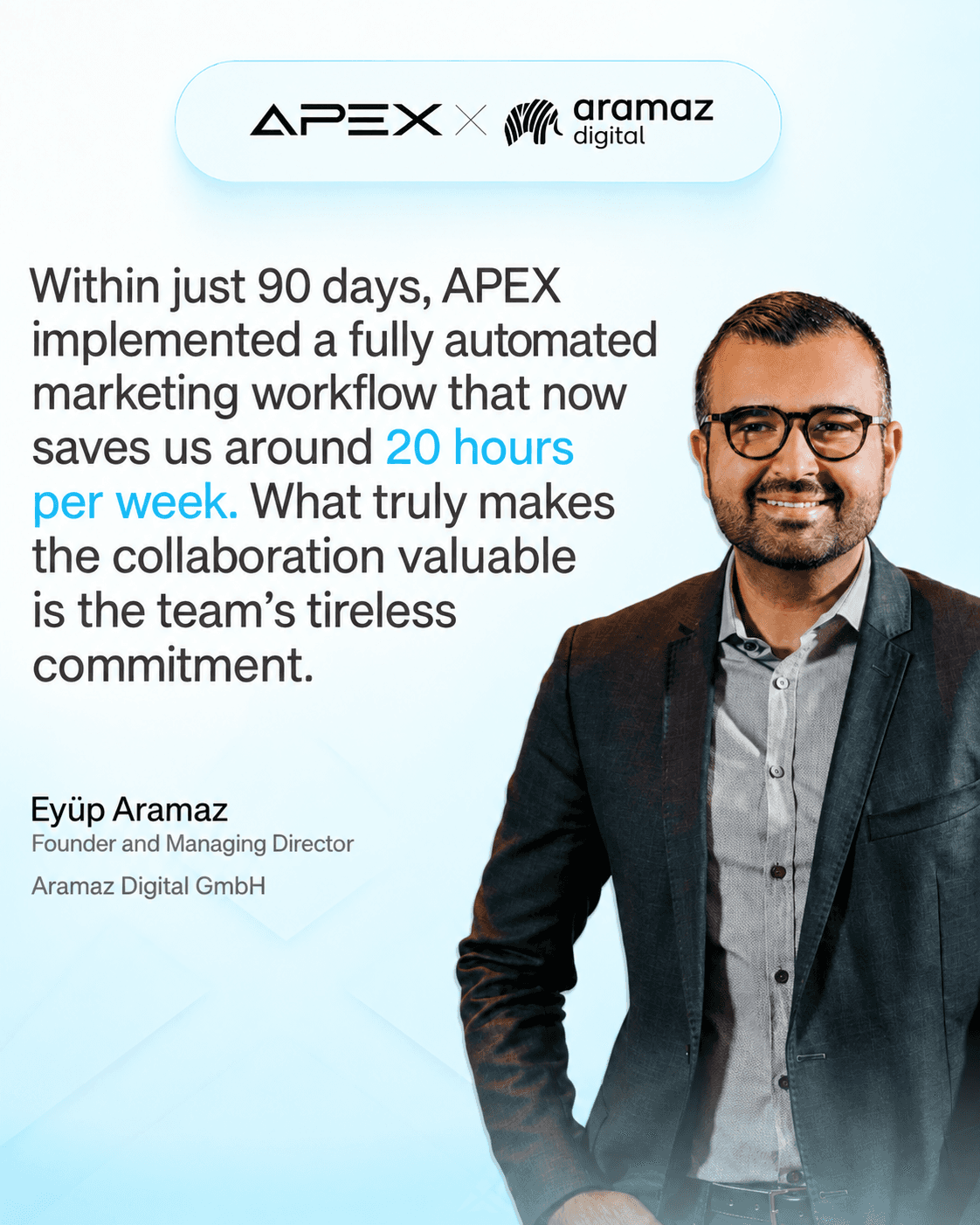
Successful automation in practice: Together with APEX, Aramaz Digital optimized its marketing processes and now saves around 20 hours of work time per week.
According to a Forbes article, the actual cost of building an AI project from scratch can turn out to be 15 times higher than originally planned, mainly because of the infrastructure required.
This is exactly where we make the difference. We enable a significantly more affordable and faster implementation without the need to build expensive internal structures. With proven frameworks, prebuilt modules, and clear processes, AI solutions can be introduced within weeks and without building your own AI team.
This allows companies to benefit from AI without high fixed costs or lengthy projects. The initial investment remains manageable, the benefits become measurable immediately, and the ROI is realized much earlier.
AI remains a long-term strategic asset, and with our approach, getting started becomes predictable, efficient, and productive in a short time.
The Biggest Obstacles on the Path to a High ROI
Despite the enormous potential, the path to a positive AI ROI comes with its share of obstacles. Here are the three most common challenges and how you can overcome them.
High Upfront Costs and Integration Complexity
Implementing AI requires more than purchasing software, since it also involves integration into existing systems and employee training. According to a Deloitte survey, many companies still have their AI projects in the pilot or proof-of-concept stage: 68% of respondents have moved less than 30% of their AI projects into production.
A major reason lies in missing budgets for employee training, which 35% of executives identify as the biggest hurdle according to the State of Data & AI Literacy Report 2024.
Solution: Rely on a step-by-step implementation and invest early in comprehensive training platforms that cover all the necessary skills. This lowers costs in the long run and speeds up the move into production.
Data Quality and Availability
Without clean, well-organized data, AI cannot reach its full potential. Many companies collect huge volumes of data every day, which raises the question of how much of it is actually usable.
According to McKinsey, poor data quality is a constant obstacle to AI implementations, especially in the manufacturing industry. Inaccurate or incomplete data leads to flawed models, poor forecasts, and ultimately disappointing results.
Solution: Invest in solid data management systems and processes. Make sure your data is accessible, structured, and reliable, since this forms the foundation of every successful AI strategy.
Missing AI Skills in the Team
Even the best AI technology is of little use if your team does not know how to apply it. To maximize ROI, you need employees with solid AI and data skills.
The good news is that upskilling and reskilling are achievable and extremely effective. According to the State of Data & AI Literacy Report 2024, 26% of executives report a complete transformation of their decision-making through targeted data and AI training.
Solution: Commit to continuous learning. Flexible, scalable learning platforms help you prepare your teams, whether you have two employees or ten thousand.
Conclusion: AI Pays Off When You Approach It the Right Way
Artificial intelligence offers enormous opportunities in the form of cost savings, revenue growth, faster innovation, and stronger customer loyalty. To achieve a high ROI, however, you need a well-thought-out plan: define clear KPIs, manage upfront costs strategically, ensure data quality, and invest in the skills of your teams.
The challenges are real, and the long-term benefits can be transformative. Companies that invest in AI and in their people today secure a decisive competitive advantage.
Your next step: Start with a pilot project in an area where you can achieve quick wins. Measure consistently, learn from the results, and then scale. This is how your AI investment becomes a true success story.
About APEX Consulting
APEX Consulting is an AI automation and growth consulting firm supporting B2B organizations with intelligent workflows, AI agents, CRM automation, and scalable operating systems. The firm focuses on practical, implementation-driven solutions that reduce manual effort and enable sustainable growth.
More information: https://apex-consulting.ai/