Generative Engine Optimization (GEO) vs. SEO
Digital search is currently undergoing a fundamental shift. When your target audience increasingly consumes information through AI systems rather than through classic result lists, "SEO alone" is no longer enough. Alongside rankings, what matters now is whether your content is understood by generative systems, condensed by them, and used as a source.
This is exactly where Generative Engine Optimization (GEO) comes in. You optimize content so that AI systems interpret it reliably, classify it as trustworthy, and reference it in their answers. The goal goes beyond "being found" and moves toward "being part of the answer."

More than a year ago, Malte Landwehr and I already discussed how Generative AI Optimization (GAIO) and Large Language Model Optimization (LLMO) are changing classic SEO. You will learn which strategies are decisive now, how GAIO and LLMO differ, and how brands can secure their visibility in the AI-driven search era. Watch it here.
In this guide you will learn:
what GEO is and how it works
why GEO is becoming relevant for B2B service providers, agencies, and SMEs
how GEO and SEO differ and how the two work together
how to build content, structure, sources, and entities so that AI draws on you preferentially
which technical building blocks (structured data) increase your citability
1) What Is Generative Engine Optimization (GEO)?
Generative Engine Optimization (GEO) is the strategic optimization of your content for AI-supported answer systems and generative search interfaces. While classic SEO aims at strong positions in search result lists, GEO is about having your content serve as the foundation for AI answers and, ideally, be named as a source.
In practice, this means:
Your content has to be unambiguous, structured, and factually stable.
Core statements have to be easy to extract (definitions, steps, criteria, comparisons).
Trust signals have to be visible (author, experience, sources, currency, context).
One important point is that users frequently perceive AI answers as conclusive. Anyone who does not appear there loses attention.
E-E-A-T (Experience, Expertise, Authoritativeness, Trustworthiness) is becoming the central quality filter for generative systems.
2) Why GEO Is Becoming Relevant Now
Search behavior is shifting from "click and compare" toward "ask and get an immediate answer." This creates more and more situations in which users no longer click through to websites at all, because the answer already appears in an AI summary.
For you, this means:
Reach and demand emerge more strongly "in the answer layer," not only in the SERPs.
Anyone who learns early how to make content AI-readable and citable builds a structural head start.
GEO complements SEO. You secure visibility in classic search results and in AI interfaces alike.
3) SEO vs. GEO: Similarities and Differences
Similarities
The goal is visibility and discoverability
Content quality remains the foundation
Topic and question research remains decisive
Technology helps in both worlds (structure, performance, crawlability)
Authority and trust continue to gain weight
Differences
Target channel: SEO optimizes for search result pages, GEO for AI answers.
Mechanics: SEO frequently rewards signals such as backlinks and SERP relevance, while GEO rewards comprehensibility, structure, entities, and verifiable statements.
Interaction: SEO aims for clicks, GEO often works without any click at all.
Measuring success: SEO measures rankings and traffic, GEO measures mentions, citations, brand presence in AI answers, and the demand that grows out of them.
Content requirements: For GEO, semantic coverage carries more weight, including definitions, comparisons, criteria, and clear conclusions.
Coexistence
GEO does not replace SEO, it extends it. Good SEO is often the foundation, though GEO forces you to formulate content in a way that machines can extract reliably.
4) Semantic Topic Coverage Instead of Keyword Focus
For GEO, what matters is less whether a keyword appears exactly 15 times and more whether you cover the topic completely, consistently, and without contradictions.
Here is how you work semantically:
Collect the most important questions surrounding the topic (who/what/why questions, "comparison," "costs," "example," "checklist").
Build in synonyms and related terms naturally.
Work with topic clusters (pillar page plus subpages).
Deliver clear definitions and distinctions so that the AI can use you as a reference.
5) Content Strategies for Generative Systems
Writing Style and Structure
A clear core per paragraph: the first sentence delivers the statement, the details follow afterwards.
Concrete formulations: little ambiguity, and little use of "can" when you are able to justify "is."
Headings as questions: the question as an H2, with the direct answer in the first sentence beneath it.
Lists instead of running text: steps, criteria, pros and cons, checklists.
Example boxes: short, real scenarios that anchor the statement.
Formats That AI Extracts Readily
Definitions (one to two sentences)
Step-by-step processes
Comparison tables (even when you model them in the CMS as a simple list)
Criteria catalogs ("Pay attention to…")
FAQ sections with precise answers
6) Sources, Numbers, Quotes: Why "Verifiable" Wins
Generative systems prefer content that appears verifiable. You achieve this through:
concrete figures and benchmarks (with a source)
references to studies and official documentation
short expert quotes (used sparingly, but pointedly)
currency markers (as of: month/year)
transparent authorship (name, role, experience)
One important note: do not use sources as decoration, use them to support your core statements.
7) Structured Data as a GEO Lever
Structured data helps machines recognize content types, entities, and relationships cleanly. This is not "GEO on its own," though it does increase the likelihood of being understood and referenced correctly.
Example 1: FAQPage (improves extraction of Q&A)
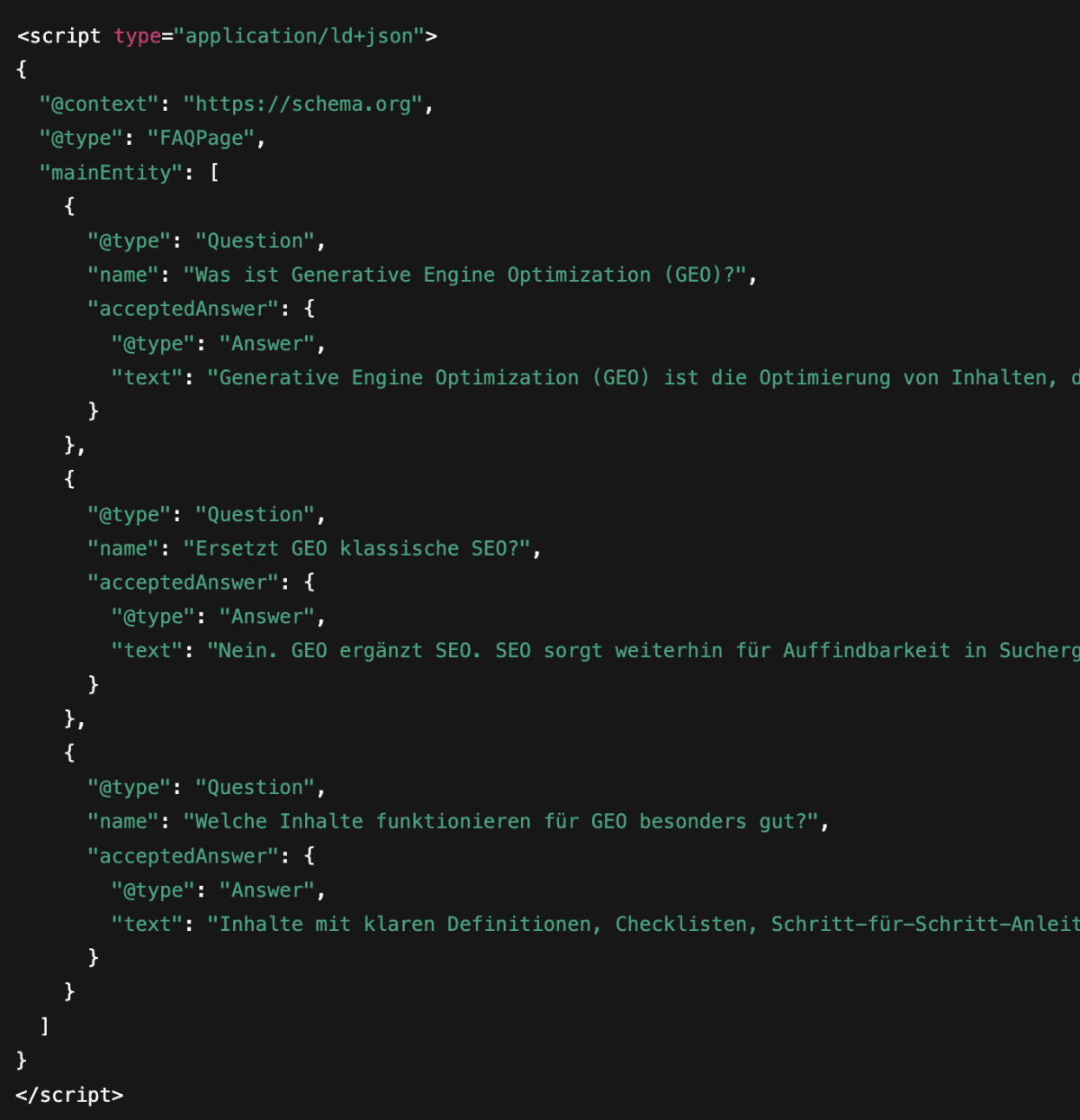
This JSON-LD snippet marks up questions and answers unambiguously for search engines and AI systems. Generative systems such as ChatGPT or Google AI Overviews therefore understand more quickly what the page is about and can use the content purposefully in AI answers.
Example 2: Article + Author (helps with authority, date, context)
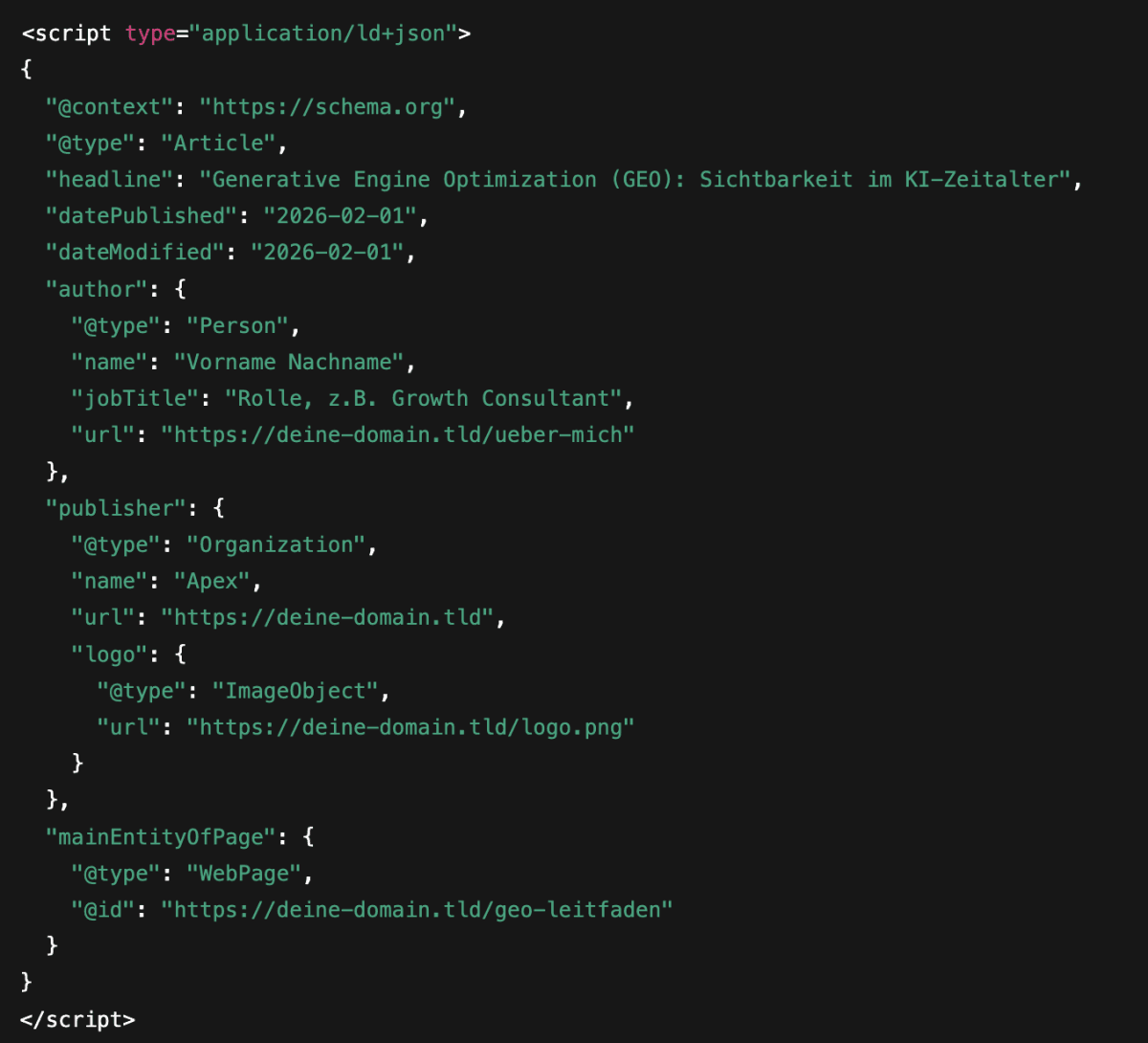
This JSON-LD markup identifies the post clearly as a specialist article with an author, publication date, and publisher. Search engines and AI systems can therefore classify the content correctly, cite it, and attribute it clearly to your brand, which is an important building block for trust and visibility in AI search.
Example 3: Organization (strengthens entity, consistency, trust)
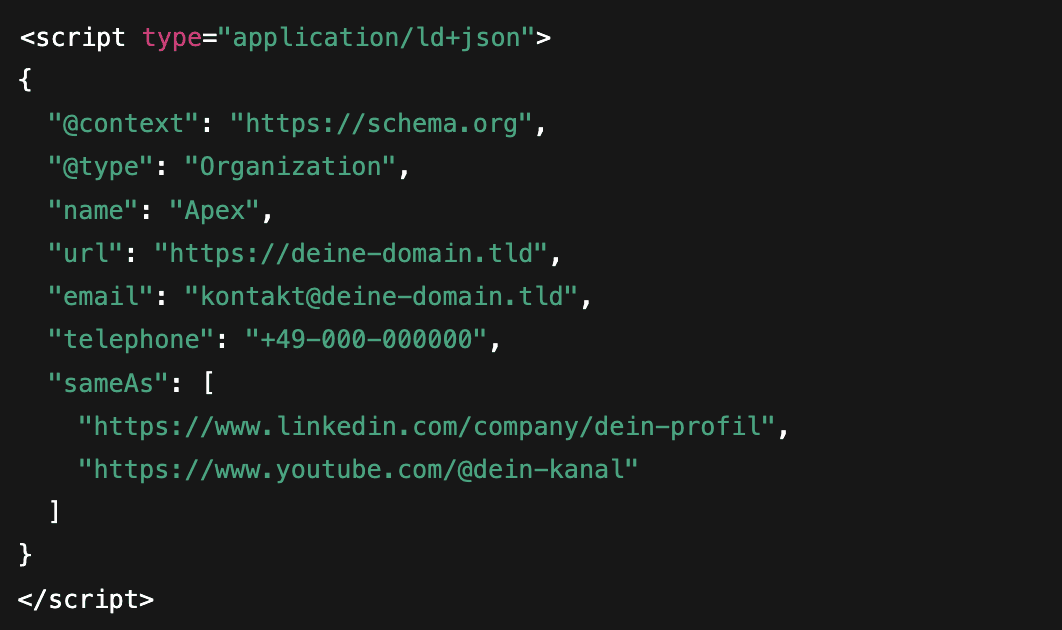
This markup defines your company unambiguously as an organization with official contact and profile information. Search engines and AI systems therefore recognize your brand as a consistent entity, which builds trust and increases the likelihood that your content is attributed correctly and referenced in AI answers.
Example 4: Person (making expertise visible)
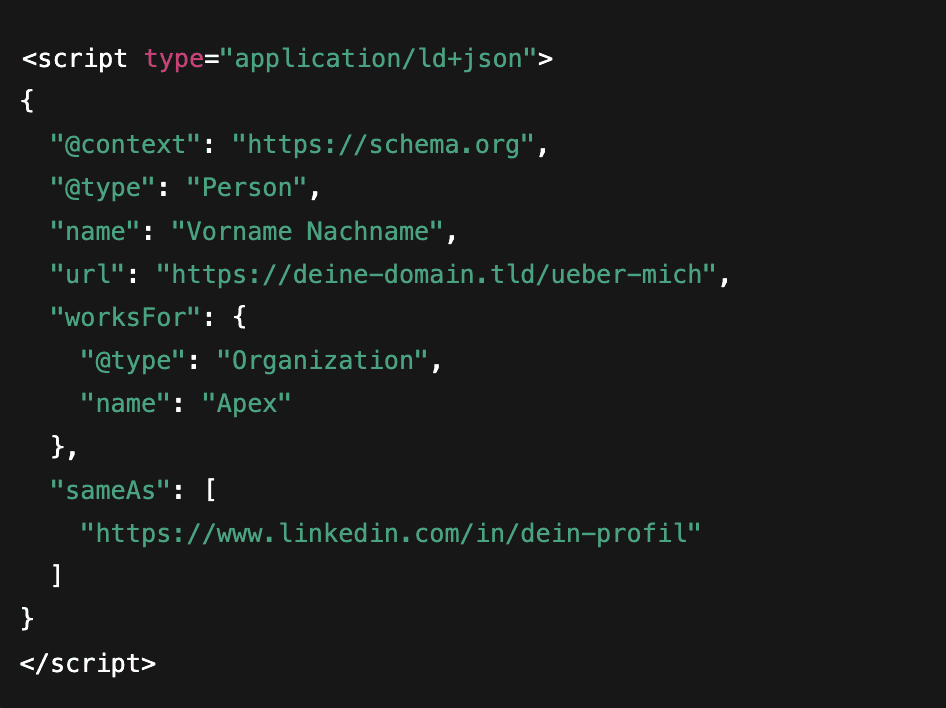
This markup links the content unambiguously to a real person and their role within the company. Search engines and AI systems therefore recognize who stands behind the content, which is an important trust factor in ensuring that your content is classified as professionally sound and worth citing.
A practical note: use placeholders only as a template. What matters is that the name, URLs, date, author, and publisher are correct and match your pages.
8) Optimizing for Conversational Queries
AI queries are often complete questions. You should align your content architecture accordingly:
build long-tail questions in as H2/H3 headings
answer directly within the first one to two sentences
add context, examples, and limitations afterwards
deliver clear criteria rather than vague formulations
9) Authority and Trust: E-E-A-T as the Core of GEO
For GEO, what counts are visible trust signals rather than merely "good text":
an author box with experience and specialization
traceable sources
case studies, references, reviews
clear contact information, imprint, privacy policy
consistent brand profiles (website, LinkedIn, industry directories)
AI systems work heavily with patterns and entities. The more consistently you appear as an entity across the web, the more easily you become "citable."
10) Challenges, Measurability, Outlook
GEO is dynamic, because AI interfaces change quickly. Two typical hurdles stand out:
Transparency: why an AI uses source A rather than source B is not always traceable.
Measurability: you need new routines such as monitoring brand mentions in AI answers, lead attribution through self-reported source ("How did you hear about us?"), and tracking via content hubs.
11) How APEX Can Support You
GEO appears complex at first, yet its implementation is highly systematic: clear structure, verifiable statements, strengthened entities, and technical signals in place. APEX combines SEO fundamentals (technology, architecture, content quality) with GEO mechanics (extractability, citability, authority).
12) Mini Check-Up: The AI Visibility of Your Website
A sensible starting point is a short check across three areas:
Technology: indexability, performance, clean structure
Content: answers, structure, topic coverage, currency
Trust: author, sources, references, entity consistency
13) FAQ
What is GEO in one sentence? GEO optimizes content so that AI systems understand it, condense it, and use it as a source in their answers.
Why is GEO important? Because a growing share of information searches ends in an AI answer and classic click paths are becoming weaker.
What is the difference from SEO? SEO optimizes for rankings and clicks. GEO optimizes for citability and presence in answers.
Does GEO replace SEO? No, GEO complements SEO. Anyone who integrates both wins twice over.
How do I start if I already do SEO? Begin with your most important pages: a clear Q&A structure, better definitions, stronger sources, an author box, structured data, and after that the build-out of clusters.
About APEX Consulting
APEX Consulting is an AI automation and growth consulting firm supporting B2B organizations with intelligent workflows, AI agents, CRM automation, and scalable operating systems. The firm focuses on practical, implementation-driven solutions that reduce manual effort and enable sustainable growth.
More information: https://apex-consulting.ai/