
The Build vs. Buy Dilemma
Artificial intelligence is no longer just a buzzword. It is transforming how companies sell, acquire customers, develop products, and manage processes.
But in almost every strategy discussion, the same question eventually comes up:
“Should we build our own AI solution, or rather work with an agency that has already done this dozens of times?”
What initially sounds like a technical decision is, in reality, a strategic one: a choice between speed and control, cost and risk, isolated expertise and sustainable capability.
“APEX implemented a fully automated marketing workflow that demonstrably saves us around 20 hours of work per week. The tireless commitment of the team is particularly valuable - it significantly shapes the collaboration.”
Eyüp Aramaz – Managing Director of Aramaz Digital GmbH
Why so many companies fail with “Build”
Almost every company starts with good intentions: “We’ll build this ourselves. We have capable developers, we’ll save money, and we’ll learn along the way.”
That sounds reasonable.
But what initially feels like a smart decision often later turns out to be a time drain, a cost trap, or an innovation bottleneck.
Here are typical patterns we see again and again:
Tinkering mode becomes the permanent state.
A proof of concept that was supposed to take just a few weeks is still being tested six months later. No one really knows when the system is “finished”-or whether it ever will be.Knowledge is tied to one person.
One developer built the system. He understands it. No one else does. When he goes on vacation or leaves the company, the entire project comes to a halt.Small technical debt grows into massive problems.
Libraries change, APIs break, new requirements arise, and suddenly the code from spring is no longer usable by fall.Business focus gets lost.
Instead of AI simplifying processes, it becomes a process itself-one that has to be maintained, tested, and explained.
None of this happens because teams are bad, but because, internally, the big picture is often missing.
People work in the system, not on the system.
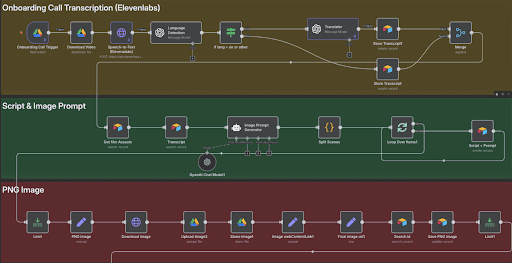
Automated n8n workflow for Meta & Google Ads: from the onboarding call to script generation to the finished image ad and conversion into video format - fully AI-powered.
Build works - but only in rare cases
Of course, there are situations where it makes sense to build something yourself. For example, when:
the company has a strong internal IT team,
AI itself is part of the product (e.g., at software companies),
and the necessary time, infrastructure, and resources are available to maintain systems long term.
But in 9 out of 10 cases, especially for B2B companies, SMEs, agencies, or industrial companies, the reality looks different:
You want results, not infrastructure. You need impact, not a new department.
And that’s exactly where the difference lies between “Build” and “partnering with experts.”
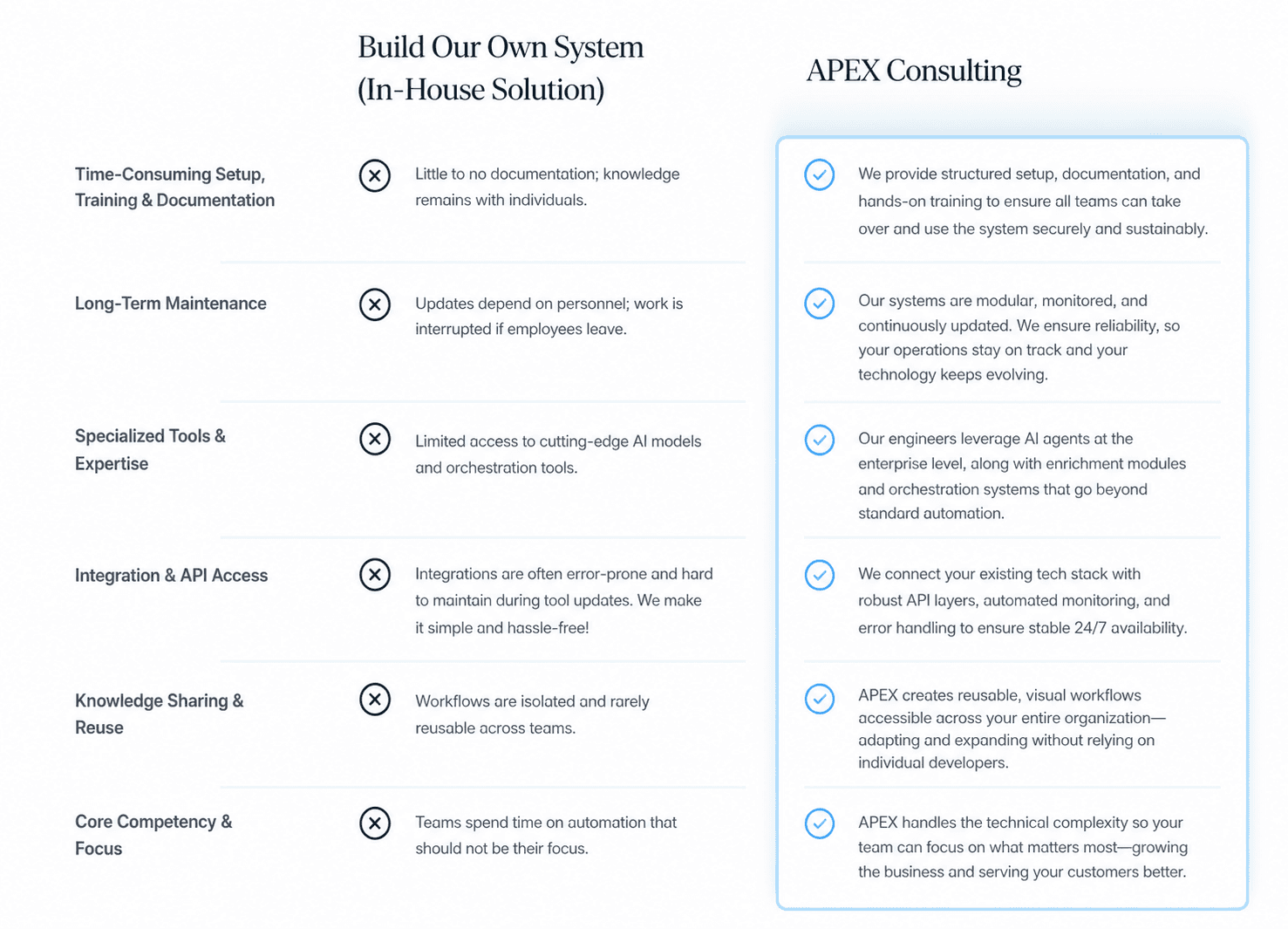
Comparison: In-house development vs. APEX consulting – why companies automate faster, more reliably, and more scalably with APEX.
Why the agency route is usually smarter
A specialized AI agency brings three things that are rarely combined internally: experience, speed, and perspective.
It has already seen what works and what doesn’t.
It knows where the pitfalls are before they even appear.
It can rely on existing frameworks, automations, and tools instead of starting from scratch every time.
Here are the key advantages, with real-world examples:
1. You gain time-and avoid the biggest beginner mistakes
When an internal team starts, it has to figure everything out on its own: Which model makes sense? Which API is stable? How should data be structured?
An agency comes with ready-made processes, templates, and proven integrations. This not only shortens the start phase but also prevents typical beginner mistakes that can slow projects down for months.
Example: A company wanted to automatically score leads by relevance. The internal project team worked for four months on a custom solution, which turned out to be unreliable due to a lack of clean data.
With APEX, the same system went live in four weeks, including data cleanup, scoring logic, and CRM integration.
2. You get systems that last, not just systems that work
Many internal solutions are prototypes, not products. They run, as long as no one touches them. As soon as an update comes or a process changes, the system breaks.
Specialized AI agencies think in terms of stability and scalability. They build systems designed to grow, with backups, logging, monitoring, and support. The result is a solution that works not just today, but a year from now as well.
3. You benefit from knowledge gained across dozens of projects
An internal team has experience from one project: its own. An agency has experience from many, often across different industries and systems.
That means it brings ideas you would never discover internally. This often leads to entirely new possibilities, such as:
automatically enriching leads with CRM data,
prioritizing responses in customer support using AI,
or running marketing workflows fully without manual intervention.
These insights don’t come from trial and error-they come from experience.
4. You get real integration instead of data silos
A common problem with in-house development: isolated solutions. One tool for leads, one for emails, one for data, but nothing talks to each other.
An agency builds systems that work together and are orchestrated, not systems that exist side by side. When a new customer fills out a form, the data is automatically sent to the CRM, the marketing tool, and accounting. No Excel lists, no copy-paste chaos.
The result: fewer errors, more speed, and a clear overview.
5. You stay independent of individual people
The biggest blind spot in many in-house solutions is dependency on individuals. If only one developer understands how something works, that’s a risk, not an advantage.
At APEX, we document every step, explain workflows, record videos showing processes in detail, and build systems that function independently of any single person. This keeps knowledge inside the company, not inside people’s heads.
6. You refocus on your core business
In the end, the question isn’t whether you can build AI, but whether you should. Every company has a core business: acquiring customers, developing products, and increasing revenue. Building and maintaining AI systems is rarely part of that core.
An agency takes over exactly that-the technical and operational work. Your team focuses on execution, strategy, and what truly makes the company strong.
APEX insight: Why “Build” is more expensive than it looks
Many believe: “If we build it ourselves, we’ll save money.” That’s only true on paper.
What’s often forgotten are the hidden costs:
Months of work spent on research, testing, and debugging
High maintenance effort for every small change
Downtime when the developer leaves or is unavailable
No support when something breaks
And most importantly: missed opportunities due to lost time
An agency may seem more expensive at first, but on closer inspection, it’s significantly cheaper. Why? Because it delivers. Fast, reliable, and with documentation.
And because it builds systems that pay off, not just technically, but economically.
When you should still build yourself
There are exceptions where “Build” makes sense. For example, if you:
have a strong tech team that can dedicate long-term capacity,
need a highly specialized solution that doesn’t exist on the market,
or deliberately want to build proprietary IP (intellectual property).
But in all other cases, partnering with experienced AI experts gets you there faster, safer, and at lower cost.
Conclusion: The question isn’t “Build or Buy”- it’s “How fast do you want results?”
Building yourself means control, but also responsibility. Working with an agency means trust, but also speed, security, and focus.
The companies that truly grow over the next few years won’t be the ones that “do everything themselves.” They’ll be the ones who know when to let go in order to move faster.
Build is good. Partner is better. Because the real competitive advantage isn’t in the code-it’s in execution.
How to take the first step now with APEX
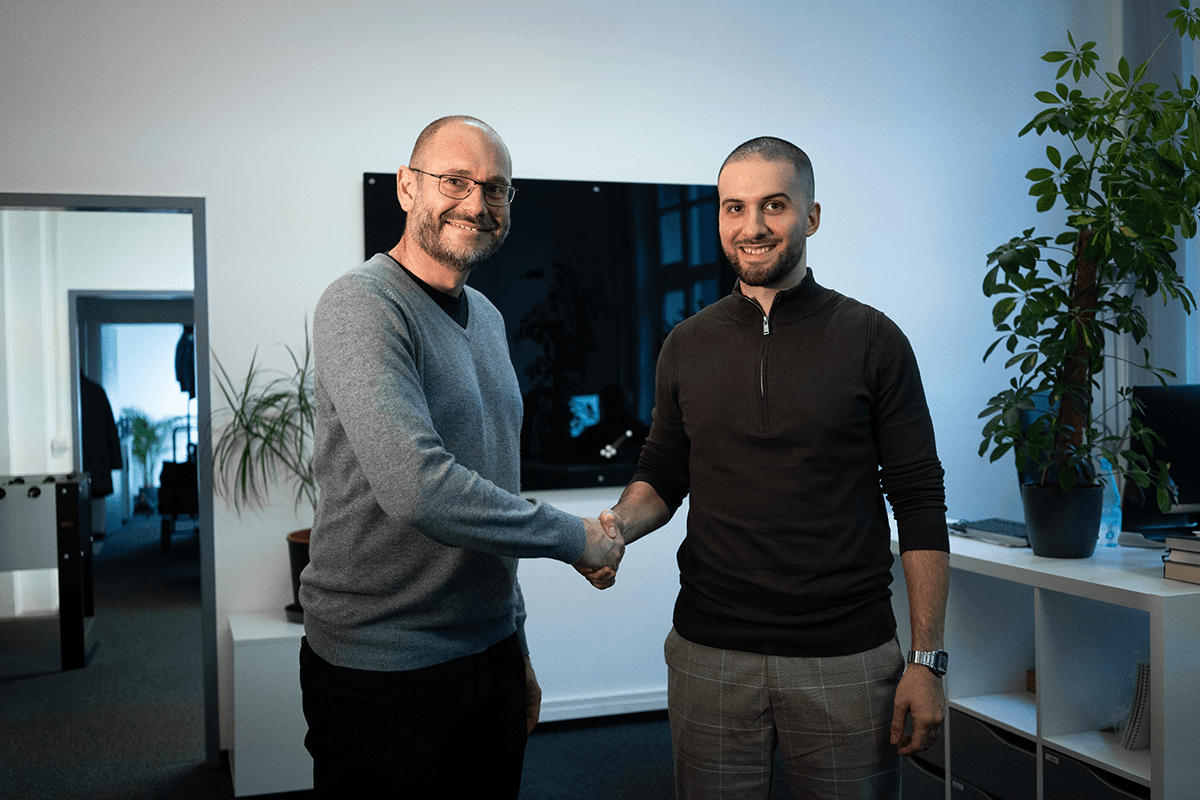
Navasto massively increased its marketing performance without adding staff. With APEX Consulting, the company tripled its content production, launched campaigns 40% faster, and quadrupled its social media activity-thanks to AI automation and data-driven systems.
Case study: How APEX supported Navasto’s rise all the way to its acquisition by Autodesk.
If you’ve read this article up to this point, you know one thing: AI automation is no longer a side topic. It is a decisive factor in how efficiently, scalably, and profitably your company will operate in the future.
The key question now is: How do you implement this in practice, without ending up in months of technical chaos or choosing the wrong tools?
The good news: you don’t have to walk this path alone. That’s exactly why we offer a free and non-binding AI automation consultation.
What you get in this consultation
1. Individual analysis of your current processes
We take a close look at your existing workflows, tools, and bottlenecks-and show you where automation is already possible today but remains unused.
2. Assessment of your automation maturity
Many problems don’t arise from missing tools, but from unclear processes. We show you how to structure your workflows so that AI and automation actually take effect.
3. Concrete recommendations for action
At the end, you receive a clear roadmap: which systems can be automated in the short term, and which measures will create long-term time savings, clarity, and growth.
Who is this consultation for?
For entrepreneurs who realize that their operations require too much manual work.
For teams who know AI can help, but don’t know where to start.
For decision-makers who aren’t looking for yet another tool, but for a system that actually works.
Important: The consultation is completely non-binding. Its purpose is to give you clarity and direction-even if you currently have no intention of hiring an agency.
How it works
You book an appointment via our calendar link: https://calendly.com/apex-consulting-call/15min
We conduct a personal strategy call (with one of our automation experts).
You leave the call with a clear assessment and concrete next steps.
Book your free AI consultation now and secure a clear roadmap to reduce time, costs, and manual work with a system.
About APEX Consulting
APEX Consulting is an AI automation and growth consulting firm supporting B2B organizations with intelligent workflows, AI agents, CRM automation, and scalable operating systems. The firm focuses on practical, implementation-driven solutions that reduce manual effort and enable sustainable growth.
More information: https://apex-consulting.ai/