
AI is far more than just hype.
Many still consider AI a toy. Nice for text, somewhat amusing for images, but supposedly out of place in real business. This attitude is rapidly becoming a strategic risk.
Because while people are still debating whether AI is "mature enough," autonomous systems or so-called AI employees are already handling real tasks. They book travel, coordinate appointments, answer inquiries, produce documents, and make decisions within clearly defined boundaries. Without a mouse. Without clicks. Without human intervention.
What is happening here is not a future scenario. It is the present. And it affects leaders sooner than they would like.
The question is not whether your company uses AI, but whether it uses it in a controlled way. If you do not define the rules of the game, shadow IT emerges: employees upload data, test tools, and build workarounds that nobody checks. That costs not only quality, but can affect compliance, reputation, and margins.
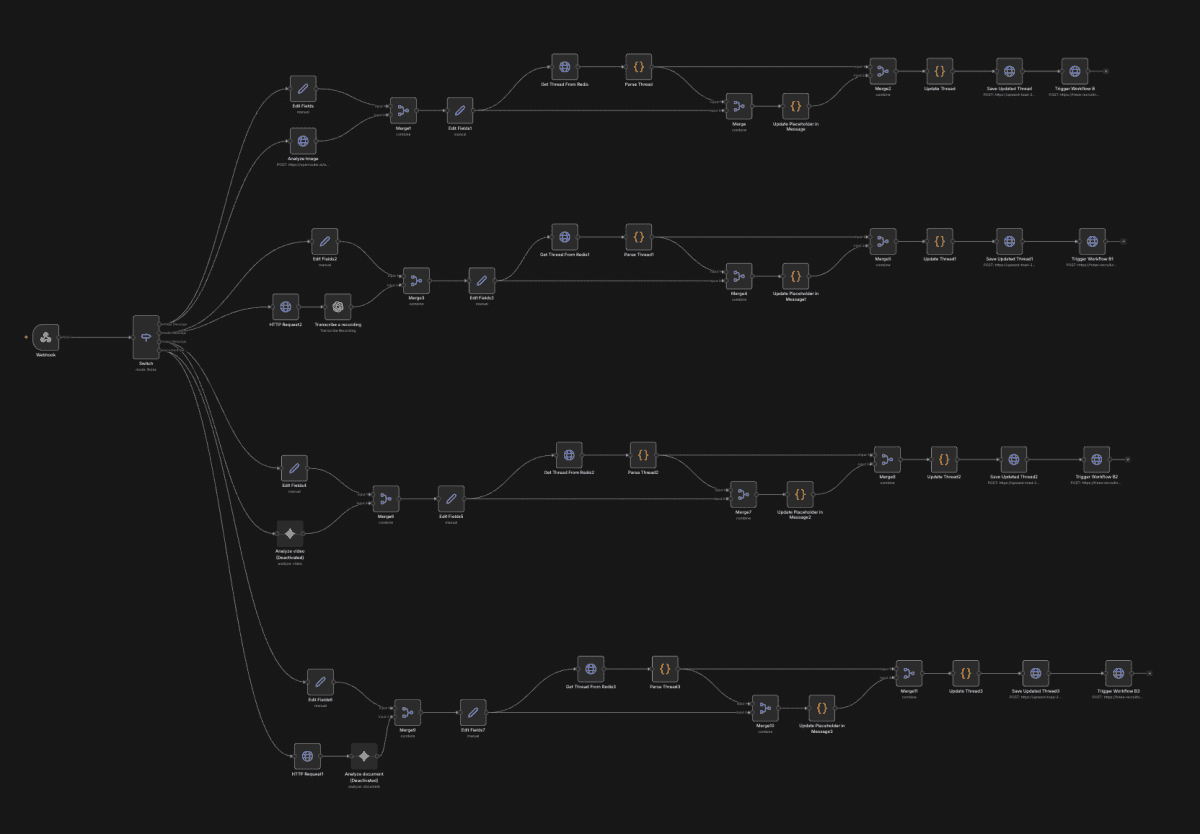
A modularly built WhatsApp AI workflow that processes different input types such as text, audio, image, and documents and transfers them into structured threads. The logic clearly separates analysis, parsing, context enrichment, and further processing from one another. The result is a scalable system that reliably supplies autonomous agents with consistent context.
From voice assistants to systems that act
What used to be simple voice commands via Siri or Alexa is today a new interaction standard. AI systems no longer wait for us to execute every individual action. They act independently in digital environments.
Browsers are operated as if by humans. Forms filled out automatically. Bookings completed. Processes orchestrated. And virtually without errors.
The difference is decisive: these systems no longer merely suggest. They implement directly.
That fundamentally changes the role of software. And it shifts responsibility away from the machine back to the person deploying it.
Why is this more dangerous than many think? Not because AI is "evil." But because it is efficient.
Technology never prevails because it is permitted, but because it is useful. People use tools that save them time. First privately, then professionally.
That was the case with email. With the smartphone. With cloud software. And it will be no different with AI.
Anyone who believes an internal ban solves the problem is misreading reality. Employees are already using AI. Just without guardrails, without standards, without quality control.
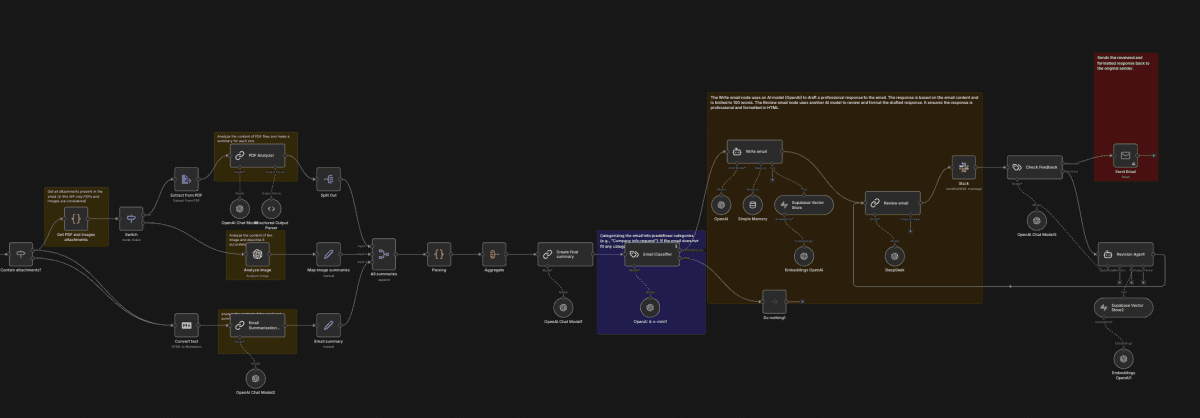
An end-to-end workflow for intelligent email processing: attachments are automatically analyzed, content summarized, categorized, and enriched with context. On this basis, an AI agent creates professional response drafts, checks them for quality, and sends them in a structured way via defined channels. The result is a scalable, consistent, and nearly fully autonomous email process.
The real misunderstanding about AI
AI is not intelligence in the human sense. It does not think. It does not understand. It simulates.
Language models calculate probabilities. They do not say what is true, but what statistically fits best. Errors are a systemic part of that.
That is not a flaw. It is a characteristic.
Anyone who treats AI like a human will be disappointed. Anyone who treats it like a tool will win.
Three factors determine the outcome
AI does not deliver objective truth. It delivers results based on three levers:
The model: more capable models deliver better results. Saving money here means saving in the wrong place.
The instruction (prompt): an unclear brief produces unclear results. Good prompts are precise, rich in context, and goal-oriented.
The context: what the system knows determines what it can deliver. Without relevant input, even the best model stays superficial.
Most poor results are not an AI problem. They are a communication problem.
Three ways companies use AI meaningfully today
Catching up: summarizing, explaining, sorting. Emails, documents, research. Low entry barrier, immediate benefit.
Collaborating: AI becomes part of existing work processes. Your own data is integrated, content validated, knowledge made structurally usable. That increases quality and speed simultaneously.
Thinking further: this is where real value is created. AI simulates scenarios, tests variants, finds solutions outside the boundaries of human experience. Not as a replacement, but as an extension.
Innovation emerges where people consciously use this level.
The real risk lies elsewhere
Not in the technology. But in the unequal distribution of competency.
A gap is currently forming between people who can use AI confidently and those who reject or ignore it. The difference is measurable in productivity, speed, and quality.
This gap is growing exponentially.
Leadership in this context does not mean controlling everything. Leadership means providing orientation. Defining rules. Enabling learning.
Mental relief is not a loss
We no longer memorize phone numbers. We do not navigate without maps. We do not calculate in our heads.
That is not decline. It is progress.
AI is the next step in this development. It relieves cognitive resources and creates space for decisions, creativity, and strategy.
Anyone who tries to stop this is not fighting against AI. They are fighting against reality.
Responsibility instead of refusal
AI is not magic. It is mathematics, statistics, and computing power. But it works exponentially.
The decisive question is not whether AI is coming. It is already here.
The question is whether you are ready to use it consciously, reflectively, and responsibly. Or whether others will use this head start while you are still debating.
A simple entry point is enough: take a task that regularly costs you time. Give the AI a clear brief. Context. Expectation. Goal.
Always evaluate the result critically. Optimize. Learn.
That is how competence begins.
About APEX Consulting
APEX Consulting is an AI automation and growth consulting firm supporting B2B organizations with intelligent workflows, AI agents, CRM automation, and scalable operating systems. The firm focuses on practical, implementation-driven solutions that reduce manual effort and enable sustainable growth.
More information: https://apex-consulting.ai/