
What already works with AI in sales today
The meaningful use of AI in sales is not determined by individual tools, but by how well processes are connected to each other. This is exactly where automation comes in. n8n is particularly well suited because it does not impose a rigid system, but functions as an orchestration layer.
It connects data sources, AI models, CRM systems, and communication channels into a seamless sales process, without taking responsibility away from the people involved.
The following article is not about abstract possibilities, but about concrete workflows that we already implement at APEX today and that meaningfully relieve the pressure on sales.
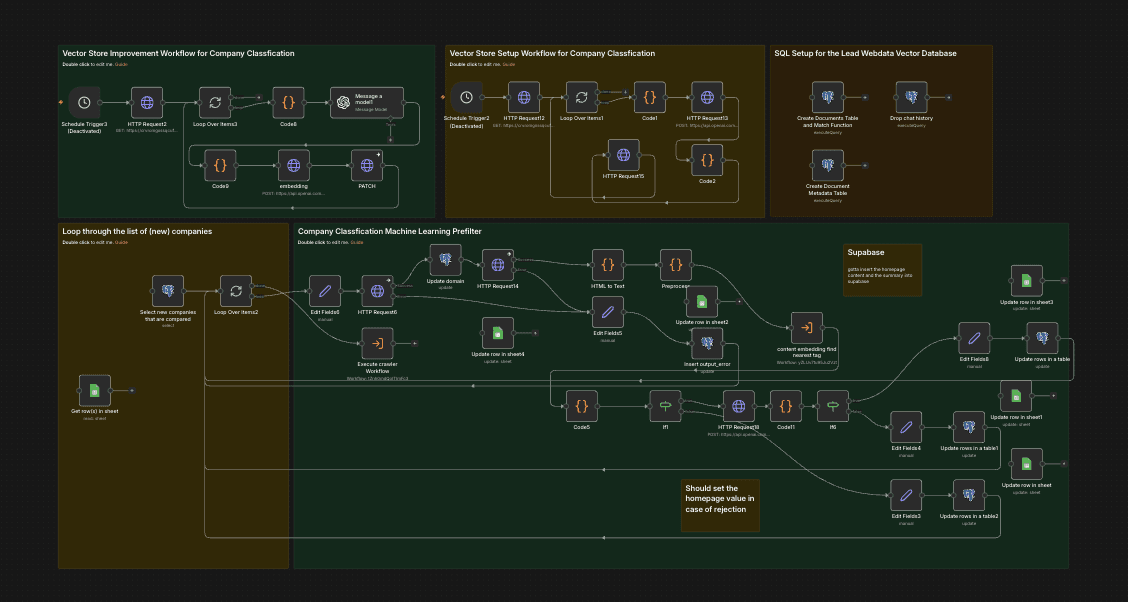
Modular n8n workflow for automated company classification: from intake of new companies, feature enrichment, and ML-based pre-qualification through vector store setup and optimization to structured storage and updating in SQL/Supabase and Google Sheets.
Lead research: context instead of contact details
The first lever lies in lead research. In many organizations the process starts with an email address and ends in manual research. With n8n this step can be automated while simultaneously improving its quality.
A typical workflow begins with a trigger from the CRM, a form, or a list of new leads. n8n then retrieves data from various sources, such as company databases, websites, LinkedIn profiles, or job postings. These raw data points are bundled and passed to a model that creates a structured company profile and checks whether these leads match the gold standard (or in English, ICP: Ideal Customer Profile). Instead of unwieldy information, a compact overview emerges: what the company does, what phase it is in, what role the contact person plays, and which topics are currently relevant.
What matters here is not the maximum amount of data, but the reduction. n8n helps create a clear picture from many sources that can be taken in within a few minutes. This preparatory work is precisely what determines whether a conversation has substance or not.
Lead qualification: criteria instead of gut feeling
Once a lead has been researched, the question of relevance arises, and again the gold standard topic comes into play. Here too n8n can help without automating decisions. In practice, qualification criteria are defined, for example company size, industry, technical maturity, regional focus, or recognizable buying signals such as new hires or investments.
n8n collects these signals, normalizes them, and passes them to an AI model that creates a structured assessment. The result is not a yes-or-no decision, but a traceable classification: why this lead is relevant, which web pages informed that decision, where risks exist, and which topics should be explored in the conversation. This assessment is stored in the CRM and serves as the decision basis for the sales team.
The advantage lies not in the automation itself, but in comparability. Every lead is evaluated using the same logic, regardless of daily form or time pressure.
Preparing conversation and decision reports
A frequently underestimated part of sales is the preparation of internal and external conversations. Whether it is a first meeting, a proposal appointment, or a management update, the relevant information needs to be gathered. n8n can simplify this process considerably.
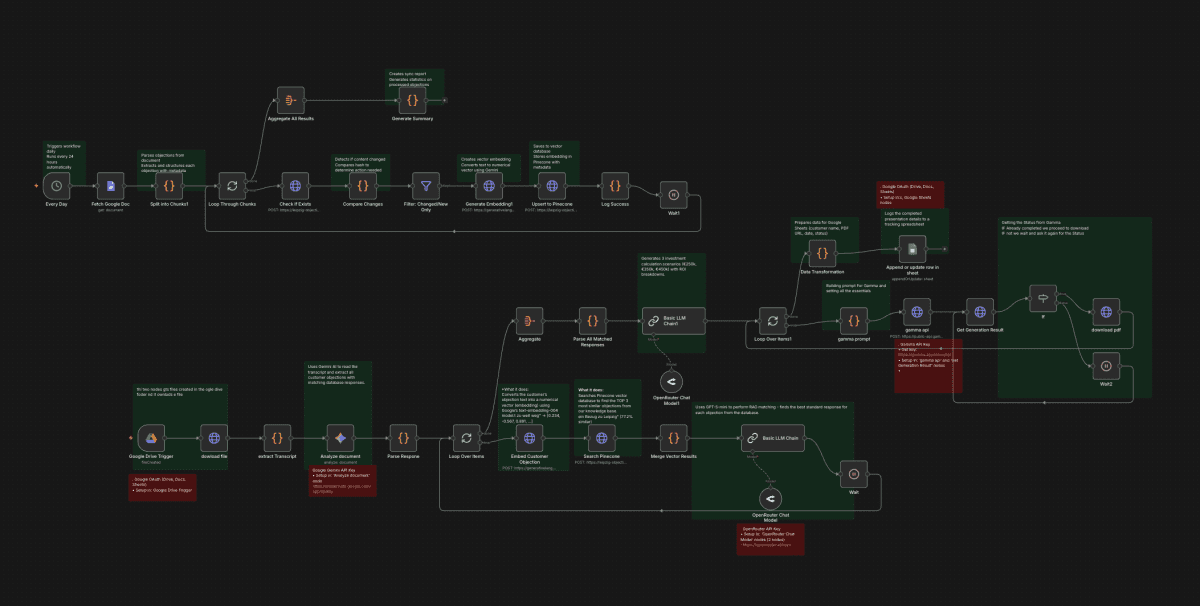
End-to-end n8n workflow for AI-powered sales and knowledge automation: from document intake and chunking through embedding creation and vector search (RAG) to automated report generation, qualification, and output in Google Sheets, Gamma, and PDF.
Based on the CRM status, n8n automatically triggers a preparation workflow. Current company data, conversation notes, open items, and relevant key figures are gathered and condensed into a structured report, completely automated. This can be output as text, PDF, or an internal document. What matters is not just summarization, but prioritization. What is really important for this conversation, which objections are likely, which references fit the situation.
The result is a consistent preparation standard that works regardless of who is leading the conversation.
Objection handling: structure instead of reaction
Objections are not a disruptive factor, but a signal that a decision is needed. Yet in day-to-day practice they are often handled on the fly. With n8n a structured approach can be established without scripting conversations.
After every conversation, objections are automatically extracted from notes or transcripts. n8n assigns them to categories such as budget, timing, risk, or internal alignment. On this basis, an AI model creates suggestions for factual, calm response strategies that fit the context of the company. These suggestions are not sent automatically, but are made available to the sales team as a decision basis.
Over the long term, a knowledge base emerges showing which objections frequently arise in which phase and which lines of argument actually move things forward. Objection handling thereby becomes more consistent and less reactive.
Trends 2026: Voice AI in sales
One area that will gain significantly in importance in 2026 is Voice AI. This is not about fully automated sales conversations, but about targeted support in clearly defined phases.

Voice AI interface for Bildungsfabrik: an AI trainer trained on training and educational materials that conveys learning content by voice, answers follow-up questions, and enables interactive conversations for training, onboarding, and knowledge retrieval.
In the opening phase, voice agents are increasingly being used to establish first contact, check interest, or pre-qualify appointments. These systems are not designed to persuade, but to gather information and hand conversations over cleanly. n8n takes on the role of coordinator here, controlling call triggers, conversation outcomes, and handovers to the CRM.
In the setting phase, voice systems support appointment coordination, confirmation, and preparation. They handle organizational communication while the human leads the substantive part.
In the closing context, new forms of support are emerging. Voice AI can deliver conversation summaries, cross-check open items, or verbally confirm next steps. What matters is that these systems present themselves as assistants, not decision-makers. Trust continues to be built between people.
In this context, n8n is not just another tool, but the connecting element. It ensures that research, qualification, preparation, conversation, and follow-up do not happen in isolation. At the same time, control stays with the sales team. Automation here does not mean autopilot. It means structure.
The strength lies in adaptability. Processes can be built step by step, tested, and extended. Anyone who starts with lead research today can integrate qualification tomorrow and Voice AI later, without rebuilding everything from scratch.
Automation as an organizing principle
AI automation in sales unfolds its value not through speed, but through clarity. n8n makes it possible to structure complex workflows so that people can focus on conversations. Lead research becomes richer in context, qualification more traceable, preparation more consistent, and objection handling calmer.
Voice AI will complement this approach in the coming years, not replace it. The sales function of the future is not automated, but better organized.
That is where the real progress lies.
About APEX Consulting
APEX Consulting is an AI automation and growth consulting firm supporting B2B organizations with intelligent workflows, AI agents, CRM automation, and scalable operating systems. The firm focuses on practical, implementation-driven solutions that reduce manual effort and enable sustainable growth.
More information: https://apex-consulting.ai/