
Writing Better Prompts with the PODS Framework
Many people talk about prompt engineering, but very few explain how to actually use it in day-to-day business. Agencies and small to medium-sized companies face the same challenge: everyone wants better results from ChatGPT, Claude, or Gemini, but the reality is often frustrating. Sometimes the output sounds too generic, sometimes context is missing, sometimes the tone is off, and sometimes the result is simply unusable.
The problem is almost never the model. It is the prompt.
A "prompt" is an instruction or request sent to an AI model such as ChatGPT in order to obtain a specific response or output. It is the user's input, which can range from a simple question to complex work assignments. The more precisely and in more detail a prompt is formulated, the better the result the AI typically delivers.
The PODS Framework is an approach that structures prompt engineering in a way that allows even teams without an AI background to achieve professional results. It is not based on tricks, but on four core components that every AI needs in order to generate relevant, precise, and actionable outputs:
The more clearly these four elements are formulated, the stronger the output quality and the faster AI integrates into real-world processes.
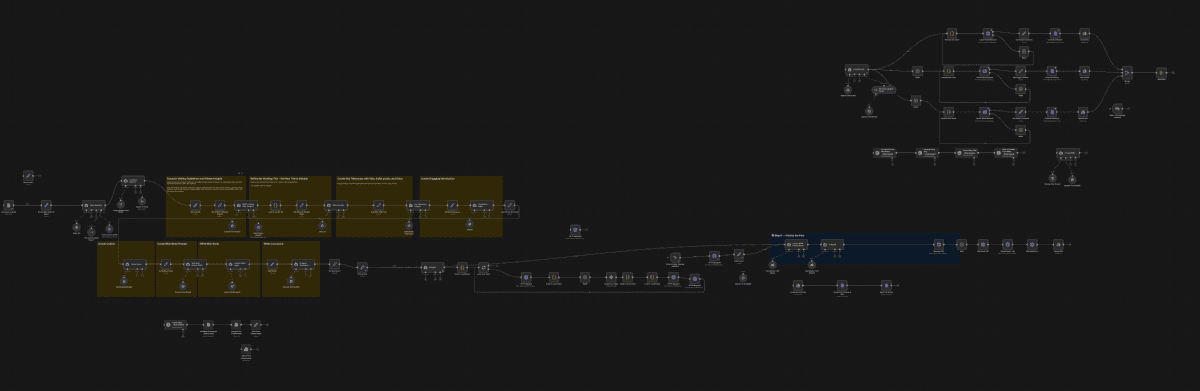
Our SEO Article Copywriter: A multi-stage n8n workflow for keyword analysis, content generation, structuring, and publishing search-engine-optimized articles.
Why classic prompts fail: a look at the day-to-day reality of agencies and SMEs
Most users give ChatGPT incomplete or overly general instructions such as:
"Write me a LinkedIn post about client acquisition." "Explain how I can improve my website." "Summarize the document."
This almost inevitably leads to non-specific copy, repetition, and a lack of depth. Agencies and SMEs feel this particularly acutely, because their tasks are rarely abstract. They are concrete, business-relevant, and require context:
An agency does not need just any social media post. It needs a post that fits its target audience, positioning, and tone of voice precisely. An SME does not want generic process optimization tips. It wants guidance tailored to its industry, structures, and resources.
That is exactly where the PODS Framework comes in.
1. Persona
Who is speaking? What role should the AI take on?
The persona is the foundation. A prompt without a persona is like a meeting without an agenda.
Take an example from a marketing agency: if the AI is supposed to write ad copy, it is not enough to write: "Write ad copy for a new gym."
The results will sound like generic advertising that could work anywhere and therefore works nowhere.
With the PODS persona, it looks different:
"You are an experienced copywriter with a focus on performance marketing. You write clear, conversion-oriented copy for social ads and understand target audience psychology."
An SME scenario: imagine a trade business that wants to automate its quotes.
A request to the AI might read: "Create a quote template for me."
The result will be banal. Better would be: "You are a technical project estimator with experience in HVAC businesses. Your quotes are precise, factual, and include clear service descriptions."
The persona defines the perspective, the expertise, and the decision-making logic. Without it, the output stays generic. With it, the AI becomes a specialized team member.
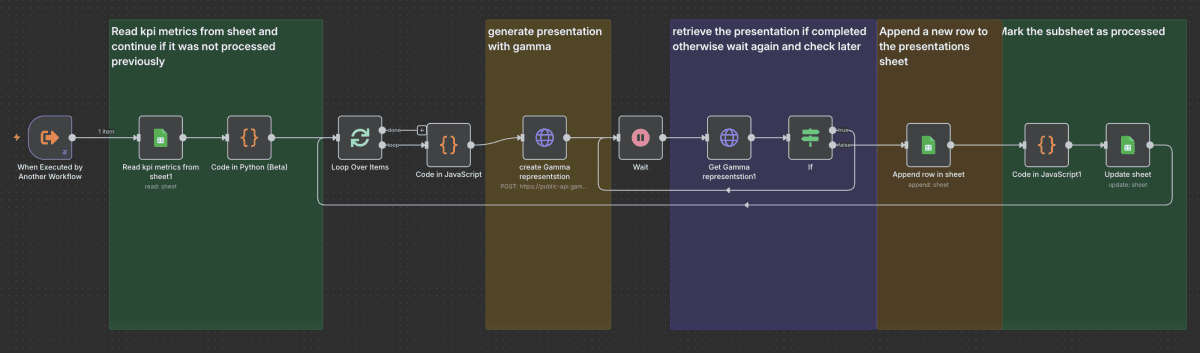
Automated n8n workflow for KPI processing: Reads KPI data from a Google Sheet, automatically generates Gamma presentations, checks generation status at repeated intervals, saves completed presentations to a second sheet, and marks processed entries to prevent duplicate execution.
2. Objective
What exactly needs to be achieved, and why?
Many prompts fail because they have no clear purpose. ChatGPT is supposed to "help", "create", "advise", but the task remains vague.
Agency example: A branding agency wants a positioning analysis. The bad prompt would be:
"Analyze the brand and give feedback."
The good prompt reads:
"The goal is to assess the brand positioning for clarity and differentiation. The output should deliver a structured analysis that makes clear which elements are already working and which need to be sharpened."
SME example: A mechanical engineering company wants to improve its client communication.
Bad prompt: "Explain how we can communicate better."
Good prompt: "The goal is to align our client communication so that technical content is understandable for non-technical decision-makers. The output should include concrete phrasings and examples we can use in quotes and presentations."
A clearly defined objective is the target marker the model needs in order to work with direction.
3. Data
What information does the AI need?
This is where most people make the biggest mistake: they provide too little data.
AI cannot guess how your company communicates, which target audiences exist, how your processes work, or which products matter.
Examples:
Agency: A social media agency creates content for a client in the solar industry. If the prompt reads: "Write an Instagram post about photovoltaics", the AI can only output generic information.
If you instead provide data:
Target audience: homeowners aged 40 to 60
Positioning: premium provider
USP: 25-year guarantee, fast installation
Tone: advisory, no sales pressure
Goal: build trust
then the AI can work with precision.
SME: A manufacturer of precision components wants to send automated emails to clients. If the AI does not know the products, delivery times, quality certificates, or typical client concerns, it cannot produce realistic communication.
Data is the raw material for high-quality results. The more relevant context, the better.
4. Style
How should the output sound?
Style determines whether a result is usable or not.
Agencies often work with brand voices, corporate language, and defined tonalities. SMEs often work with clear requirements: factual, technical, straightforward, without marketing jargon.
Examples:
A performance agency needs: "Short, precise, active, without unnecessary storytelling passages."
A tax firm needs: "Factual, accurate, understandable for non-experts, without technical jargon."
An engineering company needs: "Technically exact, structured, function-focused, no marketing style."
The Style component prevents the AI from slipping into a tone the reader will reject.
The impact of PODS on the day-to-day work of agencies and SMEs
When all four elements come together, a prompt is no longer a spontaneous attempt. It becomes a brief that any skilled professional would understand immediately.
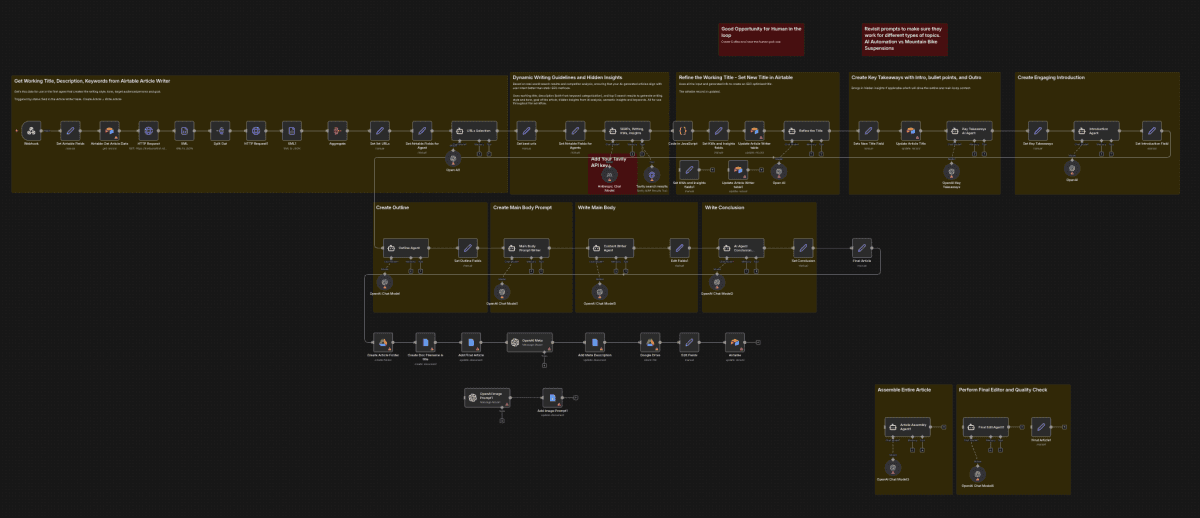
Multi-Agent SEO-Optimized Blog Writing System with Hyperlinks: A fully automated n8n workflow that orchestrates every step of article production, from title and keyword generation through outline, body text, and conclusion to the final quality check. Hyperlink integration, meta generation, Airtable sync, and Google Drive output are all included.
An agency team benefits because:
Text production becomes faster and more consistent
Revisions drop dramatically
Client documents contain fewer errors
Results are better matched to the target audience
The team develops a shared prompt language
An SME benefits because:
Quotes become easier to understand
Internal communication becomes clearer
Processes can be automated
Knowledge gaps within the team are reduced
Training materials and guides are created faster
PODS is easy to learn but powerful in its impact.
A practical example:
An agency wants to write a landing page for a new client.
Bad prompt: "Write a landing page for a dentist."
Good prompt using PODS:
Persona: You are an experienced conversion copywriter for local service providers.
Objective: Create a landing page that convinces visitors to book a treatment. The goal is a clear focus on trust, expertise, and safety.
Data: The client is a dental practice specializing in anxious patients. USP: pain-free treatment methods, modern equipment, flexible appointments. Target audience: adults between 30 and 60 with dental phobia. Important: no aggressive sales language; instead, a calming, trustworthy tone.
Style: Clear, calm, friendly, short sentences, simple language.
The result is not just better. It is ready to use immediately.
A second example from an SME:
A manufacturing company wants to improve its client-facing explanations.
Bad prompt: "Explain our production process."
Good PODS prompt:
Persona: You are a technical writer with a focus on mechanical engineering and manufacturing.
Objective: Create an easy-to-understand explanation of the production workflow that sales staff can use in client conversations.
Data: We produce CNC-milled aluminum parts. The steps are CAD design, material selection, milling, quality inspection, and final assembly. Clients have limited technical background.
Style: Factual, clear, without technical jargon. Maximum six sections.
The AI then delivers an explanation that non-technical readers can also understand.
The PODS Framework is not just a method for improving prompts. It is a structured communication model that integrates AI into professional workflows. Agencies and SMEs benefit in particular because it translates complex tasks into clear, reproducible steps.
Instead of "better prompts", PODS produces action briefs that an AI executes like a genuine specialist.
About APEX Consulting
APEX Consulting is an AI automation and growth consulting firm supporting B2B organizations with intelligent workflows, AI agents, CRM automation, and scalable operating systems. The firm focuses on practical, implementation-driven solutions that reduce manual effort and enable sustainable growth.
More information: https://apex-consulting.ai/