

Avoiding chaos with the right agency.
Developing AI workflows is relatively straightforward today. What many agencies and SMEs underestimate is everything that comes after the actual development. That is precisely where the problems arise that make projects unprofitable, strain client relationships, or in the worst case create legal complications.
The reality is: it is not the code that determines the success of an AI project, but how it is handled internally. Hosting, security, cost control, handover, and maintenance are not secondary topics. They are the foundation. Anyone without a standard here improvises every project from scratch and pays for it later.
This APEX guide describes how to set up AI workflows internally in a way that keeps them stable, clean, transferable, and manageable over the long term.

In just 90 days, we at APEX developed and implemented a fully automated marketing workflow that now saves Aramaz Digital around 20 hours of work every week. Why is this collaboration so powerful? Because it is not just about automation. It is about giving the team the ability to focus on important tasks, scale without becoming overwhelmed, and create systems that continue to drive growth long after the project is complete.
Hosting is not a technical question, it is a leadership decision
One of the most important internal rules is: the hosting question is resolved before the project starts, never after.
In practice, one clear principle has proven itself. Client projects run exclusively in the client's own infrastructure. That means the client operates their own workflow environment and we are invited in as developers to build directly within it. This keeps data, access, and responsibility clearly with the client. There is no later migration, no disputes over data ownership, and no hidden dependencies.
Our own servers or our own workflow setups are used exclusively for internal purposes. That covers internal automations, content processes, analysis workflows, or AI agents for our own business. The strict separation is essential: no client data, no external API keys, no mixed operation. The moment this boundary blurs, risks emerge.
The situation is entirely different when workflows are intended to be offered as a platform or white-label solution. From that point on, it is no longer agency work but a product business with fundamentally different requirements around licensing, liability, availability, and support. For typical agency or SME projects, that is almost always unnecessarily complex.
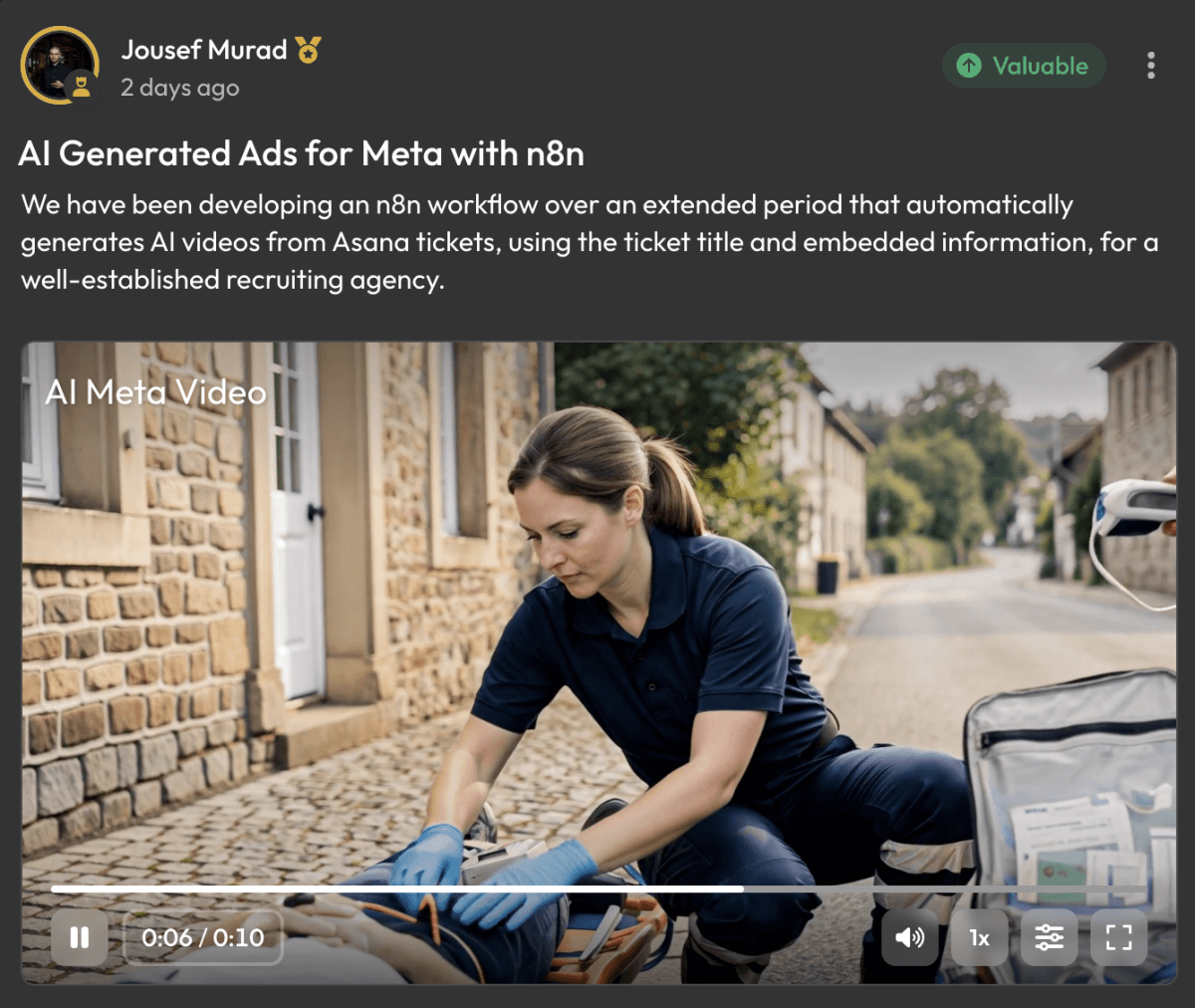
Within our AI community, our clients continuously receive access to the latest workflows, innovative approaches, and relevant trends from real-world practice.
In short: client projects belong in client infrastructure. Your own infrastructure is for your own processes. Everything else is a different business model.
Security is not built at the end, it is built into the design
AI workflows almost always process sensitive information, including emails, CRM data, support tickets, or internal documents. Anyone who considers security only as an afterthought unconsciously builds attack surfaces into their system.
Internally, professional work means access is clearly regulated. Not everyone can see everything, logs are not freely accessible, and credentials appear neither in documentation nor in plain-text comments. External entry points such as webhooks are particularly critical. They are frequently the weakest point of a system and must be treated accordingly.
Webhooks should be encrypted as a matter of principle, additionally secured, and should never transport sensitive data via URLs. Optional additional protection mechanisms can be added, such as authentication or access restrictions.
That is not overengineering. It is basic hygiene.
AI agents themselves also need protection. Without clear boundaries, external inputs can cause internal systems to be accessed or sensitive information to be exposed. Prompt injection and similar attacks are not theoretical. They happen in everyday operation.
The internal rule is therefore: external access is authenticated, prompts are clearly bounded, and sensitive actions are never triggered without protection.
Data protection is not an add-on, it is part of the system
Data protection is frequently treated as a legal topic. In reality it is a technical and structural topic. Anyone building AI workflows decides through architecture and data flows whether data protection is achievable or not.
Internally that means: only data that is genuinely necessary is connected. Logs and outputs are not visible to everyone by default, but are role-based. It must also be technically possible to delete or correct data when clients request it.
A major advantage of self-hosted systems lies exactly here. Data stays within your own or the client's infrastructure, there is no automatic sharing with third-party providers, and local or private AI models can even be deployed when needed. For SMEs or regulated industries, this is often a decisive argument.
API keys and costs do not belong to the agency
One of the most important internal lessons many learn the hard way: API keys and ongoing costs must never sit with external parties.
In the past it was common to use your own keys and then send the client a consolidated invoice later. The result is almost always disputes over usage, lack of transparency, and in the worst case, payment defaults. Technically that may be convenient. Economically it is negligent.
The clean standard is simple: the client creates the accounts themselves, enters their own payment details, and manages their API keys independently, with assistance if needed. As a service provider, we support the setup but bear neither the costs nor the responsibility for usage or consumption.
That creates clarity, avoids dependencies, and makes handovers significantly easier. When API keys need to be transferred, this happens exclusively via secure channels, never by email or in chat (ideally).
Testing is not a nice-to-have, it is mandatory
A workflow is only considered complete internally when it has been tested realistically. Not with dummy data, but with real or realistic inputs. Only then do the problems that will later arise in operation become visible.
Testing covers not only the ideal path, but explicitly also what can go wrong.
Missing data, duplicate entries, incorrect formats, or unexpected content are part of everyday operation. The goal is not to prevent errors entirely, but to catch them in a controlled way, log them cleanly, and fix them quickly.
AI workflows add an additional layer. It is not enough for something to be technically outputted. The content must be professionally correct, match the desired tone, remain consistent, and not contain sensitive or problematic information.
This quality check happens internally, not first at the client's end.
Handover, sign-off, and clear boundaries
After internal quality assurance comes client sign-off. The client should have simple ways to test outputs without having to deal with technical details. At the same time, it is critical to draw a clean line between bug fixes and features.
Bug fixes are part of the sign-off process.
New ideas, extensions, or additional logic are not. These are collected and treated as separate commissions. Anyone who does not communicate this distinction clearly produces unpaid extra work and frustration on both sides.
Documentation, backups, and maintenance are not a luxury
Clean documentation protects not only the client but above all your own team. Clear names, comments, and brief explanations prevent later support loops. Regular backups and a clear separation between test and production versions are also standard practice.
Changes are always tested before going live. A short handover or explanatory video saves more time in the long run than any written guide.
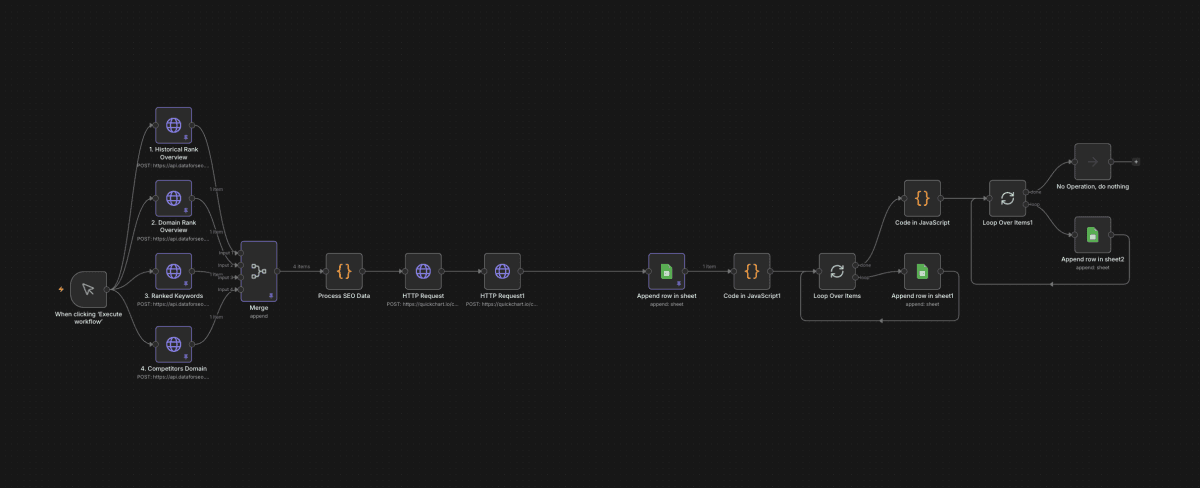
Automating monthly reports? Absolutely no problem! In this use case we automated complete SEO reports for a client end to end, and in record time.
Clarifying legal matters, maintenance, and exit from the start
At the close, everything is put in writing.
When is the project considered complete?
What exactly was delivered?
How is billing handled?
Is there maintenance, and if so, to what extent?
Maintenance covers bug fixes, monitoring, and minor adjustments, but no new features. Ownership rights are clearly defined, as is the exit from the collaboration. The client receives what was agreed, including documentation and handover. The agency retains rights to generic building blocks.
No informal agreements, no grey areas.
AI workflows almost never fail because of the technology. They fail because of missing internal standards.
Anyone who cleanly handles hosting, security, costs, testing, and handover drastically reduces stress, support workload, and risk. At the same time, projects become more profitable, more scalable, and are perceived as more professional.
Book your free AI consultation with APEX today: https://calendly.com/apex-consulting-call/ki-beratung
About APEX Consulting
APEX Consulting is an AI automation and growth consulting firm supporting B2B organizations with intelligent workflows, AI agents, CRM automation, and scalable operating systems. The firm focuses on practical, implementation-driven solutions that reduce manual effort and enable sustainable growth.
More information: https://apex-consulting.ai/