Do you really need an autonomous AI agent?
Are you thinking about AI agents? Hold up for a moment.
Before you invest hours into developing a complex AI system, you should ask yourself one crucial question: do you really need an autonomous agent, or would a much simpler solution be enough?
Most problems do not need a fancy AI agent at all. In fact, around 65 percent of all business automations can be solved entirely without AI. What you need instead is an understanding of the four levels of the AI system pyramid, and when each solution is the right one.
The AI pyramid: four levels, four solutions
Think of AI systems as a pyramid. At the bottom of the base you find the simplest tools, including Custom GPTs. The further you climb upward, the more complexity, cost, and maintenance effort come your way.
At the very top sit the fully autonomous AI agents. Sounds tempting, right? But here is the catch: the most expensive and complex solution is rarely the best one.
The four levels at a glance:
Custom GPTs / Claude Projects etc. — the reactive helpers
Simple workflow automation without AI — the predictable workflows
AI workflows — the intelligent routines
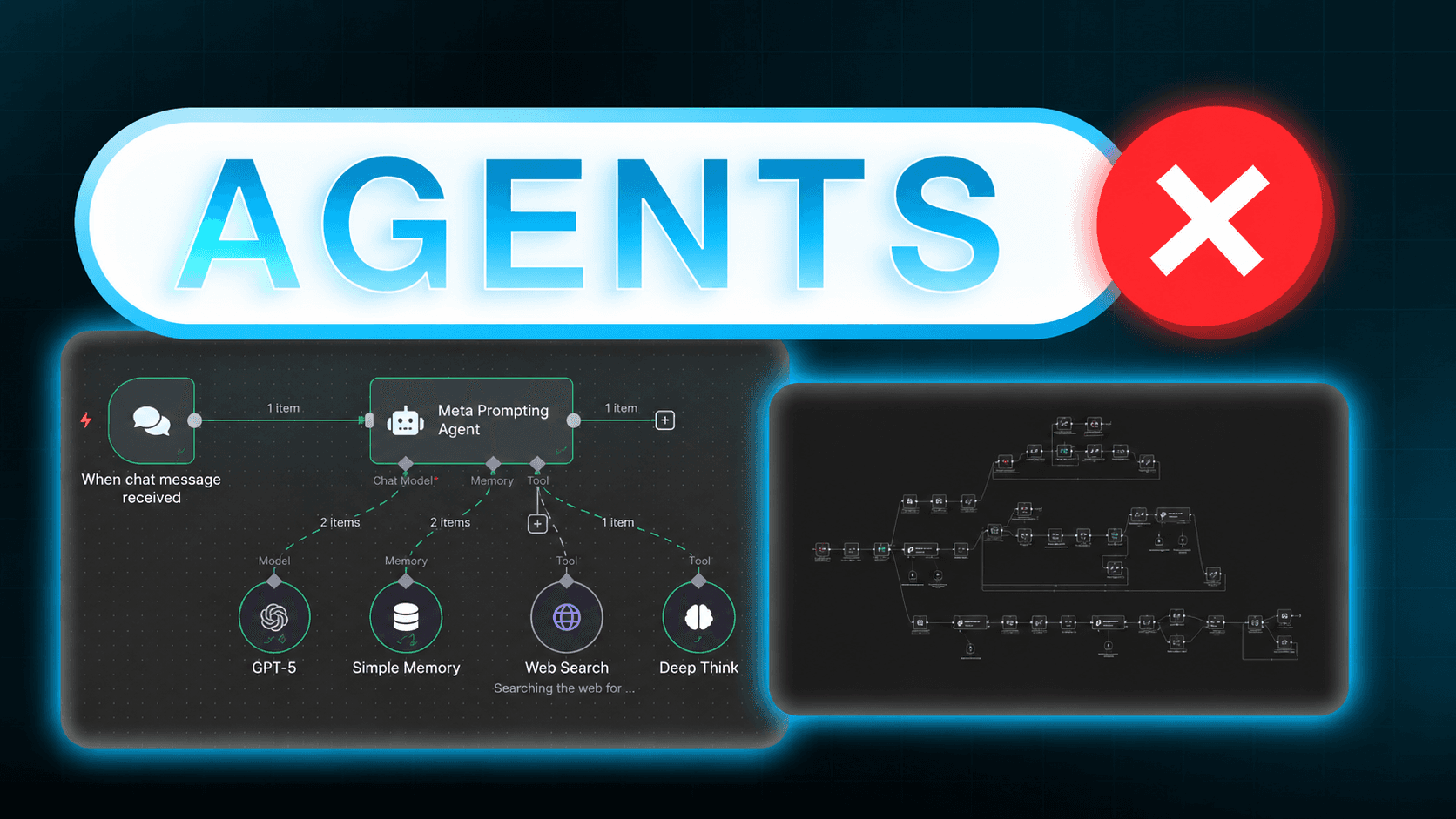
AI agents — the autonomous problem solvers
The key to success? Become a problem solver, not an AI agent builder. When someone comes to you and says "we need AI!", your job is not to immediately respond with the most elaborate solution.
Your job, or the job of your external agency, is to understand the root of the problem and find the most efficient solution that delivers quick wins, keeps costs low, and stays simple.
Level 1: Custom GPTs, your reactive assistant
A Custom GPT is essentially a preconfigured AI assistant that you give specific instructions, a knowledge base, and a defined tone. Think of an intern who knows your company and helps you on demand.
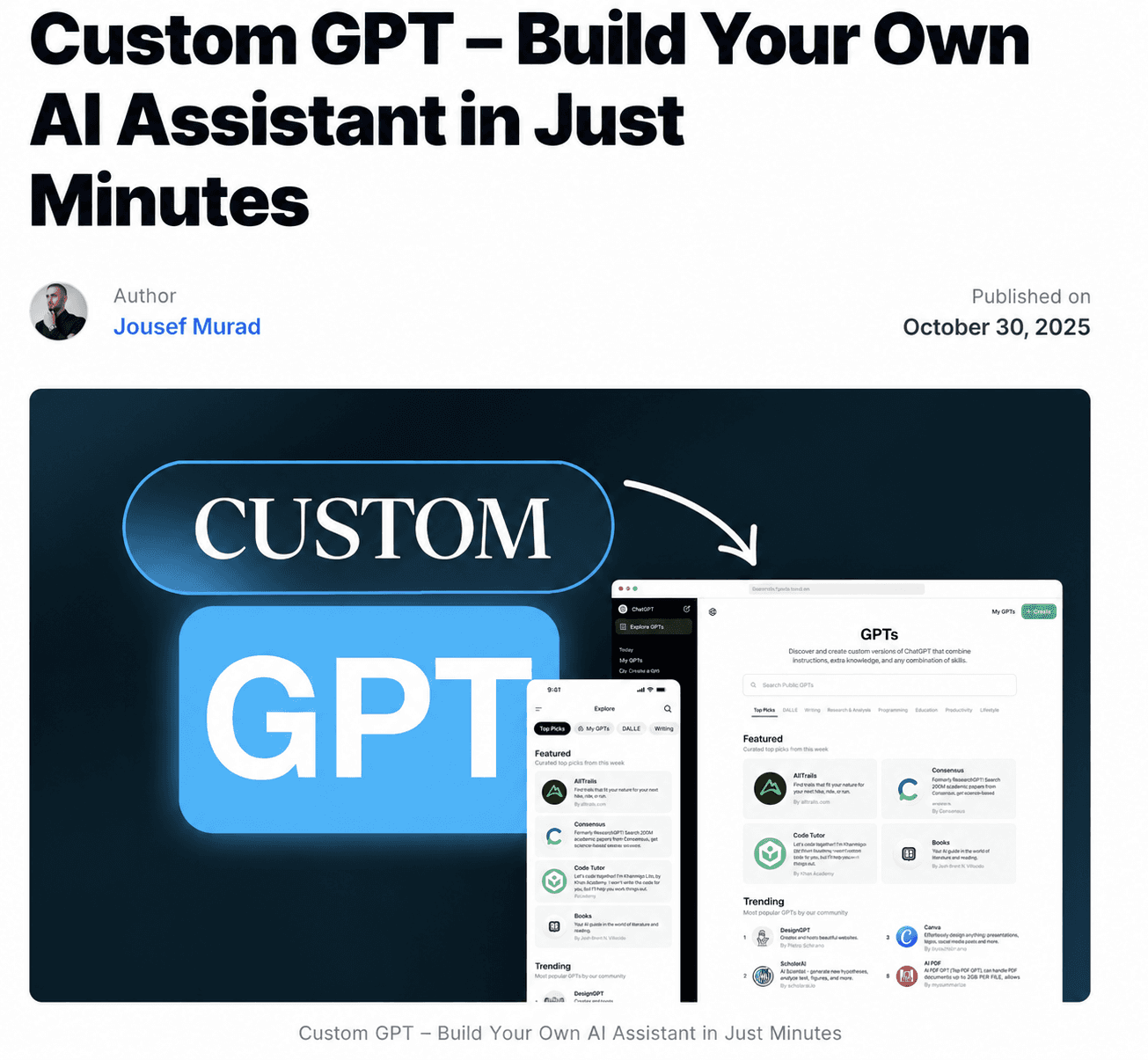
A Custom GPT is an individually configured version of ChatGPT. You decide how your assistant speaks, what it specializes in, which documents it knows, and which tasks it should handle. Source: https://www.agenturmarkt.de/magazin/custom-gpt-so-baust-du-dir-in-minuten-deinen-eigenen-ki-assistenten
The defining characteristic: it is completely reactive. That means it only works when you prompt it. Scalability? Limited. But for certain tasks it is perfect.
Practical example: imagine you regularly create blog posts and each time need to produce a setup guide as a comment or sticky note. This process is recurring but not identical. You often need small adjustments and want to be able to iterate. A fully automated solution would be excessive here. Instead: feed a Custom GPT with instructions and links, have it create the blog, and refine as needed.
Fast, simple, effective.
When to use it: whenever you want or need to be involved in every run. When you want to give feedback, iterate, and adjust. When the process is triggered by an event but requires human judgment.
Level 2: Simple workflow automation: no frills, just logic
Here we are talking about classical automation: a series of steps that run automatically based on a trigger and pure if-then logic. Zero AI intelligence. Zero surprises.
The defining characteristic: predictability. Same trigger, same steps, same result. A deterministic workflow from A to Z.
That does not mean you cannot include intelligent elements, but even those are based on clear conditions: success or failure. Black or white. No room for interpretation.
The advantage over Custom GPTs? These automations run in the background while you sleep. They can be triggered when a meeting recording is ready or every morning at 6 a.m. They scale better because they do not wait for your interaction.
When to use it: when the steps are 100 percent logic-based. When there is a clear, explicit rule that tells you which path to take. No interpretation needed.
Level 3: AI workflows: intelligence within fixed tracks
Now it gets more interesting. An AI workflow still follows a fixed sequence of steps, but now you use AI for certain decisions or outputs within that workflow.
The defining characteristic: a fixed path with intelligent decisions. The structure stays the same, but the AI makes context-aware decisions within that structure.
Example of an AI avatar workflow in n8n: through a simple voice message in WhatsApp, your AI avatar, your smart digital twin, is created almost automatically and uploaded to the Learning Suite. In less than 5 minutes! Source: Bildungsfabrik
Practical example: you receive incoming emails and want to automatically categorize them as support, finance, priority, or HR. With traditional logic or code that would be difficult because you would have to search for specific keywords. With AI, the system can read and understand the content and subject line of the email and take the right direction. After that it transitions back into a classical, predictable sequence.
Or: a content workflow where AI writes and edits texts, but always in the same order: step 1, 2, 3, 4, 5. No back and forth, no autonomy.
When to use it: when you have a fixed workflow but need AI intelligence at one or more points to understand, classify, or create. When the sequence of operations is predictable, but the decisions within it need to be context-dependent.
Level 4: AI agents: the autonomous decision-makers
Now we have reached the top of the pyramid. An AI agent is an autonomous system that works toward a goal by perceiving its environment, making decisions, calling tools, handling exceptions, and adapting its approach.
The defining characteristic: genuine autonomy. You set a goal, and the agent decides on its own: which of my five tools do I need? In what order do I deploy them?
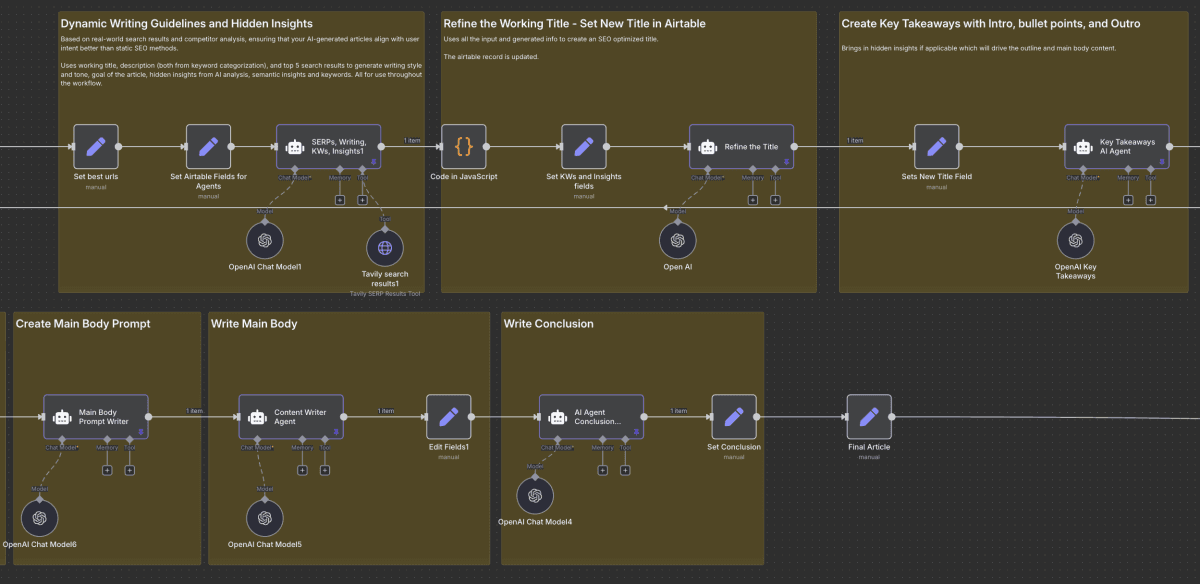
An AI-controlled workflow that automates research, structuring, writing, and finalization of blog articles, including SEO optimization, keyword analysis, and consistent writing style.
Practical example: a marketing team agent receives a request via WhatsApp. It has three content creation tools, two image creation tools, and one database tool available. Based on the request, it autonomously decides which tools to use and in what order to achieve the goal.
Interesting: even when the agent selects tools autonomously, those tools themselves can be workflows or AI workflows, meaning fixed, predictable sequences. This significantly improves performance because predictability creates stability.
When to use it: when the sequence of operations is not fixed. When you need genuine flexibility and decision-making freedom. When the agent needs to be able to jump back and forth multiple times depending on context.
The decision logic: which level is the right one?
To keep things clear, here is a simple checklist:
Question 1: Do I need to be involved in every run?
Yes → Custom GPT
No → Move to question 2
Question 2: Are the steps 100 percent logic-based?
Yes → Workflow without AI
No → Move to question 3
Question 3: Is the sequence of operations fixed?
Yes → AI workflow
No → AI agent
But be careful: edge cases exist
Sometimes everything points to an AI workflow, but an agent would actually be the better choice. Example: a customer support system that receives emails. The manual process would be: read email, search knowledge base, write response. Sounds like a fixed sequence, right?
But sometimes you do not need the knowledge base at all, in which case you waste time and tokens. Sometimes you need to search three or four times before you can be confident. In such cases, an autonomous agent that can decide flexibly would be the better choice.
The reality: it is never black and white. It depends on the situation, on how the manual process should ideally run, and on how much flexibility you actually need.
Problem first. Technology second.
The hard truth? You do not know what you do not know. Sometimes everything points to a Custom GPT, but after a few months you realize you actually need an AI workflow. Or you build an elaborate AI agent and find that a simple workflow would have been more than sufficient.
For several years we have been successfully helping agencies, startups, and SMEs measurably optimize their processes, with the result that our clients save multiple hours per week and frequently five-figure sums per year on a permanent basis.
The takeaway: become a problem solver, not a technology enthusiast. Start with the simplest solution that solves the problem. Scale up when needed, or scale back down. Test, gather feedback, optimize.
And one more insight from practice: 50 percent of all business automations do not need AI at all. Simply integrating Custom GPTs or straightforward workflows into teams can already deliver enormous efficiency gains.
So: before you want to build an AI agent next time, pause for a moment. Ask yourself the three questions. And then make the decision that actually makes sense, not the one that sounds the coolest.
About APEX Consulting
APEX Consulting is an AI automation and growth consulting firm supporting B2B organizations with intelligent workflows, AI agents, CRM automation, and scalable operating systems. The firm focuses on practical, implementation-driven solutions that reduce manual effort and enable sustainable growth.
More information: https://apex-consulting.ai/