

A dive into genAI use cases for businesses.
Generative AI moved from novelty to commercial reality with unusual speed. In a short period, conversational systems proved that software can work with language as a practical interface, produce credible first drafts, and assist with complex tasks without requiring specialized inputs. For business leaders, this matters because it changes what can be automated. Instead of limiting automation to structured workflows, companies can now streamline parts of knowledge work that depend on reading, writing, searching, summarizing, and synthesizing.
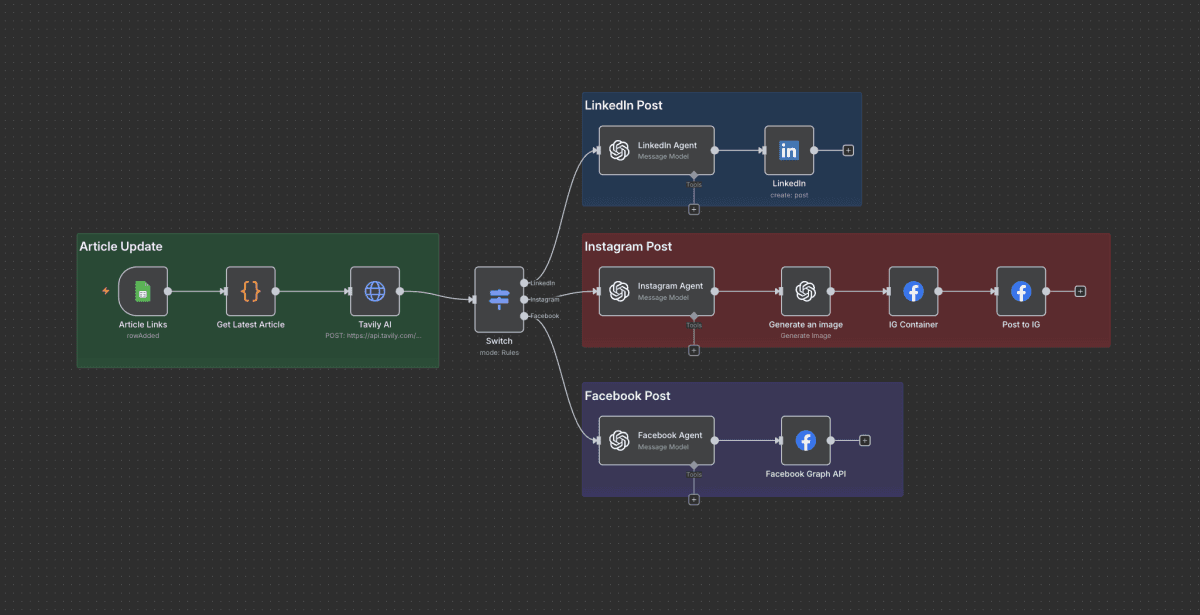
Automated social media posting with n8n: Updating an article automatically triggers posts on LinkedIn, Instagram, and Facebook - including AI-generated text and images.
The value of generative AI is not that it can produce text or images on command. Its value is that it reduces friction in how work gets done. It accelerates analysis, shortens content cycles, improves access to internal knowledge, and makes software easier to use through natural language. When implemented thoughtfully, it raises productivity while improving consistency and responsiveness across functions.
A useful way to think about adoption is in two layers. The first is using off-the-shelf tools that support individuals and teams directly. The second is building enterprise systems that connect generative models to proprietary data and business processes. Many organizations see the strongest results when they do both.
Everyday productivity improvements
Many businesses begin with practical workflows that consume time across departments. Writing is an obvious example. Drafting proposals, summarizing meeting notes, producing internal documentation, and refining messaging are necessary but labor-intensive tasks. Generative AI can produce a strong first draft that professionals review and improve. The outcome is not a replacement for judgment, but a faster starting point and quicker iteration.
The same shift applies to presentations and spreadsheets. Teams can generate an initial slide structure from an existing document, then refine it with targeted edits. In spreadsheet work, natural language requests can help users explore data, summarize key trends, and generate charts without relying on advanced formulas. This lowers the barrier to analysis and allows more employees to engage confidently with performance data.
File-based analysis extends this further. When a system can review spreadsheets, documents, and datasets, it can support basic cleaning, explain inconsistencies, generate summaries, and produce visualizations with straightforward instructions. For teams that routinely work with data but lack specialized analytics capacity, this can materially shorten time to insight.
Marketing and content operations
Marketing is another early area of adoption because the work is content-heavy and constant. Generative AI supports drafting campaign copy, creating variations for different audiences, and producing social content at scale. It can also assist with visual asset creation, enabling teams to generate multiple creative options quickly and refine what aligns with brand and performance needs.
The strategic advantage is not only speed. It is the ability to test more ideas with less effort, personalize communication more effectively, and maintain consistency across channels. For organizations that run frequent campaigns, the cumulative productivity gain can be significant.
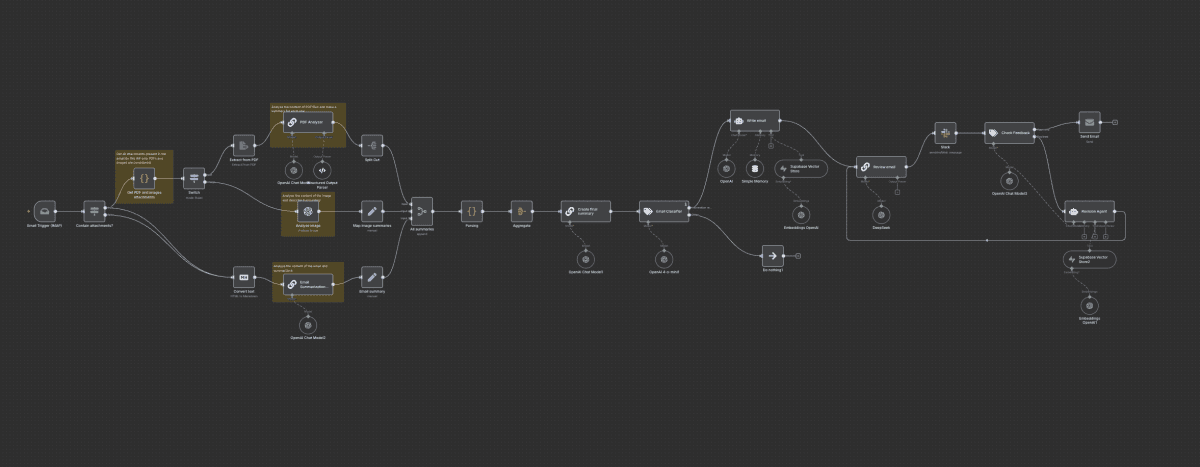
n8n in use at an agency: An AI-powered workflow processes incoming emails, analyzes attachments, generates automatic summaries, and creates response suggestions - all within a single, self-hosted environment.
Software engineering support
Generative AI is also reshaping software development. Tools can assist developers by drafting code, suggesting implementations, writing unit tests, and helping identify bugs. This does not remove the need for experienced engineering, but it reduces time spent on routine scaffolding work and accelerates prototyping. Teams can move faster from concept to workable prototype, which improves time to feedback and reduces wasted effort.
Some organizations also use generative systems to create synthetic data for testing pipelines or simulating scenarios when real data is limited or sensitive. While synthetic data does not replace real operational data in high-stakes settings, it can speed experimentation and validation.
GenAI in images, audio, video, and 3D
Generative AI is not limited to text. Image generation supports design exploration, marketing creativity, and product visualization. Audio generation supports voiceovers for training and education, and modern tools can also streamline editing workflows. Video generation and enhancement are increasingly used for short-form content and internal training. In 3D, object and scene generation can support product visualization for manufacturing catalogs, virtual facility tours, and early design mockups.
Across these modalities, the business logic is consistent: reduce production cost and shorten iteration cycles while increasing output variety.
Enterprise knowledge retrieval and grounded answers
The most durable value often appears when generative systems are connected to proprietary knowledge and business data. In many organizations, critical information is scattered across documents, presentations, policies, support histories, and internal knowledge bases. Finding answers often requires knowing where to look and spending time assembling context.
Generative AI can change that by allowing employees or customers to ask questions in natural language and receive answers grounded in internal sources. In customer operations, assistants can help with product questions, returns, bookings, and troubleshooting, provided they have access to accurate, up-to-date information. Internally, teams can query policies, product details, historical proposals, and operational guidance without manual searching.
In practice, retrieval-based grounding is often the most effective starting point because it supports current information and allows responses to be tied back to verifiable sources. When users can see which internal materials informed an answer, trust increases, and review becomes easier. This traceability is essential for enterprise adoption because reliability matters more than novelty.
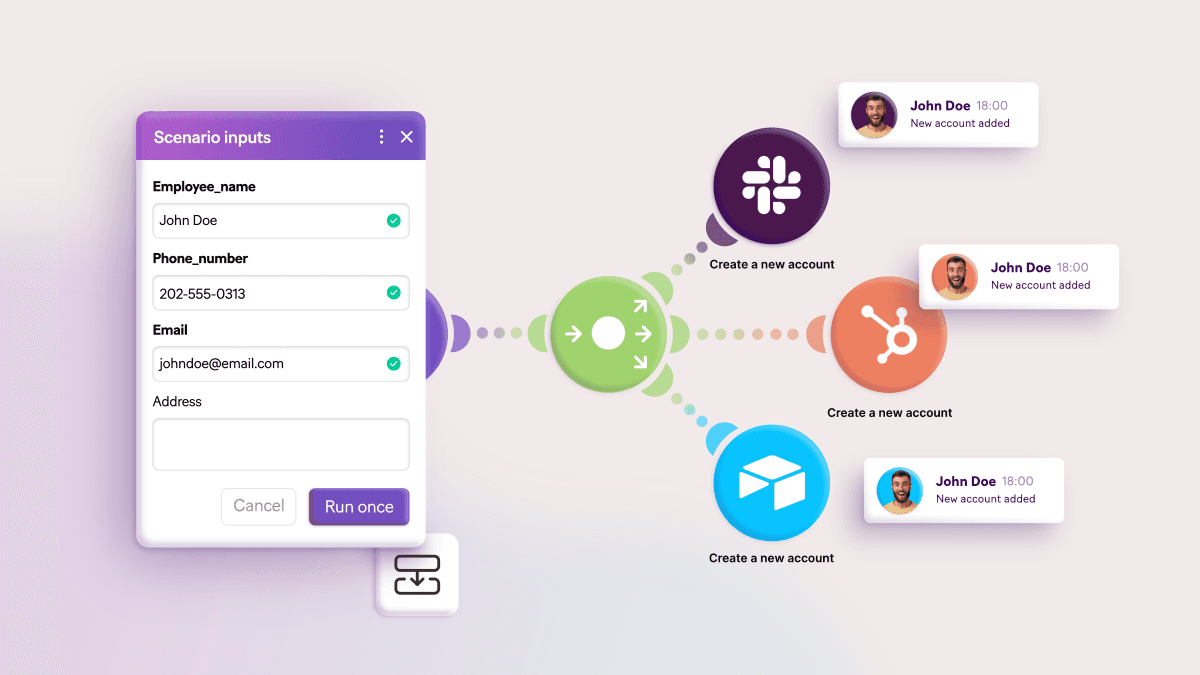
Make (formerly Integromat) - the visual automation platform that enables companies to connect workflows between apps, process data, and scale processes without writing code (image Source: Make.com).
Natural language interfaces for business software
A broader shift is emerging as generative AI becomes embedded into products and internal systems. Natural language is becoming an interface for software. Many business tools are powerful but complex, requiring training and navigation through layered menus. A language-based interface lets users express intent directly and reduces the steps required to get work done.
This approach is already visible in shopping, travel, and education experiences where users describe what they want and refine preferences conversationally. In professional settings, it can simplify interactions with analytics tools, document systems, and operational platforms. When employees can ask for summaries, insights, or comparisons in plain language, time to insight decreases, and adoption improves.
In regulated domains such as legal and healthcare, this capability can support summarization and extraction rather than unreviewed decision-making. Contracts can be navigated more efficiently by surfacing renewal terms, payment schedules, and key clauses. Clinical documentation can be accelerated through transcription and structured summarization, reducing administrative burden when paired with appropriate safeguards.
A disciplined approach to adoption
The question is not whether generative AI is relevant. It is how to adopt it responsibly and profitably. Strong starting points include workflows where speed and consistency matter, where internal knowledge is fragmented, and where users struggle with complex interfaces.
Governance should be present from the beginning. Access control, data privacy, auditability, and clear human review processes are foundational. Without them, even impressive pilots often fail to scale.
Generative AI is best understood as a capability that can improve how knowledge work is executed and how software is experienced. Businesses that apply it with discipline, grounded in real workflows and reliable information, will capture meaningful advantage.
About APEX Consulting
APEX Consulting helps B2B organizations implement AI automation, intelligent workflows, and scalable operating systems that reduce manual effort and support sustainable growth. If you're exploring what AI could look like inside your organization, book a free call with the team: https://calendly.com/apex-consulting-call/15min