
Context & Prompt Engineering
You think the key to better AI results lies purely in the perfect prompt?
Then it is time for an update.
While many are still fine-tuning their wording, a new paradigm has long since established itself in the background: Context Engineering.
With the rise of intelligent agent systems, one thing is becoming increasingly clear: it is not the model that determines success or failure, but the quality of the context. Most failures in today's agents are not model failures. They are context failures.
We are entering an era where the question is no longer what you ask, but what you equip the AI with.
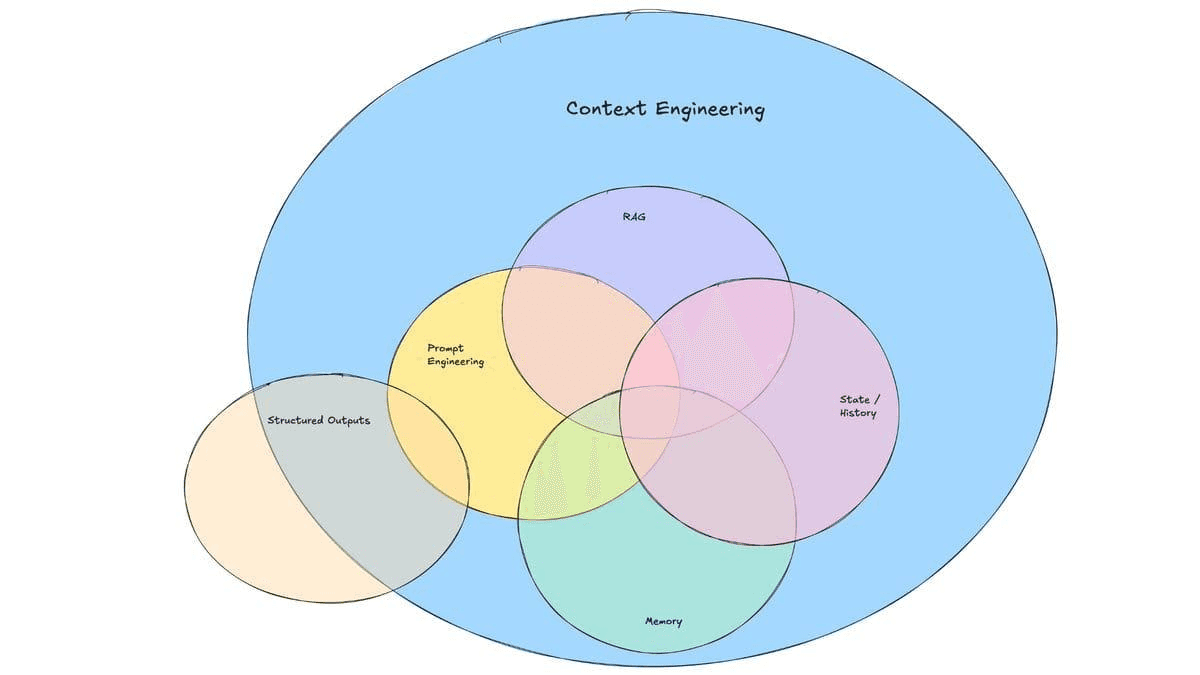
Overview of the core elements of modern context engineering systems: The graphic shows the interplay between prompt engineering, RAG, memory, state management, and structured output formats within the overarching framework of context engineering. Source: https://blog.langchain.com/the-rise-of-context-engineering/
What "context" really means
Before talking about context engineering, it needs to be clear what "context" actually encompasses in an AI system. Spoiler: it is significantly more than a prompt.
Context is everything the model sees before it generates a response. Think of it like the materials on a desk: only when everything is organized, complete, and correct can meaningful work be done.
The 7 core building blocks of AI context
The instruction (system prompt): the behavioral foundation, including rules, examples, style guidelines, and safety boundaries. (Link to the PODS Framework)
User prompt: the actual question or task.
State: the operational short-term memory of the system. Without this history, every response is context-free.
Long-term memory: permanently stored knowledge such as brand guidelines, project summaries, internal workflows, and client preferences.
RAG (Retrieval-Augmented Generation) layer: dynamically loaded information from documents, knowledge bases, CRM, CMS, APIs, or file systems.
Tools and functions: everything the model can actively execute, including calendar queries, CRM entries, database checks, and email tools.
Output structure: precise specifications for the format in which the response should be returned, for example JSON, Markdown, table, or form structure.
These building blocks ensure the AI does not operate in a vacuum, but within a clearly defined information framework.
The difference between a demo and a production-ready agent
The scenario: An email lands in your inbox: "Hey, just checking if you're around for a quick sync tomorrow."
The demo agent sees only this one sentence. No context. No system knowledge. The result is predictable:
"Thank you for your message. Tomorrow works for me. May I ask what time you had in mind?"
Formally correct, but without any real value. No consideration of reality, no capacity to act.
The production-ready agent builds context before the model responds:
Calendar: Tomorrow you are fully blocked. Email history: This contact communicates casually. CRM: This is an important person. Tools: Access to calendar and email handling.
The response suddenly becomes realistic and useful: "Hey Jim, tomorrow is completely full for me. Thursday morning works. I've sent you a calendar invite."
What makes this feel almost magical is not the model. It is the carefully constructed context.
Core message: agents almost never fail because of the model. They fail because they lack the right information.
Why prompt engineering is no longer enough for agencies and SMEs
Prompt engineering optimizes wording. Context engineering optimizes systems.
For professional use cases such as client communication, lead qualification, content production, and internal automation, you need systems that:
Retrieve data automatically
Filter out irrelevant information
Integrate tools correctly
Define clear output formats
Build every context dynamically and situationally
That is an entirely different level from classical prompt writing.
What context engineering really comes down to
Context engineering means designing dynamic context systems that deliver exactly the information and tools an AI needs to complete a task. Four core principles underpin this:
1. A system, not a string
Context is not produced as a static template, but as a pipeline that runs before every LLM call.
2. Dynamism over rigidity
Every task has its own context requirements. The AI must be able to assemble them automatically, drawing from calendars, CRM, documents, or web queries.
3. Relevance over completeness
Not everything is helpful. Too little context produces errors. Too much context produces noise. The art lies in making the right selection.
4. Structure beats volume
Well-summarized information outperforms any data dump. A clearly structured tool schema leads to better actions than vague descriptions.
What agencies and SMEs need to take away from this
Here is the decisive insight: companies that use AI only as a text generator will be overtaken by companies that think of AI as a system component.
For agencies and SMEs, this means concretely:
AI can only write good brand copy if it knows your brand guidelines.
AI can only create good quotes if it understands your pricing models.
AI can only qualify leads if it is allowed to read CRM data.
AI can only automate client communication if it has access to calendars, inboxes, and histories.
AI can only take over processes if it can interact with tools.
AI is not a replacement for expertise. It is an amplifier, but only when fed correctly.
Become a context architect
The future of AI applications does not depend on better prompts or new models. It depends on whether companies learn to build context systems that:
Provide information in a structured way
Integrate tools meaningfully
Respond dynamically to tasks
Continuously improve context quality
It is not the AI that decides the quality of your results, but the system that controls it. The competitive advantage of the coming years will not come from model knowledge. It will come from context engineering.
About APEX Consulting
APEX Consulting is an AI automation and growth consulting firm supporting B2B organizations with intelligent workflows, AI agents, CRM automation, and scalable operating systems. The firm focuses on practical, implementation-driven solutions that reduce manual effort and enable sustainable growth.
More information: https://apex-consulting.ai/