
There are seven recurring patterns in AI for businesses.
Electricity didn't transform industry through a single invention. It became a foundational capability, something that quietly embedded itself into operations, infrastructure, and products. AI is doing the same thing. Not in one department, not through one product, but as a set of methods that lets organizations predict, detect, interpret, and optimize in ways that conventional software simply cannot.
The range of what's already deployed is wide enough to be disorienting: self-driving systems reading complex environments in real time, clinical tools extracting signals from medical imagery, demand forecasting engines adjusting retail inventory, and fraud detection running silently in the background of every transaction. Generative systems have since extended the frontier further, making natural language a functional interface for business workflows and collapsing the gap between what AI can produce and what humans would otherwise spend hours creating. And increasingly, these capabilities don't operate in isolation, AI agents are beginning to orchestrate them together, perceiving context, making decisions, and taking action across multi-step workflows with minimal human handholding at each turn.
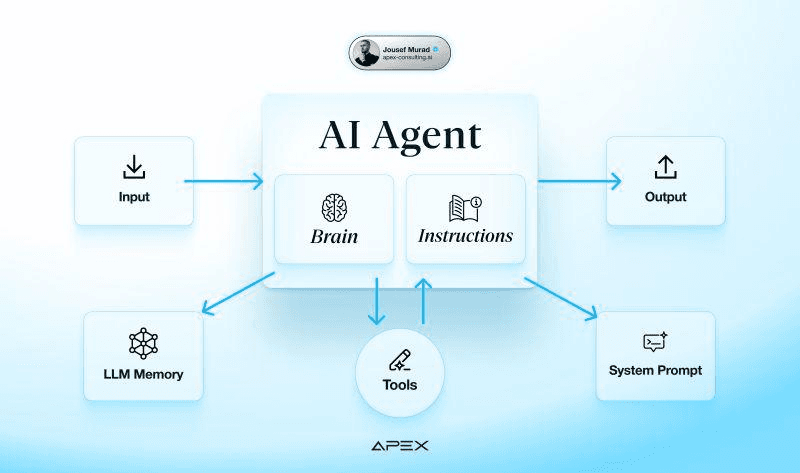
AI Agents are the most prominent tools growing in business today, but an agent is only as capable as the patterns it can orchestrate.
The more useful question, though, isn't what AI can do in the abstract. It's what patterns keep showing up across industries, because those patterns are what make it possible to identify opportunities inside your own organization, understand what data you actually need, and define what success should look like before you've committed to anything.
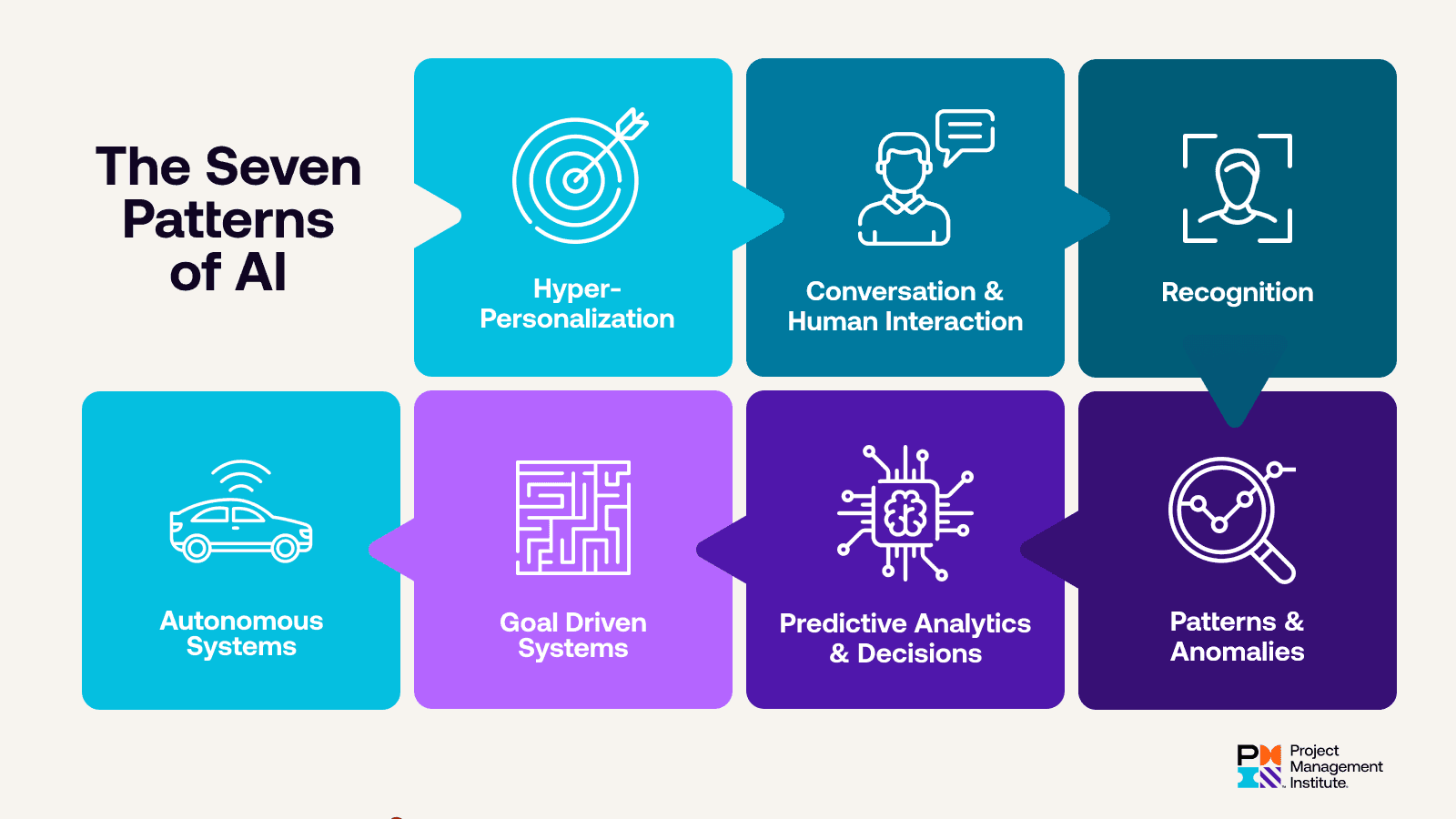
The seven patterns of AI In Businesses (image source: Project Management Institute)
Seven Patterns Worth Understanding
Most applied AI in business, across sectors and use cases, falls into one of seven recurring patterns. Not categories in a taxonomy sense, patterns in the sense of mechanisms that recur because they solve real problems in recognizable ways.
Predictive Analytics & Decisions is the most common pattern, and for a straightforward reason: a significant portion of business decisions hinge on estimating what happens next. Prediction models learn from historical data and apply that learning to new inputs. In retail, this means demand forecasting, dynamic pricing, and targeted promotions. In manufacturing, it means anticipating equipment failures from sensor readings before they become costly downtime. In banking and insurance, it underpins credit scoring and individualized pricing. In healthcare, it supports readmission risk modeling and treatment planning. The through-line is always the same: decisions made with better estimates of future outcomes tend to be better decisions.
Hyper-Personalization surfaces natural groupings within data without requiring predefined labels or known outcomes. The model looks for structure that already exists, rather than learning to predict one that was provided. Customer micro-segmentation is the most familiar application, revealing behavioral patterns that support sharper marketing, better product positioning, and more coherent customer experience design. In healthcare, clustering can stratify patients by shared characteristics or treatment histories in ways that inform more tailored care. The value isn't just categorization; it's a clearer understanding of a population that wasn't visible before.
Patterns & Anomalies is built for the problem of rare but consequential events. It works well precisely in situations where labeled examples of what you're looking for are scarce, because the thing you're trying to catch doesn't happen often enough to build a conventional classifier. Financial fraud, irregular network access, unusual patterns in clinical data, and emerging equipment issues in industrial settings, in each case, the model learns what normal looks like and flags meaningful deviation from it.
Recognition allows systems to interpret images and video at a scale and consistency that human review cannot match. Deep learning has made it remarkably accurate. The applications range from automated defect detection in manufacturing lines to medical image analysis, property risk assessment from aerial imagery, retail shelf monitoring, and the environmental perception systems that autonomous vehicles rely on entirely.
Conversation & Human Interaction turns unstructured text and speech into something machines can work with. In business, the highest-impact application is document processing, replacing slow, manual extraction workflows with automated parsing that works across contracts, claims, onboarding forms, and operational records. The same capability powers sentiment analysis at scale, intent detection in customer service systems, and the language-based assistants now standard in enterprise software. Extended to voice, it enables contact center analytics that surface real-time agent recommendations, flag compliance issues, and monitor sentiment throughout a call, while in healthcare, transcription tools reduce the documentation burden that has long been one of the profession's more draining realities.
Autonomous Systems take individual AI capabilities and combine them into end-to-end workflows that execute without constant human intervention. In B2B environments, this is most visible in robotic process automation handling back-office tasks, invoice processing, data entry, compliance checks, and system updates that previously required manual effort at every step. As these systems mature, they increasingly incorporate judgment alongside execution, moving from rule-based automation toward adaptive workflows that can handle exceptions, reroute around obstacles, and escalate only when genuinely necessary. This is where AI agents are beginning to operate, orchestrating multiple patterns in sequence to complete complex, multi-step processes across business functions.
Goal Driven Systems is the pattern closest to what has historically been called prescriptive analytics, determining the best decision under a specific set of constraints. Logistics network design, production scheduling, portfolio construction, dispatch routing for delivery and mobility platforms: these are all problems where the goal isn't just to predict an outcome but to identify the action that improves it against a defined objective.
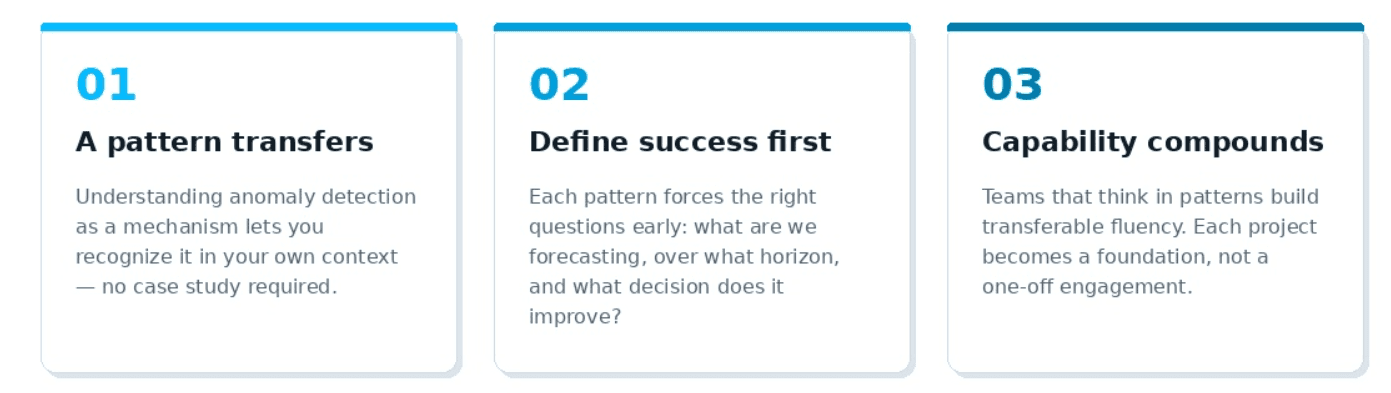
Thinking in patterns rather than examples forces the right questions earlier, builds transferable organizational capability, and is ultimately what separates companies that scale AI from those perpetually stuck in pilot mode.
Why Patterns Matter More Than Examples
Long lists of AI applications are easy to find and surprisingly hard to use. They generate awareness without generating direction. The value of thinking in patterns is that a pattern transfers. If you understand how anomaly detection works as a mechanism, you can recognize the problem it solves in your own context, regardless of whether your industry appears in any published case study. You can assess what data you have, what normal behavior looks like in your operations, and what the cost of a missed detection actually is.
The same logic applies across all seven. Identify the pattern, and the planning questions become much sharper: what does the training data need to look like, what does a good prediction actually mean in this context, how do we define success before we build anything?
Avoiding Failure in AI Business Projects
That last question is more consequential than it sounds. Most AI initiatives don't fail because the technology underperforms, but because success was never properly defined before the work began, which means there's no shared basis for evaluating whether the initiative is working, no clear signal for when to scale, and no way to distinguish a model that needs more data from a problem that was misconceived from the start. Pattern-based thinking forces that definition earlier, because each pattern comes with a specific set of questions that have to be answered before anything meaningful can be built. A prediction problem requires you to articulate what outcome you're forecasting, over what time horizon, and what decision that forecast is actually meant to improve. A clustering problem requires you to think through what you'd do differently if the segments looked one way versus another. Those constraints are generative. They compress months of vague exploration into a much more directed conversation.
There is also a compounding effect that tends to go unacknowledged. Organizations that learn to think in patterns develop an internal capability that outlasts any individual project. The team that successfully frames a demand forecasting problem as a supervised learning challenge, defines the right evaluation metric, and navigates the data preparation process has built something transferable, a way of approaching the next problem that doesn't require starting from scratch. Contrast that with organizations that treat each AI initiative as a one-off engagement, importing external expertise to deliver a solution without building the internal fluency to evaluate, maintain, or extend it. The gap between those two trajectories widens considerably over time.
That clarity, more than any particular tool or vendor, is what separates organizations that extract durable value from AI from those still running pilots two years in.
About APEX Consulting
APEX Consulting helps B2B organizations implement AI automation, intelligent workflows, and scalable operating systems that reduce manual effort and support sustainable growth. If you're exploring what AI could look like inside your organization, book a free call with the team: https://calendly.com/apex-consulting-call/15min