How AI Optimization, Integration, and Timing Are Transforming Entire Markets
Remember 2007: Steve Jobs unveils the first iPhone, and the world changes. Yet in Germany, it took until 2011 for the smartphone to truly become a mass phenomenon.
Today we're seeing something similar, only much faster.
ChatGPT reached one million users in just five days (source). For comparison: Instagram took 2.5 months, Netflix 3.5 years. Today over 800 million people already use ChatGPT every week.
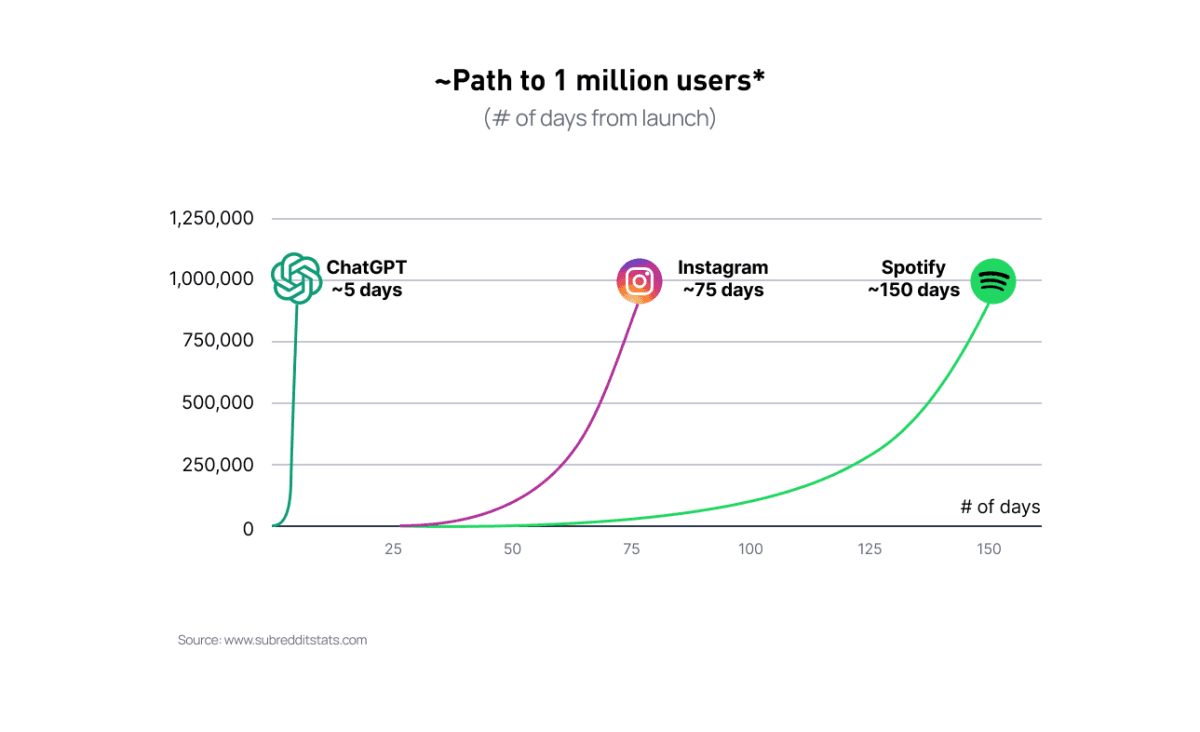
The Race to 1 Million Users Compared: ChatGPT, Instagram, and Spotify
We stand at the beginning of a revolution that will fundamentally change our behavior, our work, and our society, and most of us massively underestimate what is happening right now.
The exponential development we don't want to see
Our brains aren't built to grasp exponential developments. We think linearly. The same thing is happening with AI right now, only faster. In 2001, around 500 million people worldwide were online. Today about 5.6 billion use the internet. While that development took decades, ChatGPT reached 100 million users in just eight weeks, a growth rate that even established platforms like Airbnb or Twitter never achieved.
The biggest trap: we try to compare AI with what we already know. Many see ChatGPT as just a chat window, similar to the early PC days (who still remembers MS-DOS?).
But just as the smartphone was never simply a phone with a screen, AI is far more than a better chatbot. The real revolution still lies ahead.
We've arrived at the Nokia 3210 of AI
Think about the Nokia 3210: small, robust, always with you, and it completely changed our behavior. For the first time, we were reachable on the move. That was revolutionary, even if we barely realize it today. Ten years later, the iPhone changed everything. Not because of a single invention, but because Apple united touch, sensors, the App Store, and the operating system into one seamless system for the first time.
That is exactly where we stand today with AI. We have countless models and applications, including ChatGPT, Gemini, Claude, and thousands more, on platforms like Hugging Face, where over two million AI models are available. Everyone uses them somehow, but most people don't know exactly which models exist, what they work best for, or how to use them optimally.
No one knows what the "iPhone moment" of AI will look like, but it will come. Probably not as a single app on your smartphone, but as a fundamental hardware innovation that integrates AI seamlessly into our daily lives.
How to use AI truly effectively
To use AI meaningfully, you need to understand two central concepts:
Augmentation means AI extends and supports your own abilities. This is a skillset that everyone can and should learn. It's about practical applications in everyday life: improving texts, developing ideas, summarizing complex information.
Autonomy describes independent AI systems that can take over complex processes, for example in companies or in automating entire areas of work like marketing, sales, or customer support. This concerns more strategic and structural questions.

A fully autonomous WhatsApp agent that analyzes customer inquiries in seconds, detects errors, and delivers precise answers, all without human intervention.
The art of prompting: context is everything
Most people use AI like a search engine. They type: "Find the best restaurant in my city." And then wonder why they get mediocre results.
Context is the key. The more precise and detailed your request, the better the answer.
A better approach would be: "I'm looking for a restaurant in Amsterdam with a quiet atmosphere where I can have a nice meal with my parents (both over 50 years old). It shouldn't be too loud and should serve classic cuisine."
The three pillars of using AI
When you work with AI, three factors come together:
The model, the "engine" running in the background (GPT-4, Claude, Gemini, etc.)
The context, all the information you give the model
The prompt, your specific request or task
Important to know: AI models don't work with letters but with so-called tokens, smaller language building blocks. They calculate probabilities based on massive datasets (several terabytes of text) and don't "understand" anything in the human sense. That's why they sometimes "hallucinate," inventing answers that sound plausible but are false. In a way, these models were trained to hallucinate.
Every model also has a so-called system prompt, like the editorial guidelines of a newspaper. It determines how answers are phrased. That's why different AI systems behave differently, even when asked the same question.
Prepare for the future, it's already here
We stand at the beginning of an era that will change our lives as profoundly as the internet or the smartphone did. The speed is breathtaking, the possibilities enormous, and so are the risks.
The most important insight: AI is not a hype that will disappear again. It is already changing our behavior, our work, and our relationships. The gap between personal and professional use is increasingly vanishing. Companies and individuals who fail to act now will be left behind.
Your takeaway: Start using AI consciously in your business and your daily life. Learn to write good prompts. Understand how the technology works, at least in its basic principles. And above all, stay critical. AI is a powerful tool, but no substitute for human thinking, creativity, and real relationships.
The next big "iPhone moment" of AI is coming, guaranteed. Exactly when, no one knows. But you can prepare to make the most of the opportunities.
Try it yourself today. Ask ChatGPT a truly detailed question with plenty of context, and watch how much better the answer becomes.
About APEX Consulting
APEX Consulting is an AI automation and growth consulting firm supporting B2B organizations with intelligent workflows, AI agents, CRM automation, and scalable operating systems. The firm focuses on practical, implementation-driven solutions that reduce manual effort and enable sustainable growth.
More information: https://apex-consulting.ai/