
Understand the AI agent in 5 minutes
AI agents are considered the next big step in the development of artificial intelligence.
But what does that mean in concrete terms for your daily work and your business, especially if you already regularly work with AI tools like ChatGPT?
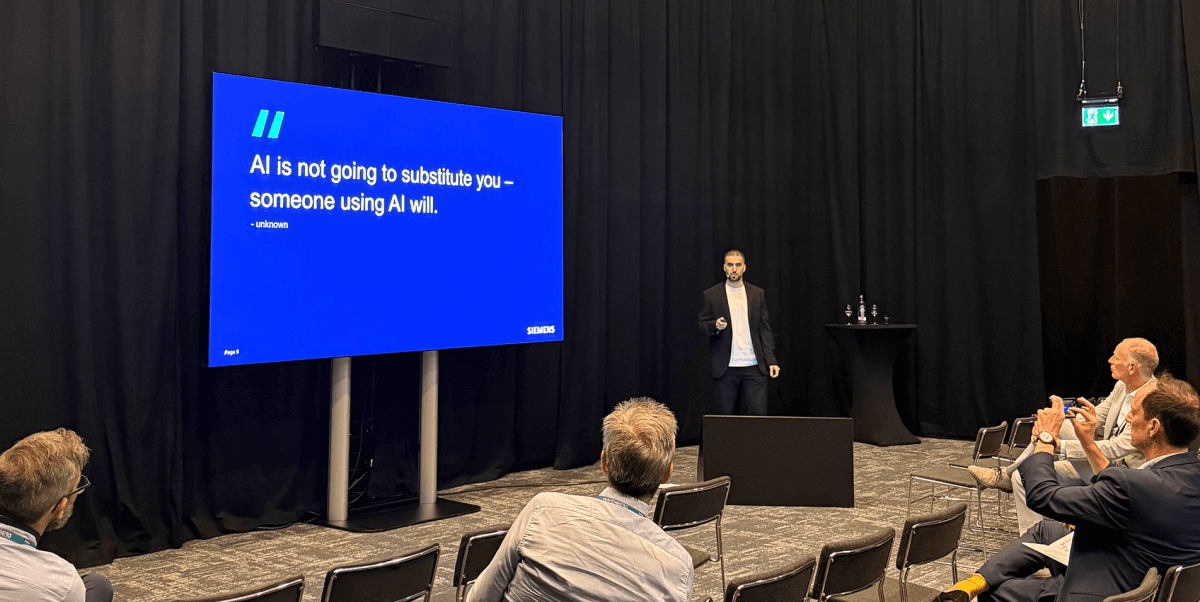
My presentation on AI agents at Siemens in Amsterdam.
To understand why AI agents are so significant, it helps to look at three stages of development:
Large Language Models
AI workflows, and finally…
AI agents
Each stage expands on the capabilities of the previous one, and enables you to solve complex tasks with significantly less effort.
Many professionals already use ChatGPT, Claude, or Perplexity in their daily work. Yet despite these tools, the actual work often remains the same: constant prompting, manual adjustments, copy-pasting between tools, tedious research, and repetitive routine tasks. AI helps, but it doesn’t fully take work off your plate. The tools are fast, but not truly autonomous.
This leads to a growing problem:
You gain minutes, but not hours.
You get support, but not real relief.
You build more and more small workarounds, but not a holistic digital employee.
And the more tasks you distribute across AI tools, the more time you spend correcting outputs, rethinking processes, and adjusting workflows. The pace increases, but efficiency stagnates.
The solution to this is AI agents. They represent the next evolutionary stage: systems that don’t just provide answers, but independently plan, control tools, make decisions, and iterate on tasks until they achieve a satisfactory result.
AI agents don’t work like a better version of ChatGPT, but like a digital employee who understands problems and solves them autonomously.
Stage 1: Large Language Models, the starting point
Large Language Models, LLMs, such as GPT, Claude, or Gemini form the foundation. They generate text, answer questions, and provide creative content. They are fast, versatile, and already indispensable in many areas.
But they have clear limitations:
They cannot independently operate tools.
They are not consistent and produce varying levels of quality.
They are passive and require user input every single time.
Example: An LLM can write an email, but it cannot independently schedule a meeting in your calendar. It can analyze data, but it cannot open databases. That means LLMs are productive, but not capable of taking action.
Learning: LLMs are always reactive. They only work when you tell them what to do.
Stage 2: AI workflows, efficient automation with fixed rules
AI workflows expand LLMs by adding access to tools and predefined processes. Platforms like n8n, Zapier, or Make connect calendars, emails, Google Sheets, Notion, and APIs, and automate workflows.
Example:
New emails are automatically sent to an LLM.
The LLM analyzes the content.
The workflow schedules meetings in the calendar or creates notes.
But these systems also remain structurally limited:
Workflows always follow a rigidly defined sequence.
If the output is not suitable, you have to adjust the prompt yourself.
If a new tool is required, you have to add it manually.
Workflows are powerful, but deterministic. They cannot independently decide how a problem is best solved.
Learning: Workflows automate processes, but they do not think. They replicate your process, they do not optimize it.
Stage 3: AI agents, digital employees instead of tools
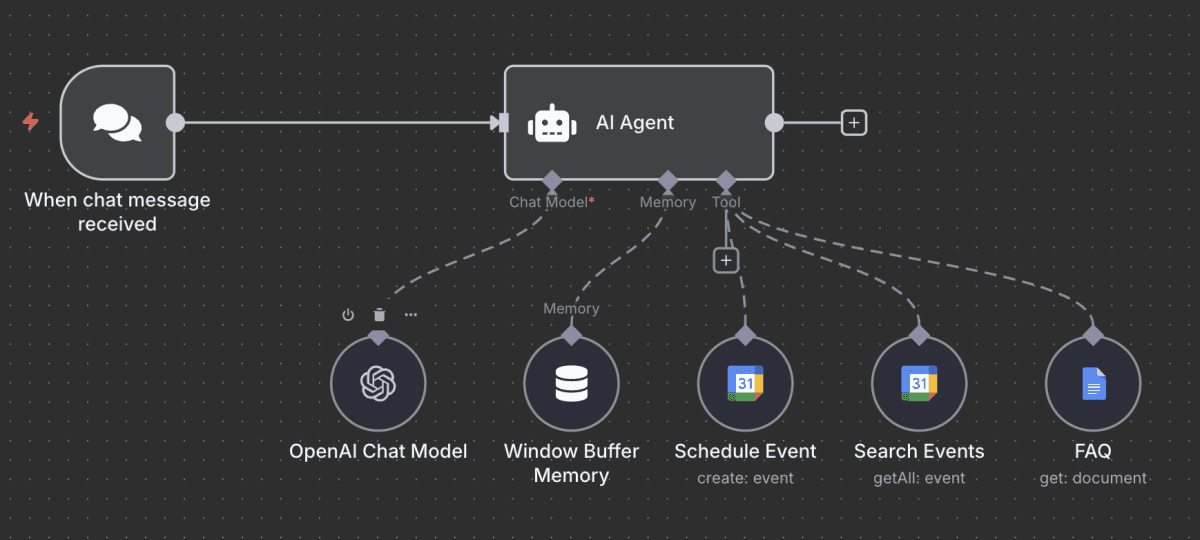
Example of a chatbot AI agent that you can easily implement on your website. Prospective customers can book an appointment with your team directly through the chat. The agent draws its knowledge from a document tailored to your business that contains all the key questions and answers.
The key leap happens when an LLM doesn’t just generate text, but also takes on two additional capabilities:
Planning: The agent decides for itself which steps are necessary.
Example: It decides whether it needs a link, a PDF, or the raw webpage.Selecting and using tools: The agent chooses the right model, the right API, or the right tool on its own.
This means the agent doesn’t just replace the workflow, it also replaces the human who has to build the workflow in the first place.
What an agent actually does
An agent can:
decide how to approach a task
select tools independently
detect and correct errors
iterate until the result is satisfactory
test alternative approaches
integrate additional models when useful
dynamically construct internal workflows
In other words, an agent builds its own workflow in real time. It is flexible, dynamic, learning, and adaptive.
Example: Claude Code
Claude can program an app by:
first developing a plan,
then researching APIs,
generating code,
testing for errors,
and iteratively improving the code.
All of this without a fixed workflow. The reasoning happens inside the agent.
Learning: An AI agent solves tasks autonomously. It does not ask, “What should I do?”, but rather, “How do I solve this problem in the best possible way?”
Why agents are a game changer for productive work
They reduce human control
Instead of formulating dozens of prompts, you simply describe the goal. The agent takes over both strategy and execution.
They save significantly more time than LLMs or workflows
Where LLMs save minutes and workflows save hours, agents save days. They eliminate the biggest time drain: manual adjustments.
They scale work like employees
An agent can research, analyze, generate, iterate, and improve at the same time. That’s more than productivity. That’s multiplication.
They take over complex knowledge work
Agents can:
create market analyses
automatically optimize reports
write and debug code
create and review content
answer customer inquiries
automatically connect data
monitor systems
Not as rigid processes, but as flexible problem solvers.
Concrete learnings for your daily work
If you regularly write prompts, you need LLMs.
If you have recurring processes, you need workflows.
If you want to fully delegate complex tasks, you need agents.
The greater the need for decision-making, the greater the advantage of agents.
Agents do not replace tools, they connect them into intelligent processes.
Agents work like digital employees, not like AI features.
The evolution moves from pure text generation to structured automation and finally to autonomous problem solvers. AI agents mark the point where AI no longer just supports, but takes responsibility.
Anyone using AI tools today is facing the next stage of productive work with agents: systems that plan, act, decide, and improve.
If you would like to find out which specific agents, workflows, or automations can immediately make your company more efficient, we offer a free AI assessment at APEX. Together, we analyze your current processes and identify where AI agents can instantly save you time, costs, and internal resources.
About APEX Consulting
APEX Consulting is an AI automation and growth consulting firm supporting B2B organizations with intelligent workflows, AI agents, CRM automation, and scalable operating systems. The firm focuses on practical, implementation-driven solutions that reduce manual effort and enable sustainable growth.
More information: https://apex-consulting.ai/