
Finally, a clean CRM, thanks to AI!
Many companies invest huge sums in marketing campaigns, trade shows, and lead lists, only to realize that by the end of the quarter, their CRM contains mostly one thing: data junk.
Duplicate entries, outdated contacts, incorrectly assigned industries, or leads that never respond to a single message.
The result: sales teams waste time, marketing campaigns fall flat, and reporting dashboards no longer tell the truth.
But while most companies continue to clean things up manually, a clear trend is emerging: artificial intelligence can radically improve the quality of your leads, automatically, continuously, and at scale.
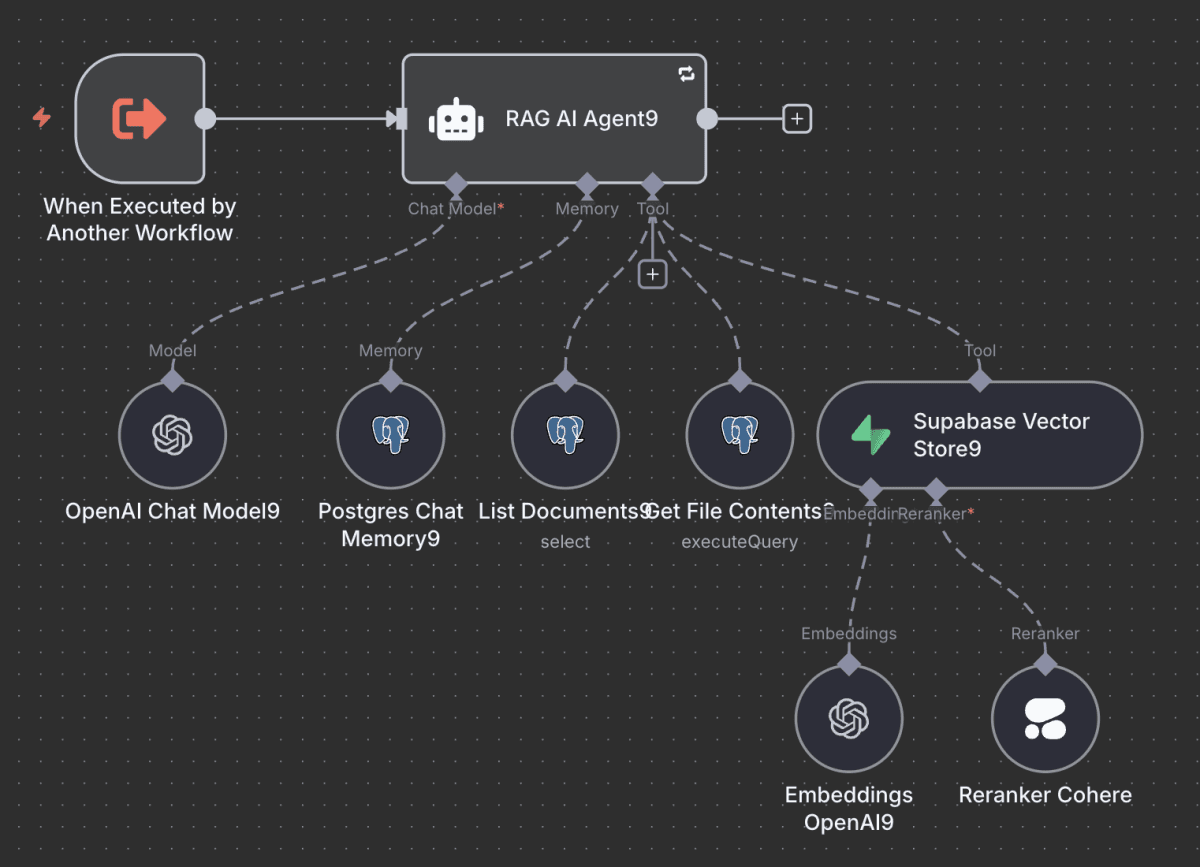
This n8n workflow diagram shows a RAG-based AI agent for lead qualification that retrieves data from a Supabase vector database, analyzes it with OpenAI, and learns contextually through Postgres chat memory.
The core problem: when your CRM costs more than it delivers
A CRM system is only as good as the data inside it. Because everyone knows: garbage in means garbage out.
But in reality, it often looks like this:
Data chaos: Leads are imported from multiple sources, website, events, ads, and purchased lists, without proper deduplication or formatting.
Outdated information: Companies merge, change domains, or switch contacts, and no one notices.
Lack of prioritization: Sales teams don’t know which leads are actually ready to buy and waste time on irrelevant contacts.
Missing context: Critical details like company size, industry, tech stack, or decision-making level are absent.
Manual work: Every record has to be reviewed, enriched, or deleted by hand, a productivity nightmare.
The result? A CRM that creates confusion and frustration instead of driving growth. Sales and marketing talk past each other, and valuable resources get invested in the wrong leads.
The vicious cycle: why bad data keeps getting more expensive
What many underestimate: poor data isn’t a “nice-to-fix” issue, it’s a direct cost driver.
Every unqualified lead your sales team contacts costs time and money.
Every email sent to an outdated address hurts your deliverability.
Every incorrect report leads to bad marketing budget decisions.
And every missed touchpoint with a truly interested lead means lost revenue.
Our experience shows that 30–40% of CRM data in B2B companies is inaccurate or incomplete, and that average data quality declines by 10–20% every year if nothing is done about it.
Sales loses focus, marketing loses trust, and the company loses speed.
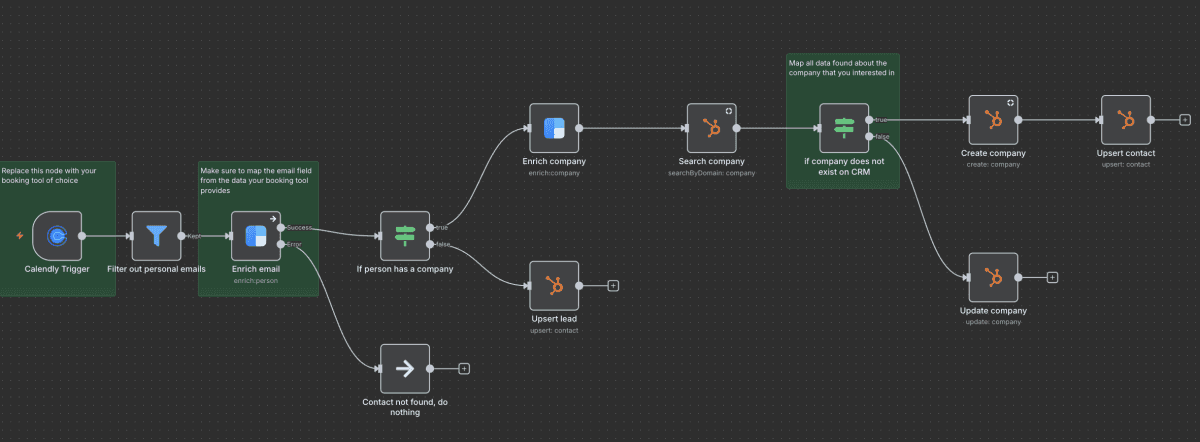
This n8n workflow diagram automates lead qualification from Calendly bookings by filtering out personal email addresses, enriching contacts and companies, and then creating or updating them in the CRM (e.g., HubSpot).
The solution: our APEX AI as your lead intelligence system
Instead of reacting by deleting and correcting data, artificial intelligence can now proactively ensure that your CRM stays alive, accurate, and sales-ready. This happens through four key steps:
1. AI-powered lead discovery & identification
AI-driven tools analyze millions of public data points, from company websites and job platforms to (increasingly) social media, and automatically identify potential target customers that match your Ideal Customer Profile (ICP). This allows you to discover new leads before they even appear on your radar.
Example: A system connected to platforms like Clay or Coresignal can use machine learning models to detect when a company is growing, hiring for new roles, or expanding into new markets, clear buying signals.
Instead of blindly purchasing lead lists, you identify real, dynamic market movements that indicate genuine interest or investment readiness.
2. Automated enrichment & context generation
A name and an email address are worthless today without context. AI can enrich every lead with relevant data points, such as:
Company size and revenue
Industry and technology stack
Location and regional presence
Recent funding rounds or press releases
Job title, seniority, and decision-making level
Social links (LinkedIn, X, Crunchbase, etc.)
This transforms a raw dataset into a complete lead profile, enabling your sales team to communicate in a personalized way and set clear priorities.
3. Pre-qualification & lead scoring
Once leads are enriched in your CRM, AI can evaluate them based on relevance and potential. This happens through a dynamic lead scoring model that weighs factors such as activity, intent, fit, and freshness.
Example:
A CTO at a fast-growing tech company with a matching tech stack → high score
A student using a personal email address → low score
This way, your sales team automatically focuses on the leads with the highest chance of success, instead of relying on guesswork.
AI can also learn which lead types actually converted in the past and continuously improve its model. The result: self-learning prioritization and sales intelligence that gets smarter with every interaction.
4. Real-time CRM cleaning & data maintenance
Perhaps the most important aspect: AI doesn’t just find new leads, it can repair your existing CRM.
Through automated workflows, the system detects:
Duplicate and incomplete records
Outdated or unreachable contacts
Inconsistencies between systems (e.g., HubSpot vs. Pipedrive)
Inaccurate or incorrect assignments
Instead of an annual data clean-up, this becomes a continuous, automated process. If a company rebrands, changes its domain, or a contact leaves the organization, your system knows first and adjusts accordingly.
This keeps your CRM up to date at all times, without manual intervention.
What this looks like in practice
A real-world example: A B2B company with 20,000 CRM contacts discovered that only 30% of its leads were still active. With an AI-powered workflow, they were able to:
Automatically remove 4,500 outdated contacts
Enrich 7,200 records (website, industry, key contacts)
Add 1,800 new leads based on intent signals
Implement a dynamic lead scoring system
The result: The sales team reduced contact time per deal by 40%, and the conversion rate increased by 28%, without increasing the marketing budget.
The cultural shift: from volume to precision
Many companies still believe “more leads = more revenue.” In reality, the opposite is true: quality beats quantity.
A clean, well-maintained CRM with 2,000 relevant, enriched, and scored leads is far more valuable than 50,000 raw datasets without context. AI makes it possible not only to achieve this level of precision, but to maintain it permanently.
Your CRM is only as smart as your data flow
A modern CRM system isn’t a static archive, it’s a living organism. If you feed it bad data, it produces bad outcomes in sales, marketing, and reporting.
Today, artificial intelligence allows you to automate and optimize every phase of your lead cycle:
Actively find leads before your competitors do
Automatically enrich and evaluate them
Keep your CRM continuously clean and relevant
This isn’t a luxury, it’s the foundation of profitable sales in a data-driven B2B era.
In short: If you’re still cleaning data manually, you’re working against the clock. If you use AI to manage your data, you’re working with it.
Get started with AI, here’s how
Book an appointment via our calendar link: https://calendly.com/apex-consulting-call/ki-beratung
We conduct a personal strategy session (with one of our automation experts).
You leave the call with a clear assessment and concrete next steps.
About APEX Consulting
APEX Consulting is an AI automation and growth consulting firm supporting B2B organizations with intelligent workflows, AI agents, CRM automation, and scalable operating systems. The firm focuses on practical, implementation-driven solutions that reduce manual effort and enable sustainable growth.
More information: https://apex-consulting.ai/