
How to staff your AI strategy
The moment an AI initiative moves from idea to execution, an important shift happens. It is no longer about what models might do, but about who will build them, maintain them, and integrate them into real operations. Many promising AI programs stall not because of technology failing, but because the resourcing model is unclear or mismatched to the company’s goals.
Successful AI adoption starts with treating talent strategy as part of system design. The right approach depends on how central AI is to your competitive advantage, how quickly you need results, and how deeply solutions must integrate with your data and workflows. For most organizations, the answer is not purely in-house or fully outsourced. It is a deliberate blend that evolves as maturity grows.
Build in-house, outsource, or combine both?
Internal capability offers control, faster iteration, and long-term learning. AI systems improve through feedback, better data, and continuous refinement. When the work lives inside the business, these improvements happen more naturally. The downside is cost, competitive hiring markets, and the time required to onboard talent.
Outsourcing accelerates early progress. Experienced partners can validate ideas quickly, deliver proof of concept, and fill specialized skill gaps. However, heavy reliance on vendors can limit knowledge transfer, slow iteration, and create dependency on core systems.
Many organizations succeed by outsourcing early experimentation, then gradually building internal ownership as use cases prove valuable and stable.
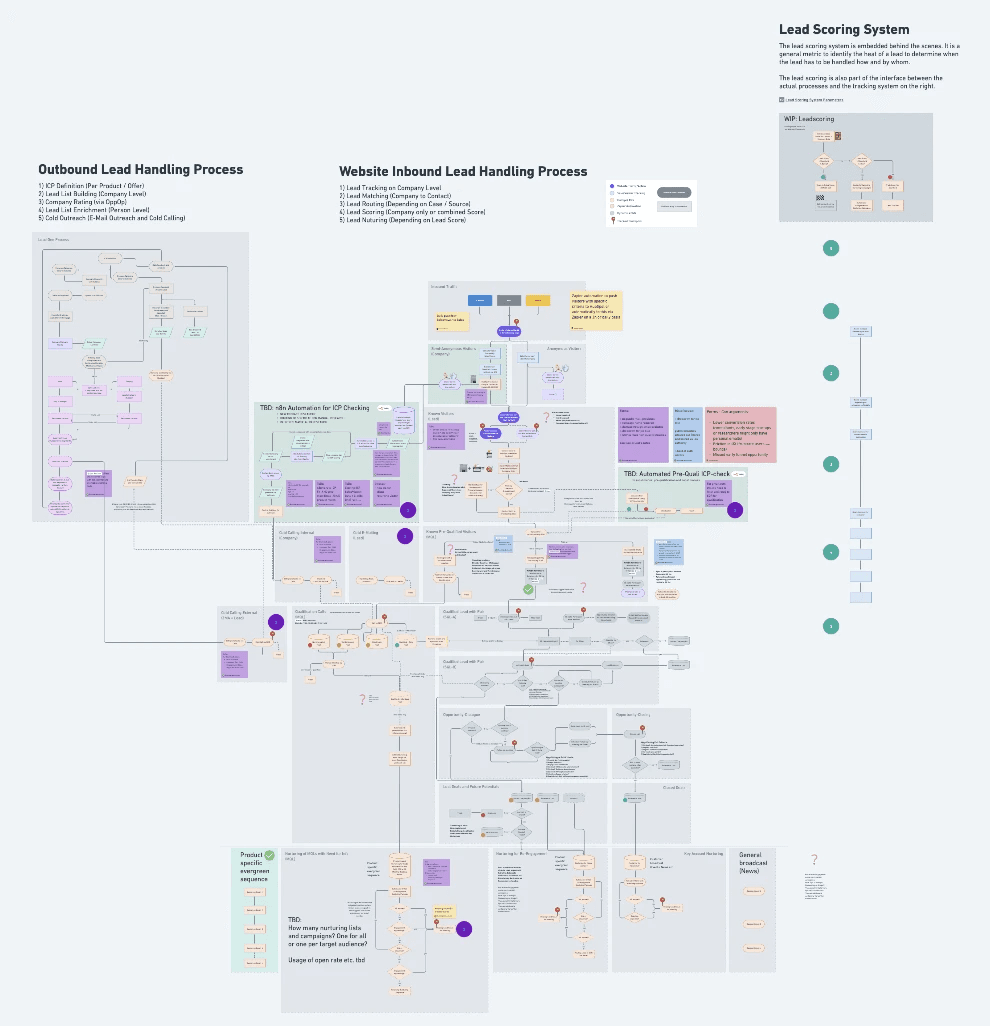
This diagram shows the complete lead-handling process that we developed at APEX together with a client – from outbound to website inbound – including lead scoring, automations, and decision logic. It visualizes how qualified leads are efficiently captured, evaluated, and handed over to sales teams in order to achieve maximum conversion.
Practical factors that guide the decision
Rather than debating philosophy, focus on concrete drivers.
If you are new to AI, external partners can shorten the learning curve and help avoid expensive missteps. As experience grows, shifting core work in-house usually improves speed and control.
When AI is central to differentiation, such as personalization, pricing, fraud detection, or intelligent automation, internal capability becomes strategic. If AI simply supports existing operations, outsourcing can remain effective longer.
Time pressure also matters. Tight deadlines favor outsourcing. Long-term capability favors internal investment.
Budget should be viewed across years, not months. Vendors often appear cheaper early, but can cost more over time than a small, focused team that continuously improves systems.
Customization and integration complexity push toward in-house ownership. The more your models depend on proprietary processes, sensitive data, and deep system connections, the harder it becomes to externalize effectively.
Specialized skill gaps may justify targeted outsourcing, especially in areas like computer vision, advanced NLP, or large-scale deployment.
The roles that make AI work in production
AI value does not come from a single hire. It emerges from a small ecosystem of complementary skills that turn data into a reliable business capability.
Data scientists translate business problems into modeling tasks, build and evaluate models, and iterate until results are operationally useful. They define performance thresholds, manage experimentation, and ensure outputs support decisions rather than simply maximize accuracy.
Data engineers create the pipelines that collect, clean, transform, and deliver data for both training and production inference. Without this foundation, even strong models remain fragile prototypes.
MLOps engineers focus on deployment, monitoring, version control, security, retraining workflows, and system reliability. They transform models into services that can run continuously and be governed properly.
Software engineers integrate AI outputs into applications, dashboards, and operational systems. This is where adoption happens. A model only creates value when it becomes part of daily workflows.
Full-stack data scientists who can handle modeling, data work, and basic deployment are extremely valuable early on, especially in smaller organizations. They allow rapid end-to-end progress before specialization becomes necessary.
When early initiatives center on large language models rather than custom machine learning, the first hire often looks different. Strong software engineers who understand LLM application patterns, evaluation methods, retrieval systems, and guardrails can deliver significant value without immediate deep modeling expertise.
Data science becomes more critical when you begin fine-tuning models, building custom evaluation frameworks, or optimizing performance in domain-specific contexts.
For organizations focused on AI automation rather than custom model development (connecting LLMs to business workflows, automating document processing, or building intelligent CRM and operations systems), the weight shifts meaningfully toward software and integration engineering. The core work is API connectivity, workflow logic, prompt design, and system reliability, not model training. This is where most B2B automation value is built in practice, and it requires a different hiring profile than the one typically described in AI talent frameworks.
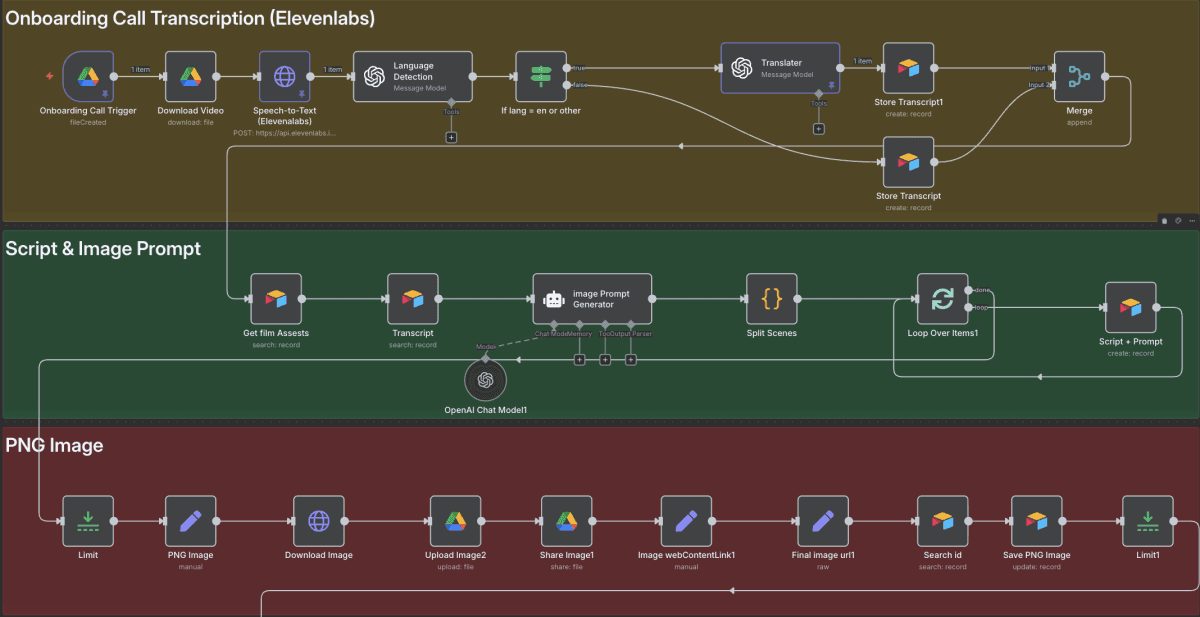
Automated n8n workflow for Meta & Google Ads: from the onboarding call to script generation to the finished image ad and conversion into video format, fully AI-powered.
Optional and scaling roles
As AI becomes more embedded, additional roles increase impact.
Research-oriented specialists are useful when pushing beyond standard approaches is necessary for competitive performance, though many businesses never require this level.
Data analysts often uncover the operational patterns that lead to strong AI use cases by quantifying bottlenecks, inefficiencies, and repeatable decision points.
Product leadership with AI literacy is essential when AI is central to the product itself rather than a supporting feature.
In larger organizations, scaling adoption benefits from domain experts who embed business knowledge into model design, project managers who coordinate multiple initiatives, executive sponsors who unlock resources and momentum, and functional champions who drive adoption within departments.
What to hire first
Instead of chasing a perfect team structure, aim for the smallest group that can deliver a real workflow improvement.
For traditional machine learning initiatives, an effective starting nucleus often includes:
One strong data scientist
One software engineer or full-stack profile
Domain experts from the business unit
As data volume increases, add a data engineer. As production use grows, invest in MLOps.
For generative AI-focused efforts, early teams often include:
One LLM-oriented software engineer
A technical resource responsible for data retrieval and integration
Business stakeholders validating outputs and driving adoption
More specialized roles can be layered in as complexity increases.
How team structure evolves by organization type
Smaller companies benefit from generalists who can deliver end-to-end systems quickly. Specialization grows naturally as volume and reliability requirements increase.
AI-first startups typically invest earlier in engineering depth, product leadership, and deployment infrastructure because the AI system itself is the product.
Medium and large enterprises often succeed with a small central capability paired with strong domain involvement. Over time, platform teams, governance, and operational roles expand as adoption spreads across departments.
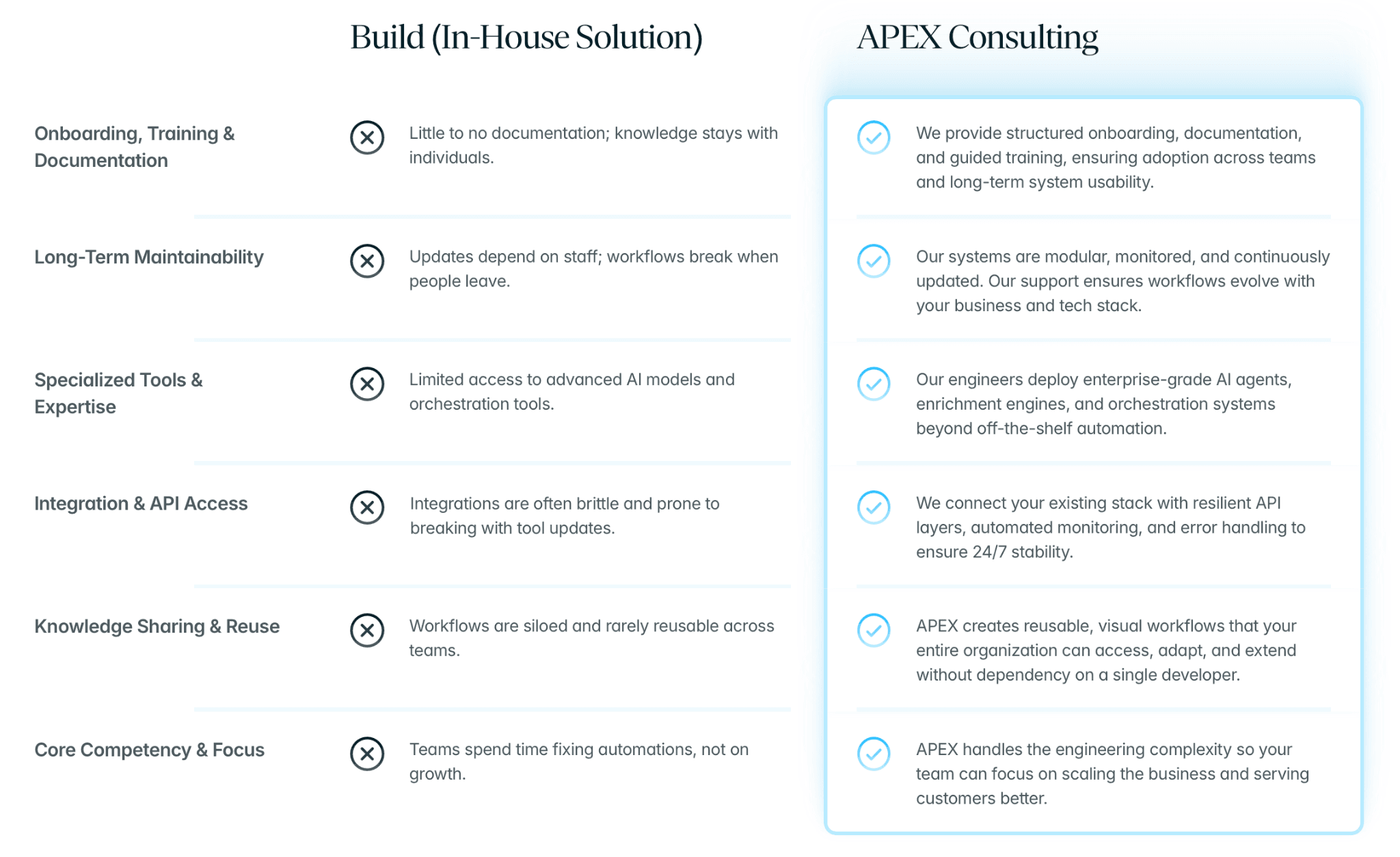
Comparison: In-house development vs. APEX consulting, why companies automate faster, more reliably, and more scalably with APEX.
Getting the people strategy right
The organizations that succeed with AI rarely start with large teams. They start with focused capability, deliver tangible wins, and scale deliberately. They use outsourcing strategically rather than permanently. They design knowledge transfer into every external engagement. They invest in roles that support production rather than continuous experimentation.
Most importantly, they treat talent decisions as strategic infrastructure, not short-term staffing.
AI becomes a real business capability when the right people are empowered to build, integrate, monitor, and continuously improve systems. With a thoughtful build, buy, or blend approach, companies move faster, waste less effort, and turn promising use cases into a durable operational advantage.
About APEX Consulting
APEX Consulting helps B2B organizations implement AI automation, intelligent workflows, and scalable operating systems that reduce manual effort and support sustainable growth. If you're exploring what AI could look like inside your organization, book a free call with the team: https://calendly.com/apex-consulting-call/15min