

De-risking AI projects in business starts with proof of concept.
AI initiatives usually fail because uncertainty is underestimated. Even when a problem is real, and the value seems obvious, the path from idea to operational system is full of unknowns: whether the data contains enough signal, whether a model can reach acceptable performance, whether stakeholders will trust the output, and what it will cost to run and maintain at scale. Unlike traditional software projects, where requirements can be fully specified upfront, AI projects depend on learning from data, and learning introduces variability that cannot be resolved through planning alone.
This is why the proof of concept has become an essential business discipline for AI. A well-designed proof of concept is not a toy prototype, and it is not a marketing demo. It is a structured experiment that helps you decide, quickly and credibly, whether an AI idea is worth serious investment. It reduces the risk of expensive failures by forcing the organization to answer the questions that matter most before committing to a full program.
A proof of concept does not guarantee success. It does something more practical. It turns uncertainty into evidence.
Why proof of concept matters more in AI than in most initiatives
AI projects carry uncertainty across three dimensions that are often difficult to validate in advance:
technical uncertainty.
business uncertainty.
organizational uncertainty.
A proof of concept is designed to address all three. It tests feasibility, collects feedback from real users, and provides the basis for realistic production planning. When done correctly, it answers the central question that leaders care about: is this initiative worth scaling, and under what conditions?
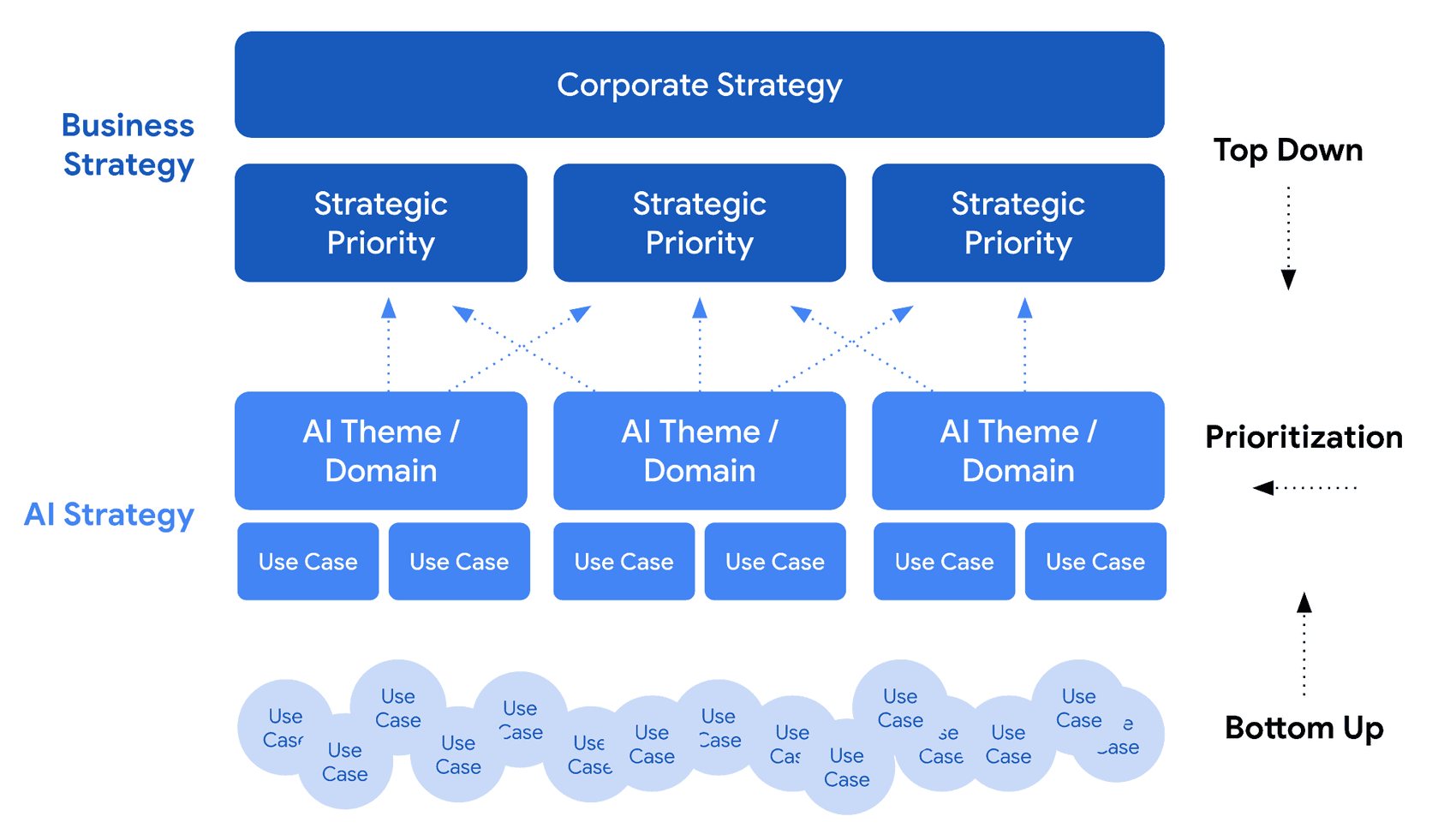
Once you've mapped business priorities to AI applications, the proof of concept is simple: one problem, one hypothesis, 30 to 90 days (image source: Google).
Mapping business priorities to AI applications
The purpose of a proof of concept in three outcomes
A successful proof of concept delivers three outcomes that are distinct from building a full system.
First, it tests whether AI is the right approach. AI can be powerful, but it is not always the best tool. In some cases, simpler rules, process redesign, or conventional analytics deliver similar value with less complexity. A proof of concept helps you avoid forcing AI into problems it does not need to solve.
Second, it generates early stakeholder feedback. By exposing a concept to the teams who will use it, you learn whether the outputs are useful, whether the format makes sense, and what constraints are non-negotiable. This feedback builds buy-in and improves design decisions early, when change is cheap.
Third, it supports production planning. A proof of concept clarifies what building a production-grade capability will actually entail: data pipelines, integration, infrastructure, monitoring, maintenance, security, and governance. It replaces optimistic assumptions with a grounded view of timeline and cost.

You don't need a perfect result. You need a real one. Set your objective, define your KPIs, give it 30 to 90 days — and let the outcome speak. Success builds trust. Failure builds knowledge. Either way, you're no longer guessing.
A practical blueprint: ten elements that keep a proof of concept credible
The organizations that benefit most from proofs of concept treat them as structured projects rather than informal experiments. A useful planning blueprint includes ten elements.
1) The problem. Define the operational pain or the value you want to create. The problem must be specific and tied to a process, not a broad aspiration such as “improve quality” or “optimize service.”
2) The hypothesis. State what you believe AI will change and why. This is not a technical claim. It is a value claim. In an RFP document extraction example, the hypothesis might be that a model can identify and pull the relevant requirements from incoming proposals quickly enough to reduce manual review time and free specialist staff for higher-value work like evaluation and response strategy.
3) The scope. Proof of concept scope should be intentionally narrow. The goal is to test the core learning problem, not to build the full production workflow.
4) Success criteria. Define what “good enough” means for the proof of concept. This includes business criteria such as throughput or time savings and technical criteria such as model performance. Importantly, proof of concept targets should be realistic and staged.
5) Data. Identify the datasets required, including volume, quality, and labeling needs. In supervised learning use cases, labels often become the critical bottleneck. In a defect detection proof of concept, this may mean thousands of images with clear annotations indicating defect presence and type.
6) Modeling approach and tools. Decide how you will build or leverage capabilities. In many cases, starting with an existing service or pre-trained model is the fastest route to evidence.
7) Infrastructure. Specify what compute and storage are required for the proof of concept and what would be needed for scale. Managed services can reduce infrastructure work. Custom training often requires specialized computing.
8) Deliverables. Define outputs beyond “a model.” A proof of concept should typically produce reproducible code, documentation, a clear report of results and limitations, and recommendations for what to do next. Depending on the audience, a simple interface for testing the model can help stakeholders validate results with new inputs.
9) Team. Ensure the proof of concept has the right mix of skills: someone who can build and evaluate models, someone who can manage and prepare data, someone with domain expertise, and someone who can coordinate work and expectations.
10) Timeline. Keep the proof of concept short enough to preserve urgency and avoid overinvestment, but long enough to produce meaningful evidence. Many effective proofs of concept run in weeks rather than quarters, precisely because they are designed to answer specific questions quickly.
This blueprint achieves something important: it forces clarity. Teams stop debating AI in theory and start validating a specific hypothesis with defined constraints.
A proof of concept is valuable only if it leads to a decision. Once you have results, leaders should review a small set of questions that determine whether to proceed, iterate, or stop.
If the improvement is marginal, or if simpler methods can achieve the same benefit, it may be better to redirect effort. Walking away is not failure. It is good governance.
Proof of concept results help set realistic expectations for production performance by showing whether additional data and refinement can reach the accuracy your operations require, recognizing that some use cases tolerate imperfection while others demand high reliability. They also clarify whether existing AI tools are sufficient or if custom development is necessary, balancing speed and simplicity against flexibility and control.
Finally, proofs of concept reveal the true cost of scaling, including infrastructure, integration, monitoring, and ongoing maintenance, which often outweigh initial model development. With this evidence, organizations can confidently proceed, refine, or stop based on feasibility and return.
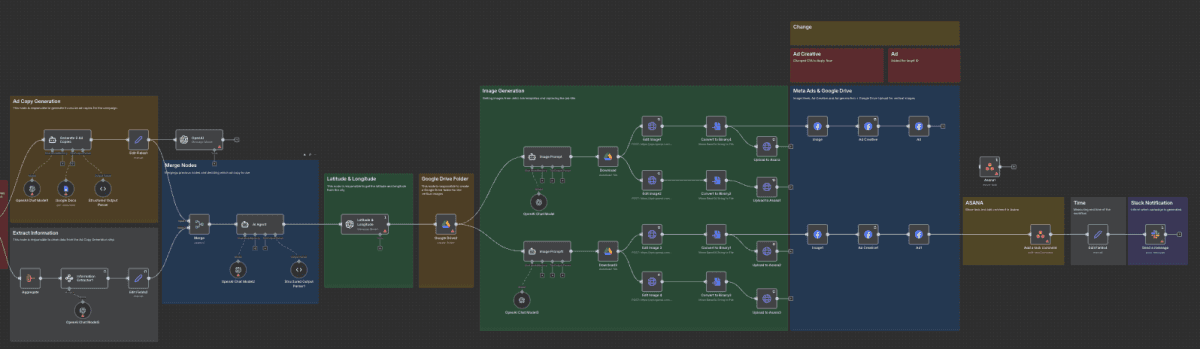
This workflow represents a fully built n8n production system. A proof of concept for something like this would isolate and test a single component first, like whether the model can reliably generate compliant ad copy from a creative brief, before any of the surrounding automation is built.
The strategic value of doing proof of concept well
Organizations that treat proofs of concept as disciplined experiments build more than models. They build the muscle of execution. Over time, they learn how to frame problems effectively, assess data readiness, involve stakeholders early, and plan for production realities. They also reduce the cultural risk of AI adoption by replacing hype with evidence.
The most productive AI programs are not defined by the number of experiments run. They are defined by the quality of decisions made after each experiment. A proof of concept, designed with rigor and evaluated with honesty, is the mechanism that makes those decisions possible.
About APEX Consulting
APEX Consulting helps B2B organizations implement AI automation, intelligent workflows, and scalable operating systems that reduce manual effort and support sustainable growth. If you're exploring what AI could look like inside your organization, book a free call with the team: https://calendly.com/apex-consulting-call/15min