Die KI-Grundlagen, die du für dein Unternehmen kennen musst!
Die meisten Fachkräfte, die heute mit KI zu tun haben, tun dies eher aus sicherer Entfernung. Sie nutzen zwar die Tools, schauen bei Demos zu und nicken bei Meetings an den richtigen Stellen, aber die Konzepte dahinter bleiben oft ein echtes Rätsel. Das ist eine Wissenslücke, die wir super einfach schließen können!
Du musst überhaupt keinen Code schreiben können, um von einem KI-Verständnis zu profitieren! Alles, was du brauchst, ist ein klares Bild im Kopf. So kannst du ganz leicht einschätzen, was machbar ist, unrealistische Ideen charmant bremsen und Fragen stellen, die dein Team wirklich voranbringen.
Drei Begriffe, die absolut nicht dasselbe bedeuten
Die erste kleine Stolperfalle ist die Sprache selbst. Künstliche Intelligenz, Machine Learning (maschinelles Lernen) und Deep Learning werden in Business-Gesprächen oft munter durcheinandergeworfen – fast so, als wären sie Synonyme für dieselbe schlaue Software. Aber das stimmt nicht! Sie beschreiben drei ganz verschiedene Ebenen im selben Bereich.
Künstliche Intelligenz ist der größte Rahmen – das spannende wissenschaftliche Ziel, Systeme zu bauen, die wie wir Menschen wahrnehmen, planen und Entscheidungen treffen können.
Machine Learning (maschinelles Lernen) ist ein spezieller Weg dorthin: Statt dem System feste Regeln vorzugeben, fütterst du es mit historischen Daten und lässt es die Muster ganz von alleine lernen!
Deep Learning geht noch eine Stufe tiefer. Es nutzt künstliche neuronale Netze mit vielen übereinanderliegenden Schichten, um super komplexe Muster zu erkennen – besonders in unstrukturierten Daten wie Texten, Bildern und Tonaufnahmen.
Wenn im Geschäftsalltag jemand sagt „Wir nutzen KI“, ist damit fast immer Machine Learning gemeint. Genau hier entsteht nämlich der echte geschäftliche Nutzen – und das ist auch die Ebene, die man in Meetings wirklich verstehen sollte!
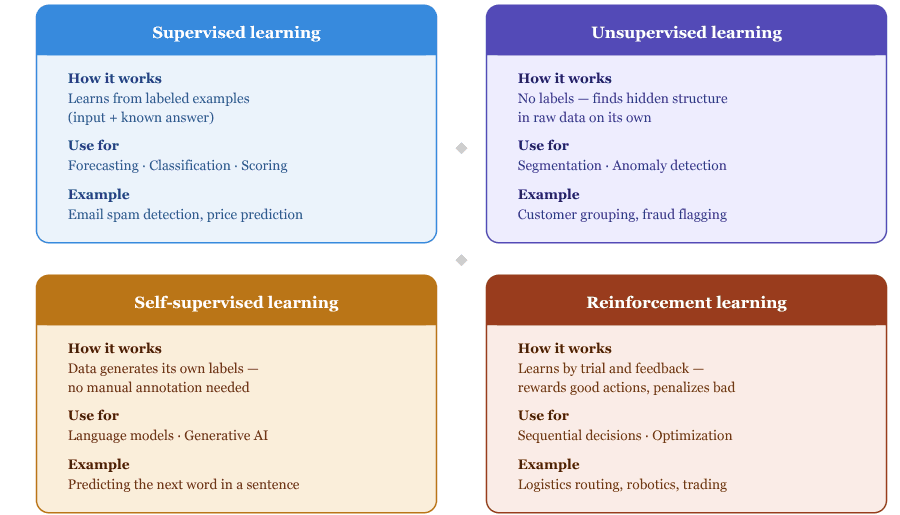
Die vier Arten des maschinellen Lernens lösen jeweils eine ganz andere Art von Aufgabe – je nachdem, welche Daten vorliegen und welches Ergebnis gewünscht ist.
Wie Maschinen eigentlich lernen
Machine Learning ist keine einzelne Zauberformel, sondern eine ganze Familie von tollen Methoden, von denen jede perfekt für eine bestimmte Aufgabe geeignet ist.
Überwachtes Lernen (Supervised Learning) wird im Alltag am häufigsten eingesetzt. Es funktioniert immer dann super, wenn du historische Daten hast, bei denen sowohl die Eingaben als auch die Ergebnisse schon bekannt sind. Du zeigst dem Modell Tausende von Beispielen – wie alte CRM-Daten samt erfolgreichem Verkaufsabschluss, um vorherzusagen, welche Kunden am ehesten kaufen werden. Oder du nutzt vergangene Bestellmengen und Lieferketten-Infos, um Engpässe frühzeitig zu erkennen. Das Modell lernt die Zusammenhänge so gut, dass es sie auf neue, unbekannte Fälle übertragen kann! Die meisten Prognosen im Business fallen in diese Kategorie.
Unüberwachtes Lernen (Unsupervised Learning) startet ganz anders. Hier gibt es keine fertigen Antworten oder Etiketten. Das Modell arbeitet nur mit den Rohdaten und versucht, von selbst eine Struktur oder Muster zu finden. Ein tolles Beispiel ist die Kundensegmentierung: Statt dem System zu sagen, wer deine Kundengruppen sind, findet es ganz von alleine logische Gruppen basierend auf Verhalten oder Alter. Auch das Erkennen von ungewöhnlichen Abweichungen (Anomalie-Erkennung) funktioniert so hervorragend!
Selbstüberwachtes Lernen (Self-supervised Learning) ist extrem wichtig geworden, denn es ist der Motor hinter der modernen generativen KI! Die geniale Idee dahinter: Die Kennzeichnungen (Labels) werden direkt aus den Daten selbst erzeugt, sodass niemand mühsam händisch Daten sortieren muss. Bei Sprachmodellen ist die Aufgabe ganz einfach gestrickt, hat aber eine riesige Wirkung: Sage das nächste Wort voraus, basierend auf dem, was davor stand. Wenn man das mit Milliarden von Beispielen macht, entwickelt das Modell ein fantastisches Verständnis für Sprachstruktur, Kontext und Bedeutung! Erst dadurch wurden Tools möglich, die wir heute täglich nutzen.
Bestärkendes Lernen (Reinforcement Learning) funktioniert nach einem ganz anderen, spannenden Prinzip! Statt aus fertigen Daten zu lernen, lernt das System durch Ausprobieren in einer Umgebung. Es trifft Entscheidungen und bekommt Feedback in Form von „Belohnungen“ oder „Bestrafungen“ – wie in einem Videospiel! So verbessert es seine Strategie Schritt für Schritt, um den maximalen Erfolg zu erzielen. Das eignet sich perfekt für knifflige Kettenentscheidungen, wie dynamische Preise, die sich der Nachfrage anpassen, oder die Echtzeit-Optimierung von Lieferrouten.
Warum Deep Learning so besonders wichtig ist
Früher ließen sich im Business vor allem strukturierte Daten leicht analysieren – also Tabellen, Zahlen und feste Kategorien. Doch die allermeisten wichtigen Infos stecken in Dingen, die sich nicht so leicht in Tabellen pressen lassen: Verträge, E-Mails von Kunden, Produktbilder, Sprachaufnahmen und Anleitungen.
Deep Learning hat hier völlig neue Türen geöffnet! Durch das Lernen in vielen Schichten können neuronale Netze heute Bilder extrem präzise verstehen, gesprochene Sprache deuten und Texte so erfassen, dass sie den echten Sinn dahinter verstehen (und nicht nur nach Stichworten suchen). Für Unternehmen ist das ein Riesenvorteil: Aufgaben, die früher viel Zeit und händische Arbeit gekostet haben, können jetzt blitzschnell, zuverlässig und im großen Stil erledigt werden!

Krabbeln – Gehen – Laufen beschreibt den einfachen Schritt-für-Schritt-Weg zum KI-Erfolg. Unternehmen starten mit kleinen, feinen Tests, integrieren KI dann ganz gezielt in ihre Prozesse und nutzen sie am Ende voll automatisiert und skalierbar. Das sorgt für nachhaltigen Erfolg ohne stressiges Chaos!
Was sich ändert, wenn du das verstehst
Es gibt einen einfachen Grund, warum manche KI-Projekte nicht klappen: Es liegt selten an der Technik, sondern meistens an der Herangehensweise! Manchmal wird versucht, Probleme mit Machine Learning zu lösen, die gar nicht dafür geeignet sind, oder die Datenbasis fehlt schlichtweg. Oder die Erwartungen stammen eher aus einem Science-Fiction-Film als aus der Realität.
Wenn du die Grundlagen verstehst, bekommst du etwas viel Wertvolleres als reines Fachchinesisch: ein richtig gutes Bauchgefühl! Du kannst Angebote von Dienstleistern viel besser einschätzen, weißt schon vor Projektstart, welche Daten wirklich gebraucht werden, und kannst mit der Geschäftsführung ganz ehrlich besprechen, was machbar ist. Das spart jede Menge Stress!
Für all das musst du kein einziges Modell selbst bauen können. Du musst nur wissen, wie du die richtigen Fragen stellst und wann eine Antwort Hand und Fuß hat.
Über APEX Consulting
APEX Consulting hilft B2B-Unternehmen dabei, KI-Automatisierungen, intelligente Workflows und skalierbare Systeme einzuführen, die den Alltag erleichtern und für gesundes Wachstum sorgen. Wenn du herausfinden möchtest, wie KI auch dein Unternehmen beflügeln kann, buche dir einfach ein kostenfreies Kennenlerngespräch mit unserem Team: https://calendly.com/apex-consulting-call/15min