Agentic Engineering in the LLM era
Many agencies and SMEs are currently having the same experience: an AI agent works remarkably well in testing, but as soon as real users work with it, unexpected problems emerge. Responses are formally correct but professionally off the mark.
Processes run, but not in the way the team expects. Trust is lost, even though the technology "technically works."
This is not down to poor implementation, but to a fundamental misconception. AI agents are not classical software. Anyone who treats them like normal automation will fail sooner or later. This is exactly where a new approach comes in that is increasingly gaining traction: agentic engineering.
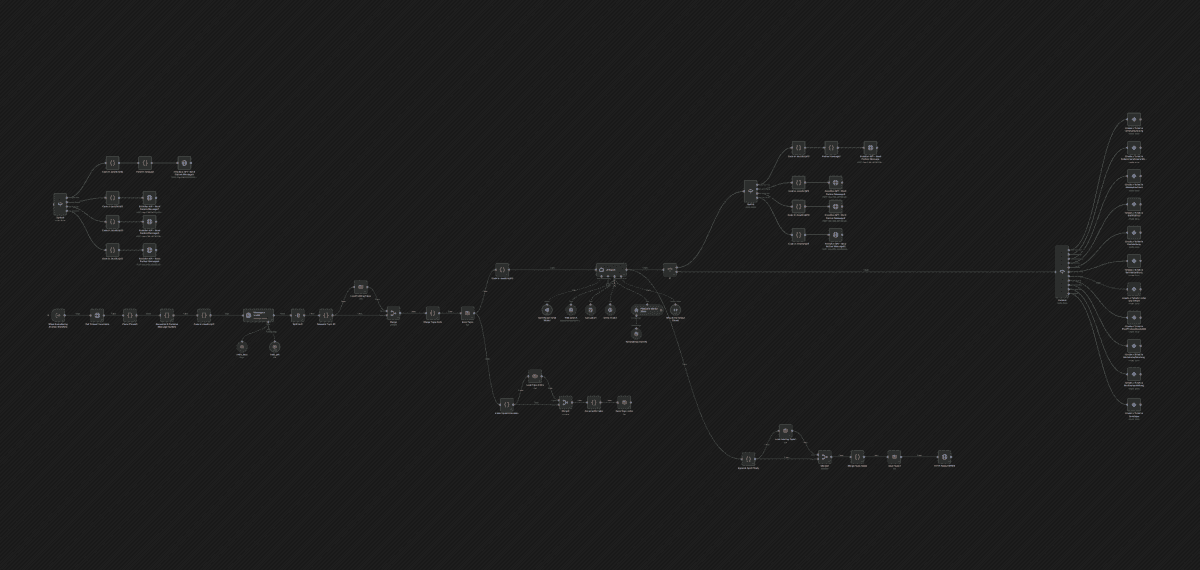
One of six interconnected workflows that together map a scalable WhatsApp customer support system. Each workflow takes on a clearly defined role, from intent recognition and context enrichment through to escalation and CRM updates. This is exactly where agentic engineering proves decisive: only through clean role distribution, controlled decision spaces, end-to-end tracing, and iterative optimization does the overall system remain reliable, transparent, and manageable, even with high query diversity and unpredictable user inputs.
Agents are not tools, they are behavior
Classical software follows clear rules. When input A arrives, output B happens.
Agents, on the other hand, interpret language, context, and intent. They decide which steps make sense, which tools to use, and how to respond. This makes them more similar to new team members than to technical modules.
That has a consequence many underestimate: agents cannot be fully "finished" in advance. They only develop their actual behavior once in operation. Production is not a risk, but the only realistic learning environment.
Teams that run stable agents today have understood that deployment is not the goal, but part of the development process. This way of thinking is strongly shaped by organizations like APEX, and we always aim to pass it on to our clients.
What agentic engineering really means
Agentic engineering is not a new role and not a framework. It is a way of working. At its core, it is about turning non-deterministic systems step by step into reliable contributors.
The most important shift in perspective: you are not optimizing code paths, but decisions. Not just whether the agent does something, but why it does it, and whether that why makes sense in a business context.
Three disciplines interlock here.
Product thinking defines which task the agent should take on at all and where its boundaries lie.
Engineering ensures that the agent interacts cleanly with systems, can catch errors, and remains traceable at all times.
Analysis and evaluation make visible where the agent fails or surprises in day-to-day operation.
Especially in smaller companies, one person often combines several of these perspectives. What matters is not the division of roles, but that none of them is missing.
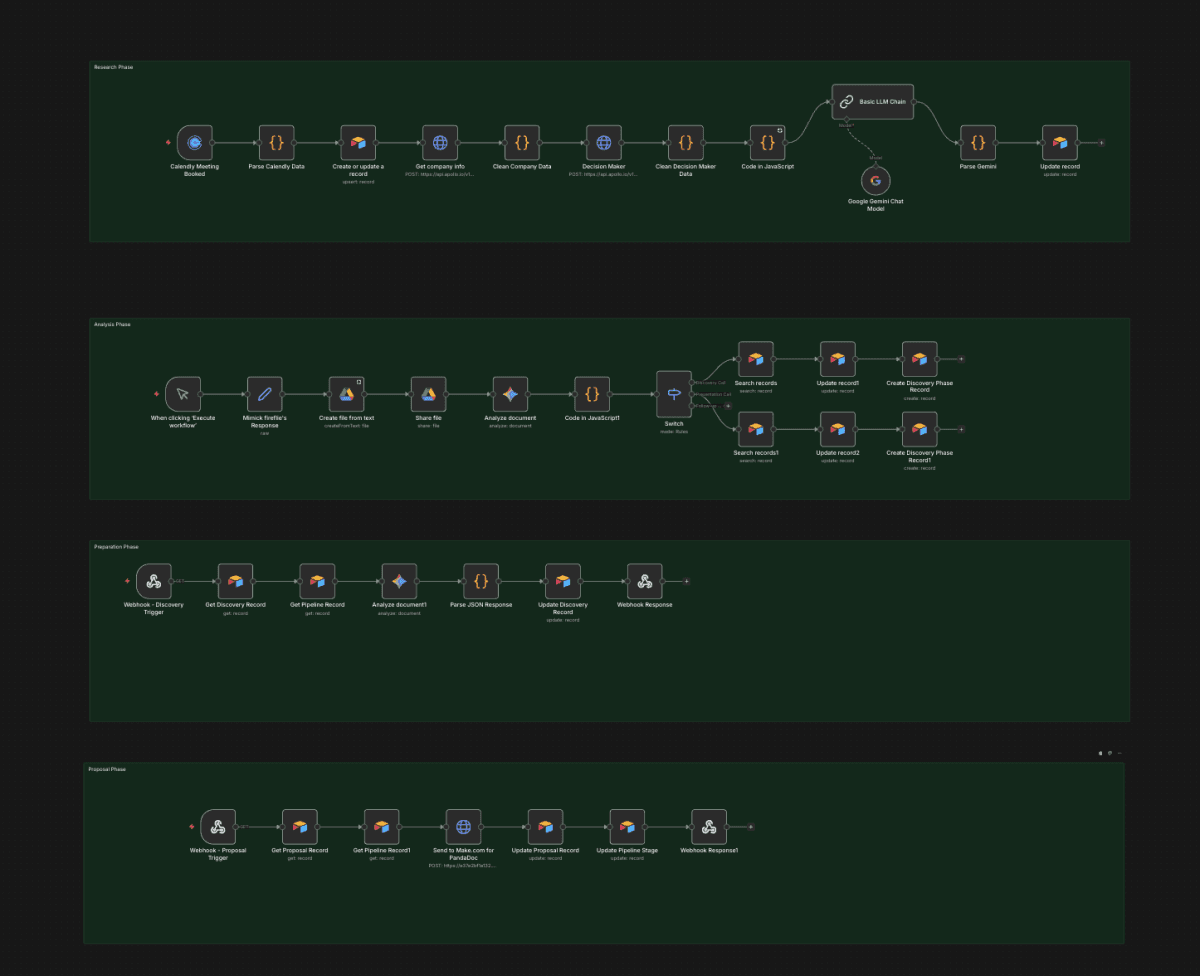
AI-powered CRM based on Airtable, built across several clearly separated phases from research through analysis and preparation to proposal creation. Each section is a standalone agent workflow with a defined purpose, its own decision logic, and clean data handover. Agentic engineering is decisive here because business logic, data enrichment, and AI decisions are not mixed together in one monolithic flow, but work together in a controlled, traceable, and iterative way. The result is a CRM system that not only automates but also works context-awarely and becomes more reliable with increasing use.
Why this is particularly relevant for agencies and SMEs
Agencies frequently deploy agents in client-critical processes: lead research, outreach, content preparation, reporting, or support. A misplaced tone or an inappropriate decision has a direct impact on client relationships.
SMEs, on the other hand, have less of a buffer. If an agent in sales makes wrong assumptions or gives inconsistent answers in service, the damage is felt immediately. At the same time, the leverage is enormous when it is done right.
Both groups therefore benefit particularly from agentic engineering because it does not aim for perfection before launch, but for controlled learning cycles during operation.
A practical look at reality
A good illustration comes from a seemingly trivial web detail: the "edit consent again" button. Users want to revise decisions, change settings, undo things. Systems need to be prepared for that.
Applied to AI agents, this means: users correct themselves, change their minds, or phrase requests vaguely. An agent must then not guess creatively, but respond in a structured way. Ask follow-up questions, offer options, document states. Reliability does not come from cleverness, but from clean decision spaces.
Many problems in agent projects arise precisely where these fallback points are missing.
How agentic engineering works in practice
Successful teams do not start with maximum autonomy, but with a stable foundation. They define clearly which decisions the agent is allowed to make and which it is not. They test with realistic scenarios, but accept that real users will always introduce new variations.
The decisive step is the deliberate deployment into an observable operation. Every agent run is made traceable: conversation history, tool usage, context. On this basis, evaluations emerge that fit the task, not just the technology. Targeted refinement follows, often surprisingly simple: more precise prompts, clearer tool boundaries, better follow-up questions.
This cycle repeats continuously. Not quarterly, but weekly or even daily.
Agentic engineering is not a trend term but a necessary response to a new kind of system. AI agents do not unfold their value through a one-time implementation, but through structured further development in real-world use.
For agencies and SMEs, this approach determines whether an agent remains a novelty or becomes a reliable part of the business.
Book your free AI consulting call now: https://calendly.com/apex-consulting-call/ki-beratung
About APEX Consulting
APEX Consulting is an AI automation and growth consulting firm supporting B2B organizations with intelligent workflows, AI agents, CRM automation, and scalable operating systems. The firm focuses on practical, implementation-driven solutions that reduce manual effort and enable sustainable growth.
More information: https://apex-consulting.ai/