

2026 - The Year of AI Employees
Anyone introducing artificial intelligence into agencies or mid-sized companies today is no longer entering uncharted territory. They are stepping into a field full of well-intentioned but poorly executed initiatives.
After more than 100 AI, automation, and process projects that we have accompanied at APEX, one thing is very clear: most problems do not arise because the technology is immature, but because companies overestimate their own organization, decision-making logic, and working reality.
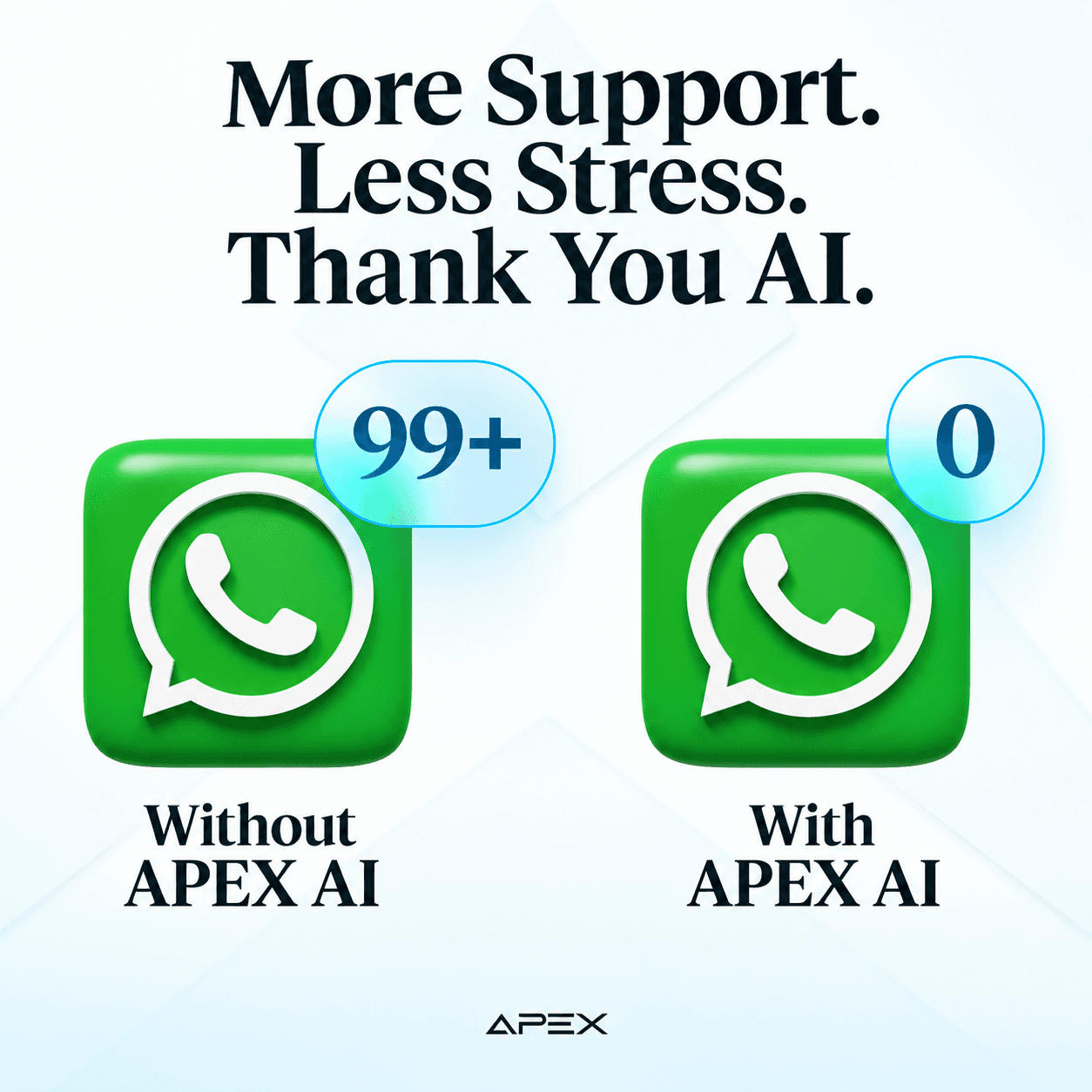
WhatsApp Customer Support Agent: with Ticket System and Responses in Under 1 Minute. What looks simple here is highly complex in reality. Our APEX Customer Support Agent consists of seven highly complex workflows that interact with each other, orchestrate knowledge, manage tickets, and secure handovers to team members.
What follows are not theoretical best practices, but patterns that repeat across projects and determine whether they succeed or fail.
"Anyone who wants to handle AI and automation entirely in-house rarely builds speed. The organization gets stuck in day-to-day business while the topic is strategically supposed to be driving acceleration."
AI is introduced before there is clarity about the actual problem
In many initial conversations, the desire for AI is present, but nobody can specify exactly what should concretely improve as a result. Efficiency is mentioned, time savings, or innovation, without any clarity about which bottleneck in daily operations is actually causing pain. In practice, this leads to projects starting with a lot of energy but quickly stalling because nobody can say whether the result is even relevant.
From experience, AI projects run stably when the underlying problem is described so concretely that it would be understandable even without AI. Only when it is clear where time is being lost, where decisions are getting stuck, or where quality is suffering can AI be deployed meaningfully. Everything else remains actionism.
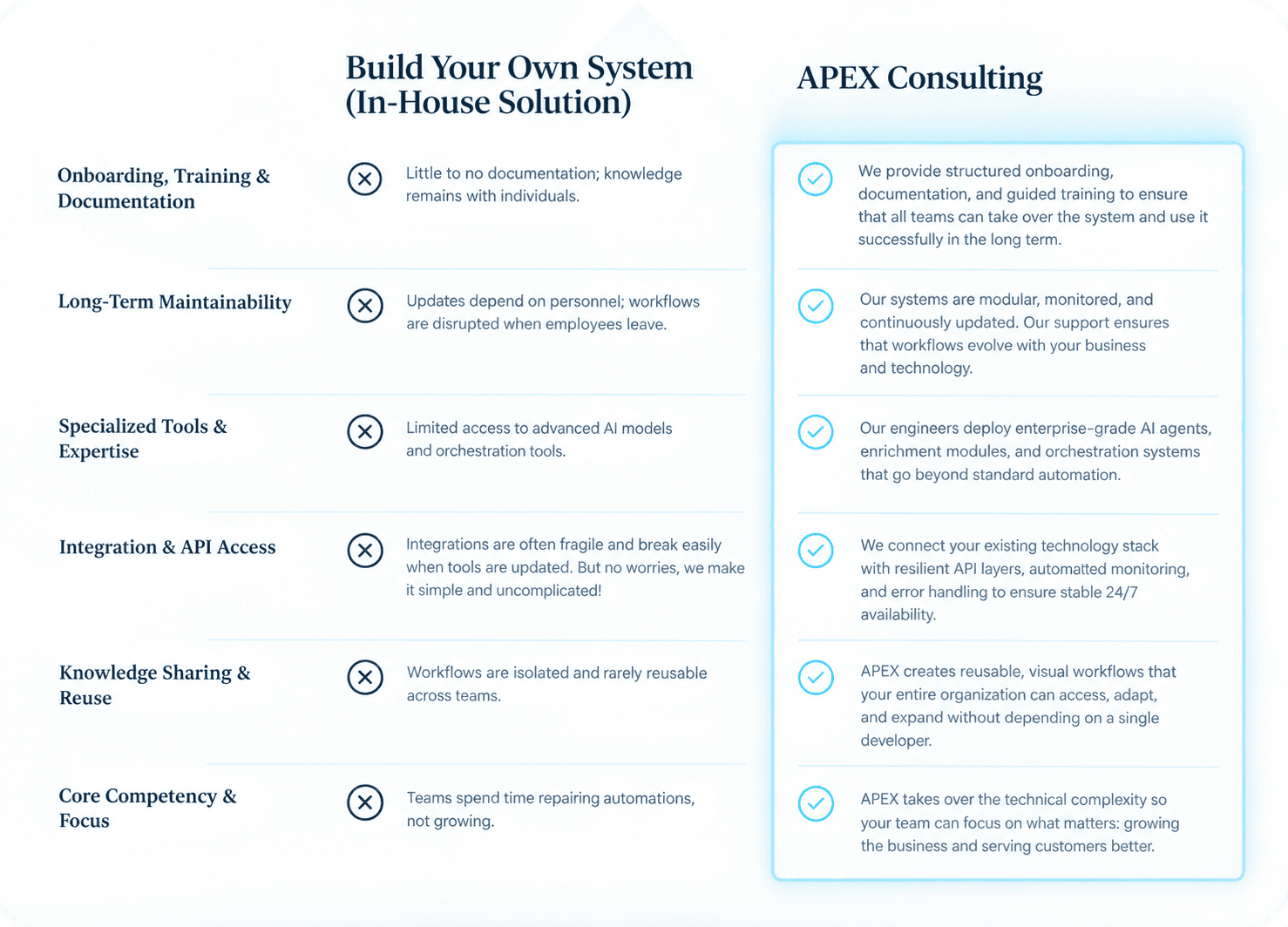
Build vs. Buy is not a technical decision, but a question of focus and speed. In practice, in-house solutions rarely fail due to lack of capability, but because knowledge remains fragmented and automation becomes a side project.
Immature processes are automated and thereby amplified
A particularly common mistake is the attempt to automate existing workflows directly without first questioning or standardizing them. In many companies, an official process exists on paper, but in practice every employee works slightly differently, makes decisions based on gut feeling, or spontaneously adds steps.
AI makes these differences visible and amplifies them. Automations break because edge cases were not accounted for, or deliver results nobody expected. Not infrequently, AI is blamed, even though it is only reflecting what was already unclean.
Successful projects invest first in clarity. They force teams to make decisions explicitly, standardize workflows, and question assumptions. Only when a process is understandable and reproducible does AI become a genuine lever.
Data is assumed to be good enough when it is not
Almost every company believes its data is sufficient to work with AI. In reality, a different picture almost always emerges. CRM entries are outdated, mandatory fields are not maintained, important information sits in emails or Slack messages and is unusable for systems, slow and poor agencies were involved previously... the list goes on.
AI does not respond to this with small inaccuracies but with systematic false assumptions. Decisions are made on the basis of incomplete information, prioritizations seem arbitrary, and trust in results drops rapidly.
Experience from many projects shows that data quality is not a technical detail but a leadership question. Anyone who does not clearly define which data is relevant and who is responsible for maintaining it will not achieve stable results with AI.
AI is misunderstood as a replacement for decision-making
Another critical point is the handling of responsibility. Particularly where AI writes texts, evaluates leads, or makes recommendations, the temptation quickly arises to adopt these results without review. In several projects this led to situations where wrong decisions were made even though all the information was actually available.
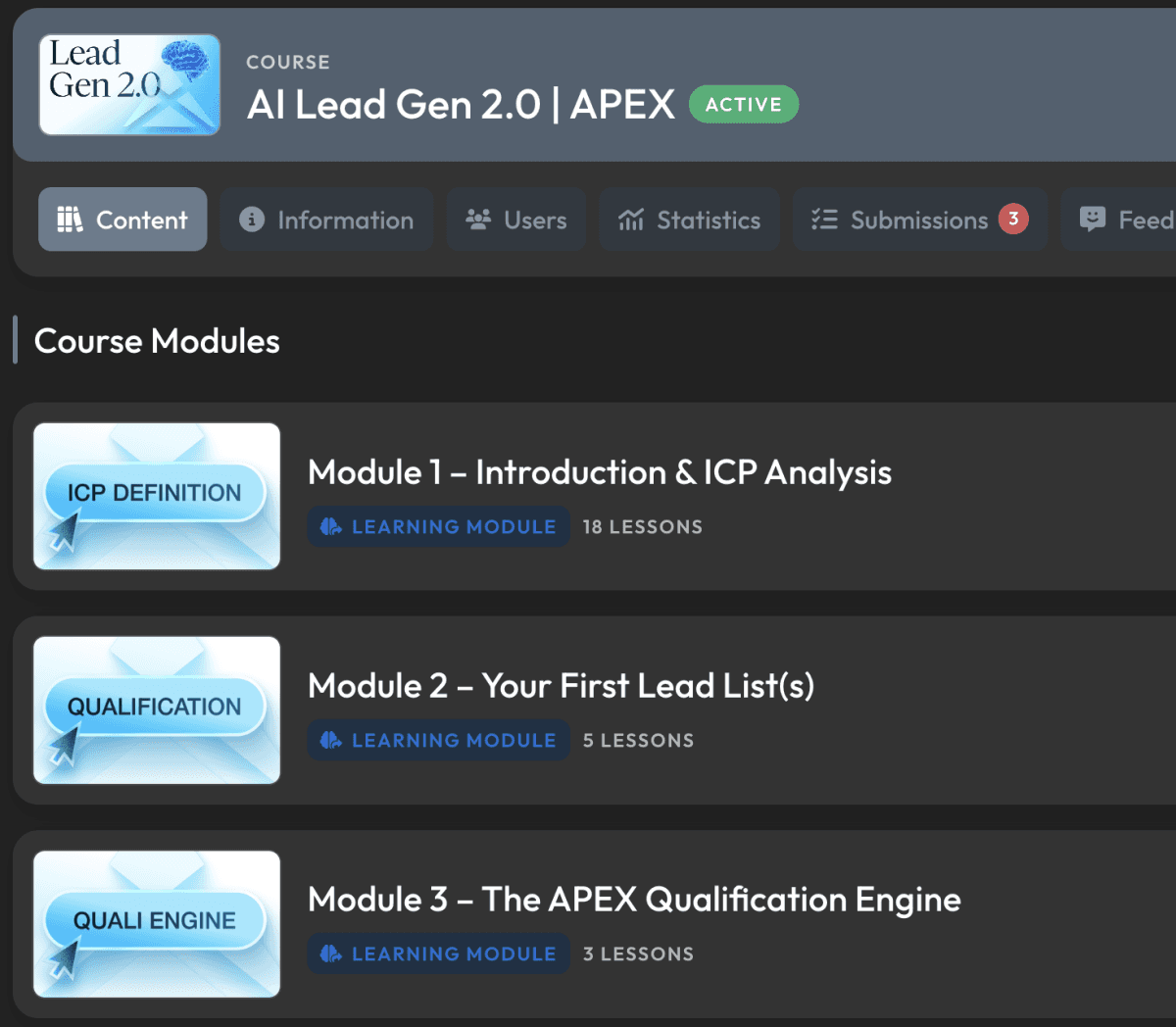
Many people think AI lead generation is a tool, a prompt, or a shortcut. At APEX we deliberately take a different approach. We clear up typical misconceptions early and show why AI lead gen does not automatically work just because you "use AI." No hype, no promises we cannot keep, but a system that works when you are ready to think clearly, define precisely, and take responsibility.
AI is excellent at recognizing patterns and structuring suggestions. However, it is not capable of fully grasping context, responsibility, or strategic consequences. Companies that ignore this expose themselves to unnecessary risks.
In functioning setups, it is clearly defined where AI ends and where human evaluation begins. This clarity creates trust and prevents dependency.
Employees are not involved early enough
Technically sound AI solutions regularly fail due to a lack of acceptance. When teams are confronted with finished systems without knowing the background or being able to influence the outcome, resistance emerges, even when it is not openly expressed.
In successful projects, employees are involved early and upskilled by an agency, their actual problems are taken seriously, and AI is deployed specifically where it noticeably eases daily work. This creates not only acceptance but often genuine enthusiasm.
Experience clearly shows that change management matters more than any feature.
Responsibility is unclear or fragmented
One of the most underestimated reasons why AI projects lead nowhere is missing or fragmented responsibility. In many companies there is interest in AI, but nobody feels truly responsible. IT waits for specialist requirements, departments wait for technical implementation, management waits for results. Decisions are deferred, priorities shift, and after go-live remarkably little happens.
In practice, we repeatedly see systems that work technically but are not developed operationally because nobody can clearly say who decides what gets adjusted or what results are actually expected. AI then becomes a side project that keeps running but never develops real leverage.
Where AI has lasting impact, accountability is crystal clear. There is a person or role that is professionally responsible, is permitted to make decisions, and is also measured by whether the solution delivers measurable value.
AI needs leadership. Without ownership it remains an experiment. An experiment that fails in 99 percent of cases.
Too much at once, too little focus
Another recurring mistake is the attempt to transform entire departments or even the whole company with AI simultaneously. Sales, marketing, back office, and customer service are supposed to be automated in parallel, often under high expectation pressure. The consequence is that complexity explodes, dependencies become unmanageable, and teams quickly lose the overview.
Many of these projects do not fail because the idea is wrong, but because the scope is too large from the start. Too many processes, too many edge cases, too many open questions simultaneously. Instead of progress, overwhelm emerges.
The most successful AI projects we have seen start deliberately small. One clearly defined use case, one concrete bottleneck, one clearly defined goal. From this first application, the team learns, optimizes, and only then scales. This step-by-step approach creates trust, stability, and genuine organizational learning.
Success is not measured cleanly
At the end of many AI projects comes an uncomfortable but honest question: was it actually worth it? In a surprising number of cases there is no clear answer. Time was invested, money spent, and systems introduced without first defining what success should actually be measured by.
Without defined metrics, AI remains a feeling. Perhaps something feels more efficient, perhaps not. That is not strategically manageable.
In successful projects, expectations are clear from the start. It is defined how much time should be saved, which costs need to fall, or which quality metrics should improve. This measurability is decisive for creating acceptance within the team, maintaining priorities, and establishing AI as a genuine business lever rather than an experiment without clear direction.
My closing thought
The most important insight from over 100 AI projects is unspectacular but decisive. AI delivers its greatest value not where it is presented most loudly, but where it works quietly. Where it stabilizes processes, prepares decisions, and noticeably relieves people, without constantly demanding attention.
The best AI systems are not the ones people constantly talk about. They are the ones that have become self-evident after a few weeks because they simply work and nobody needs to think about them anymore. That is exactly where genuine scaling begins.
About APEX Consulting
APEX Consulting is an AI automation and growth consulting firm supporting B2B organizations with intelligent workflows, AI agents, CRM automation, and scalable operating systems. The firm focuses on practical, implementation-driven solutions that reduce manual effort and enable sustainable growth. More information: https://apex-consulting.ai/