

The AI Agency Scam 2026.
There’s an uncomfortable truth in the automation market. A truth no one talks about because it’s inconvenient, because it could unsettle customers, and because it demystifies the entire hype around low-code builders, drag-and-drop automations, and template libraries: Low-code attracts masses of tinkerers, but hardly any architects.
The original idea behind low-code was a noble one. Companies should be able to digitize faster. People without deep programming knowledge should be able to automate simple processes. Innovation should no longer be exclusive to developers.
Reality looks different. Low-code has produced an army of copy-paste agencies that cause more damage than they create value.
And we see the consequences every day in our consulting calls, especially when we try to rebuild the confidence of burned clients and show them that AI is not just hot air.

We strategically led Navasto into digital visibility. The result: a successful acquisition by the billion-dollar corporation Autodesk.
Low-code makes automation accessible, but not reliable
Low-code lowers the barrier. Anyone can click together a workflow. Anyone can call themselves an architect because they connected workflow nodes. Anyone can claim they automate companies just because they chained together a few triggers and actions.
But complexity does not disappear through simplification. It only becomes invisible.
This leads to a dangerous effect: People who don’t understand system logic, data architecture, error handling, or responsibility models suddenly build systems that are supposed to support core business processes.
The difference between a functioning workflow and a scalable system is completely overlooked.
The tinkerer thinks: “As long as it runs, it runs.”
The architect knows: “Just because it runs once doesn’t mean anything. Only when it works under load, in edge cases, during growth, and under expansion, does it become a system.”
A quick look at the testimonials of many agencies is enough to realize that this has nothing to do with real architecture, high-quality automation, or proven return on investment. These are simple tool connections that any client could have implemented themselves with a few hours of Googling.
Why low-code attracts exactly the wrong people
Low-code doesn’t attract those who can think in systems. It attracts those who want to bypass systems.
Instead of learning how data models work, people hope that a ready-made template will somehow be enough. Instead of understanding API logic, they blindly try the next connector. Instead of taking responsibility for process design, they hope a drag-and-drop tool will do the thinking for them.
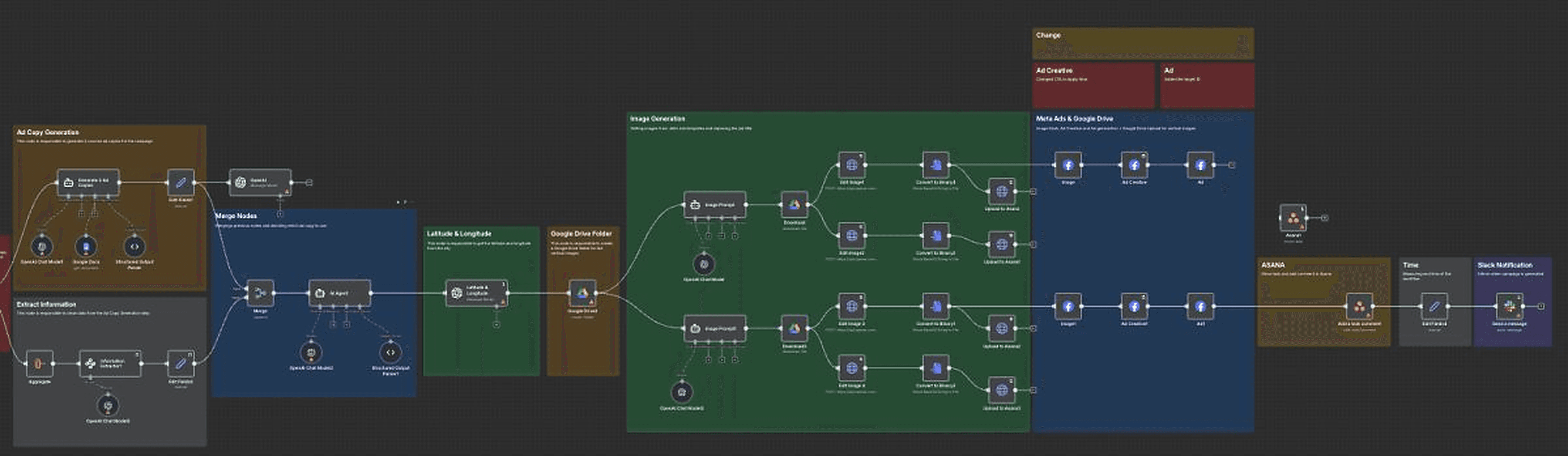
Example of an n8n workflow that sets up Meta Ads completely autonomously, including all parameters such as budget, location, copy, and so on.
Low-code sells the dream: Anyone can automate.
And that’s exactly where the problem lies. Not everyone should automate. Especially not agencies from which, to this day, I haven’t seen a single workflow that generates a multiple return on the invested fee. No case studies. No real results. Nothing. Nada. Zero.
Most low-code builders use tools like n8n, Zapier, or Make like a DIY kit. They piece together workflows without governance, without monitoring, without version control, without any infrastructure thinking. They deploy systems with zero fault tolerance. They build solutions that only work as long as no one truly depends on them.
The result is unstable processes. Data chaos. Corrupted CRM records. Irreversible automation errors that cost clients and leads.
Low-code is not the problem. The mindset of its users is.
Low-code is a tool. A powerful and meaningful tool. In the right hands, it can double a company’s productivity.
But tools never create competence. They only amplify the competence or incompetence of the person using them.
The issue doesn’t arise from the technology itself, but from the mindset it attracts.
When everyone believes they can build an automated company after watching a few YouTube tutorials, the result is a market full of overwhelmed hobbyists. Most low-code users don’t even understand concepts like idempotency, rate limits, API coherence, asynchronous processing, error recovery, or distributed systems. Yet they deploy workflows into production and then act surprised when everything blows up six months later.
Cringe.
Low-code lowers the barrier to entry, but at the same time increases the likelihood of catastrophic errors.
Low-code makes hobbyists more confident than experts
The irony is that low-code creates a dangerous illusion of competence.
The tinkerer clicks something together quickly. It works immediately. He feels smart.
But that feeling is deceptive. Real system architecture rarely works on the first attempt. It works only after hundreds of iterations, structural planning, stable data architecture, and clean error handling.
Low-code suggests: “You can do all of this too.”
But at its core, it really means: “You can build something you don’t actually understand.”
Low-code becomes a threat when companies believe it is a long-term solution
Many companies are naive. They hire someone who promises to automate the entire business using a tool like n8n, Make, or Zapier. What they get is a collection of workflows running uncoordinated, without governance, and with no scalability logic whatsoever.
After a few months, the result looks like this:
duplicate data records
lost leads
triggers firing multiple times unintentionally
automated email chaos deletions
200 nodes, but no documentation
workflows that only the creator understands
dead processes that no one notices
data overwriting itself
In the end, they call someone to fix it. And often they realize that repairing the system is more expensive than rebuilding it from scratch.
Not because the tools are bad. But because the wrong people are using them.
The difference between low-code tinkerers and real AI architects
The tinkerer thinks in workflows. The architect thinks in systems.
The tinkerer builds functions. The architect builds infrastructure.
The tinkerer follows templates. The architect starts with enterprise architecture.
The tinkerer knows nodes. The architect understands data flows.
The tinkerer assembles automations. The architect orchestrates value chains.
The tinkerer uses tools. The architect designs mechanisms.

Automated lead generation is one of the most demanding disciplines in modern B2B sales. We’ve successfully implemented it.
The company doesn’t notice the difference immediately. But whenever a process fails, data gets lost, or the system breaks under load, the gap becomes visible. At that point, it becomes clear that low-code was never the problem. It was always the person using it.
Why the future belongs not to low-code builders, but to system architects
The coming years will be dominated by companies that think about their processes end-to-end. Companies that understand automation as a strategic discipline, not a DIY project. Companies that recognize AI not as a tool, but as an orchestrator. Companies that clearly see system architecture not as a nice-to-have, but as a prerequisite for scale.
Low-code will remain. But low-code tinkerers will disappear. Because companies can no longer afford hobbyists.
In competitive markets, it’s not the company with the highest number of workflows that survives, but the one with the most stable systems.
And those systems are never built by template collectors, but by architects who truly know what they’re doing.
Work with the market leader now: https://calendly.com/apex-consulting-call/ki-beratung
About APEX Consulting
APEX Consulting is an AI automation and growth consulting firm supporting B2B organizations with intelligent workflows, AI agents, CRM automation, and scalable operating systems. The firm focuses on practical, implementation-driven solutions that reduce manual effort and enable sustainable growth.
More information: https://apex-consulting.ai/