
Watch Out for the Tool-Hopping Problem
You want to use AI effectively, but somehow it still isn't quite working? That rarely comes down to a lack of skills, and in most cases the approach is where things fall apart.
Many people believe AI is mainly a tool for automating as much as possible, yet this very idea often leads straight into a dead end. Those who understand AI can use it to improve processes, scale services, and make their own business significantly more productive.
In this article, you will learn four core principles that determine whether AI becomes real leverage for you or simply turns into another toy.
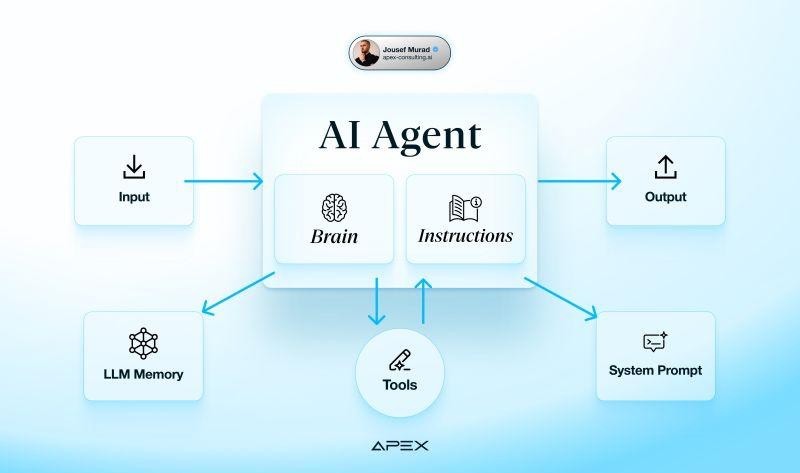
An AI agent consists of three core components: the "brain" (LLM) with clear instructions, external tools such as APIs or databases, and a memory containing system prompts. Together, they enable the agent to handle structured, multi-step tasks and carry them through to real execution, going well beyond simply providing answers.
The Real Goal of AI Is Leverage
At first glance this sounds like a play on words, but in reality it represents a decisive shift in perspective.
When AI tools became popular, the idea quickly took hold that we would build systems capable of replacing people entirely: fully automated agents that write emails, book appointments, and create websites, all without any human involvement.

€200,000 saved in six months with AI. As an engineer, I love numbers because they never lie, and they tell you exactly what is working, what is broken, and where the real leverage lies.
Fascinating in theory, but usually unrealistic in practice.
Companies quickly discovered that full automation is rarely stable, often error-prone, and almost never economically sensible. The true value of AI lies in amplifying human work.
A Sensible Distribution of AI
Successful companies avoid an all-or-nothing mindset when using AI and instead follow a clear ratio:
60% fully automated: repetitive, rule-based tasks
30% AI-assisted: tasks that require context and judgment
10% purely human: decisions, empathy, negotiations
This mix ensures that AI works where it is strong while people remain where they are irreplaceable.
Practical Examples
Automating customer support via WhatsApp? Easy!
Entering data into the CRM? Fully automatable.
Drafting personalized messages? AI can deliver drafts, and a person refines them.
Leading a sales conversation? That is a human task.
When AI shrinks a 10-hour process down to 1 or 2 hours, you are looking at a genuine competitive advantage that goes far beyond a nice feature.
Less Is More: Depth Beats Breadth
A typical mistake is chasing as many tools, as many workflows, and as many target audiences as possible. It sounds productive, yet it almost always leads to superficiality.
The Tool-Hopping Problem
Zapier today, Make tomorrow, the newest AI agent the day after, and in the end you have not truly mastered any of them.
The better path is simple: choose one tool and become really good at it.
Specialization builds competence, competence builds trust, and trust brings in clients.
The Same Applies to Target Audiences
Many people think, "The more industries I serve, the more revenue I generate."
In reality, the opposite is true. Anyone who tackles a new industry every week will always remain a beginner, whereas those who focus on a clear niche understand its problems better and better and automatically become the go-to point of contact.
Marketing Too
Being present on every platform usually results in mediocre content everywhere. The better approach is to choose one platform, build authority there, and only expand later.
The core message is to commit to one tool, one target audience, and one channel, and to become truly strong in each of them.
Complexity Kills, Simplicity Scales
AI tempts people to build enormous systems with many agents, branching workflows, and countless integrations. These systems look technically impressive, yet in practice they often turn into a nightmare.
In the real world, reliability counts for far more than fancy demos. A simple workflow that reliably saves 100 hours of work per month is more valuable than a complex AI system that constantly needs maintenance.

Automatically generates complete scientific documents from minimal input, structured context, and intelligent agent workflows.
The Most Important Question When Using AI
Many people start by asking, "How do I build the most advanced solution?"
The more useful question is, "What is the simplest solution that reliably solves the problem?"
What companies pay for are results, and technical elegance only matters when it delivers them.
Simplicity means a solution is:
easier to maintain
faster to implement
more robust in day-to-day use
easier to scale
With AI in particular, boring is good.
Process Beats Prompts, Every Time
Another common misconception is that people focus intensely on tools and prompting.
They optimize wording, test models, and build workflows without understanding the actual process they want to improve.
That approach leads in the wrong direction.
First the Problem, Then the Solution
AI is no magic wand, since it amplifies the workflows that already exist. If a process is poor, AI simply makes it poor at a faster pace.
Anyone who wants to use AI effectively must first understand:
How exactly does the current process run?
Which steps are repetitive?
Where is human judgment needed?
Where is the actual value created?
Only after that do you decide where AI makes sense.
An Important Admission
Sometimes AI is not the best solution at all. Often a good CRM, a simple automation tool, or a clear change to the process is enough.
Your goal is to solve problems sensibly, which means using AI only where it truly serves that purpose.
Practical Logic
In support, AI can prepare many responses, while empathy remains human.
In sales, AI can prepare the data, while closing the deal belongs to people.
AI complements the process without replacing it.
Iterating Beats Perfecting
Many people wait until their AI solution is perfect, yet perfection does not exist, especially at the beginning.
The smarter path looks like this:
start small
test quickly
gather feedback
improve continuously
This is why proofs of concept and MVPs work so well, since they deliver real insights drawn from practice, which are far more useful than theoretical assumptions.
A simple rule to follow:
Spend 20% of your time building and 80% of your time understanding and improving.
Conclusion: How to Use AI Effectively
Successful AI adoption has little to do with complicated tools and a great deal to do with the right mindset:
Leverage over automation: AI should amplify work and avoid blindly replacing it
Depth over breadth: focus on one tool, one niche, and one platform
Simplicity over complexity: stable solutions beat technical gimmicks
Process over prompts: understand the problem first, then apply AI
Your Next Step
Pick one concrete process today, either:
in your own business
or with a client
Ask yourself where AI can deliver the greatest leverage here.
Then build a simple solution yourself or book a call with our team of experts, take the solution(s) live, and improve them step by step.
This is exactly how AI becomes a real productivity tool and moves well beyond being just another experiment.
About APEX Consulting
APEX Consulting is an AI automation and growth consulting firm supporting B2B organizations with intelligent workflows, AI agents, CRM automation, and scalable operating systems. The firm focuses on practical, implementation-driven solutions that reduce manual effort and enable sustainable growth.
More information: https://apex-consulting.ai/