
n8n: The AI Powerhouse & Open-Source Automation Tool
If you run an agency or manage a small business, you know the problem: daily repetitive tasks, copy-pasting between tools, entering form data into your CRM, sending invoices, replying to emails - all the things that keep you from focusing on what really matters.
This is exactly where automation tools come into play.
And you’ve probably already heard of Zapier, Make (formerly Integromat), or n8n. All three promise the same thing: automate processes, save time, and avoid mistakes.
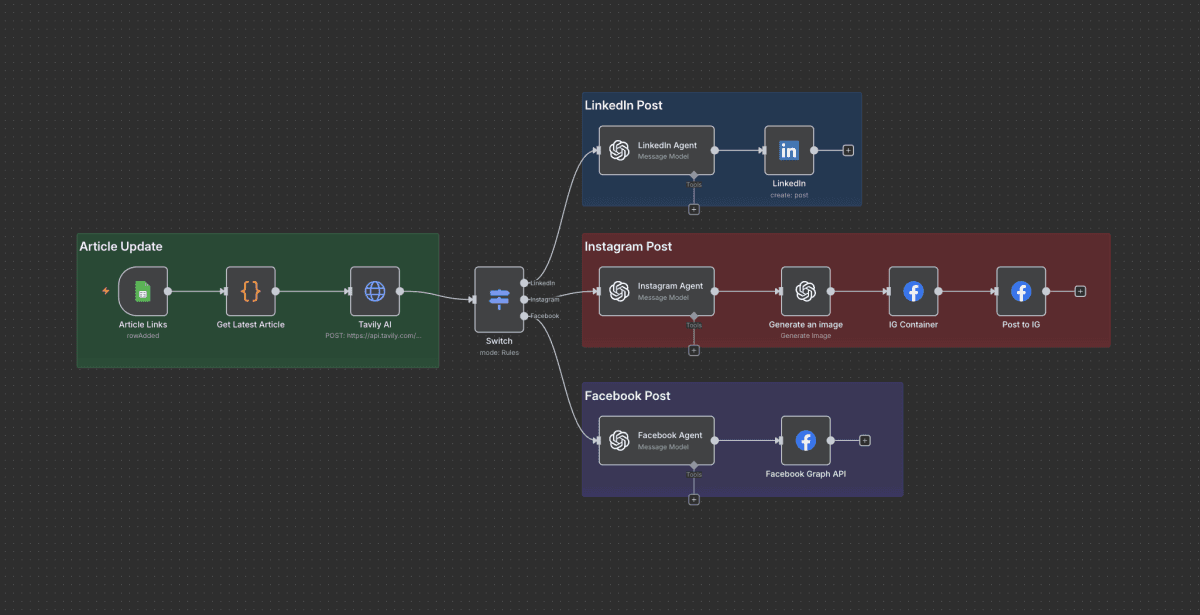
Automated social media posting with n8n: Updating an article automatically triggers
posts on LinkedIn, Instagram, and Facebook - including AI-generated text and images.
But which tool is the right one for your business?
Zapier: The quick start for beginners.
Zapier is the tool you use when you want fast results. It’s so simple that practically any team member can start using it right away.
No code, no servers, no onboarding required.
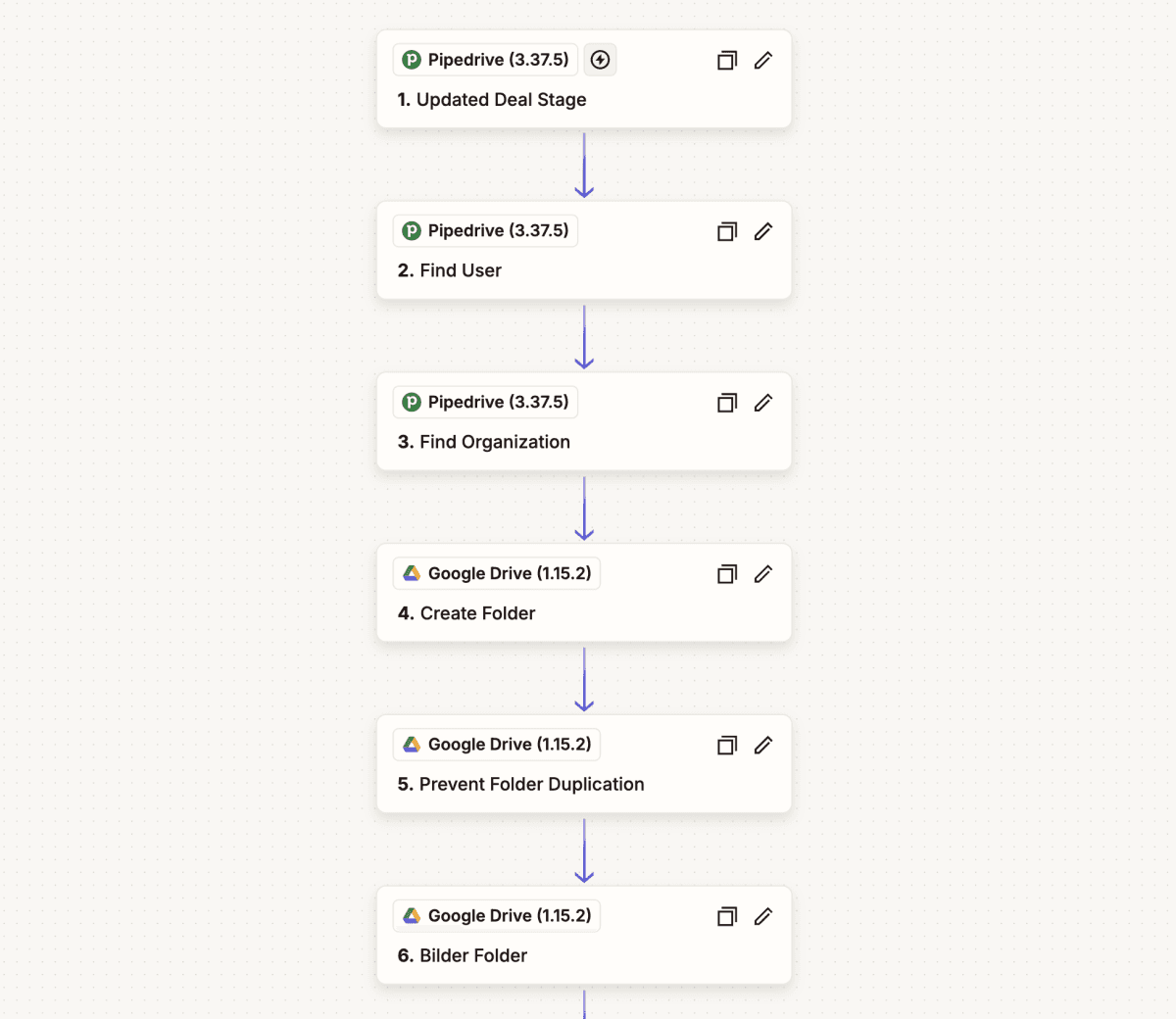
This Zapier onboarding workflow automatically creates structured Google Drive folders for new clients as soon as a deal in Pipedrive reaches a certain stage, linking user and company data in the process to prevent duplicates.
A practical example: A customer fills out a form on your website. Zapier automatically creates the contact in your CRM, adds a task to the sales board, and sends a welcome email - all before anyone on your team even sees the form.
For marketing teams or solo entrepreneurs, this is a gift. You can set up lead nurturing, appointment scheduling, or Slack notifications in just a few minutes.
But: as soon as you have more than a few simple Zaps running, you’ll notice that Zapier charges per task. Every step, every action… even the smallest ones.
And if you have 1,000 leads per month or are automating multiple client projects in parallel, the bill can quickly jump into the hundreds or even thousands.
Business Insight: Zapier is perfect for quick wins or low-volume processes, but it does not scale well financially. It’s ideal for businesses that want to save time but don’t need to automate large amounts of data. Typical use cases include:
Automatically entering form submissions into CRMs like HubSpot or Pipedrive
Slack notifications for new customer inquiries
Automatic Google Drive storage and file organization
Reminders and simple cross-app triggers
In short: Zapier is the Tesla of the automation market - lightning-fast, elegant, but expensive once you go long-distance.
Make: The visual all-rounder.
Make is like Zapier on steroids - more affordable, more visual, and significantly more flexible.
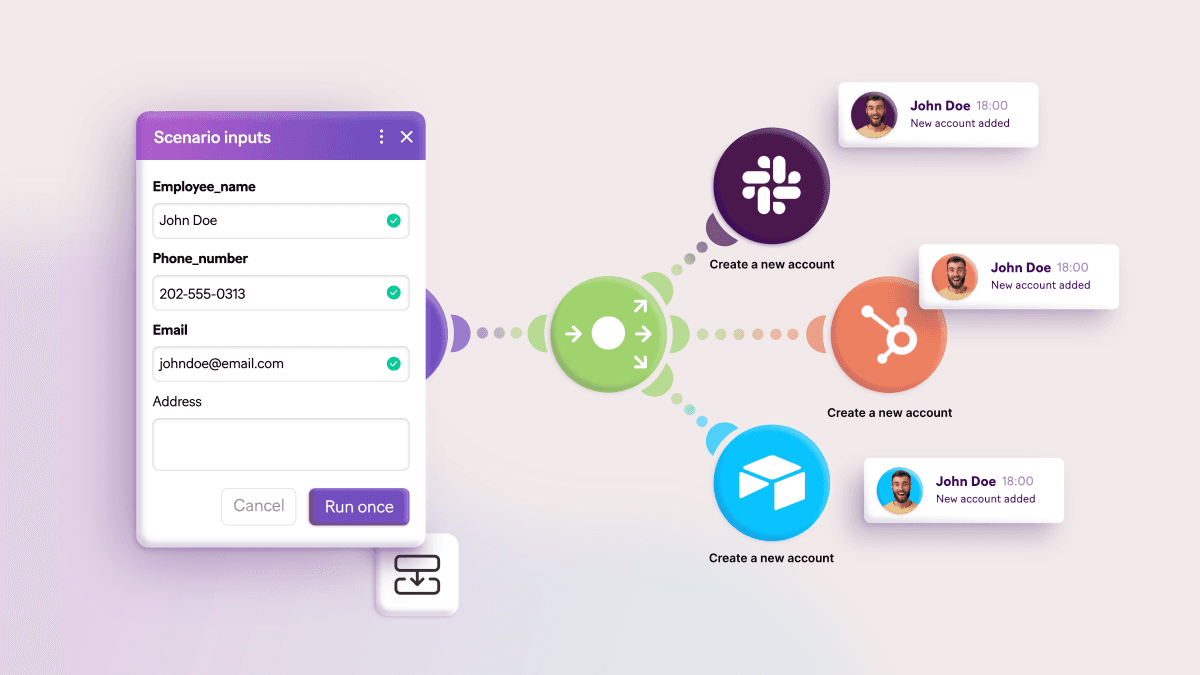
Make (formerly Integromat) - the visual automation platform that enables companies to
connect workflows between apps, process data, and scale processes without writing code.
Source: Make.com
You work in a drag-and-drop interface that shows exactly how data flows from one tool to another. This is ideal when you're connecting many systems - CRM, accounting, social media, email tools, AI APIs, and more.
A practical example:
An e-commerce company uses Make to automatically sync new orders with Google Sheets, their inventory management system, and a fulfillment partner.
Or an agency that automates client reporting: data from Meta Ads, Google Analytics, and HubSpot is merged, calculated, and sent as a PDF report to the client - every week, fully automated!
Business Insight: Make is especially worthwhile for companies that need to connect multiple tools and process data. The visual interface helps you understand complex processes, and with the so-called HTTP modules you can connect virtually any API - even if it isn’t officially supported.
It’s the perfect tool for you if you:
want to automate recurring reporting processes
need to synchronize data between different systems (CRM, ERP, marketing tools)
want to analyze and optimize campaigns automatically
need your own visual automation logic for client projects
But Make also has its limitations.
Once you start working with large amounts of data or sensitive information, things can get difficult - especially regarding hosting, data protection, and vendor lock-in.
In addition, pricing can become unpredictable when operation counts grow.
Conclusion: Make is the best choice for small and mid-sized businesses that don't yet have their own tech department but want to build professional automations. It’s affordable, powerful, and visual - but not an open-source system you can fully control.
n8n: Full Control. Full Freedom.
n8n is different. Not just another automation tool, but a platform on which you can build your own automation infrastructure.
The key difference: n8n is open source and can be self-hosted - on your server, in your cloud, or even locally.
That means: full data sovereignty, full flexibility, and no dependency on external systems.
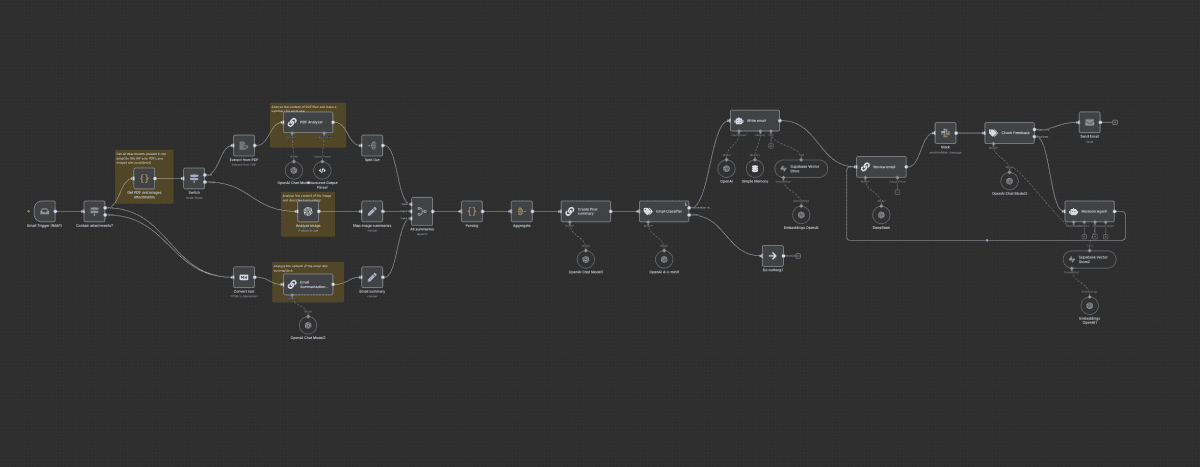
n8n in use at an agency: An AI-powered workflow processes incoming emails, analyzes attachments, generates automatic summaries, and creates response suggestions - all within a single, self-hosted environment.
A practical example from our work:
An agency uses n8n to automatically collect leads from LinkedIn, website forms, and ads, enrich them (e.g., through APIs like ApolloIO, Clearbit, or Coresignal), score them, and feed them into the CRM sales pipeline. As soon as a lead reaches a certain score, a personalized outreach email is sent automatically - generated by GPT and written directly back into the CRM.
All of this runs without manual intervention, 24/7, entirely on the agency’s own infrastructure.
Business Insight: For agencies and small to mid-sized businesses, this means:
You can offer automation as a service because you have full control over your flows.
You can integrate AI agents (e.g., for lead research, text generation, or customer support).
You can process sensitive data internally without GDPR issues.
You can run unlimited workflows and client projects on a single system - at fixed costs.
n8n does not charge per task or step, but per entire workflow execution. This makes it 10–50 times cheaper than Make or Zapier once you start scaling properly.
Of course, n8n requires more know-how. But once you understand your processes, you save massive amounts of time and money in the long run - and gain independence.
And even if the expertise is missing at the beginning: you don’t have to build it alone. Many companies bring in specialized automation partners early on to help set up the first flows cleanly and make the system understandable. This way, internal knowledge grows step by step - while you still remain in full control of your own infrastructure.
Typical business use cases:
Automated lead research & email follow-ups
AI agents for marketing or recruiting
Integrations between tools that don’t communicate otherwise
Custom dashboards or mini-apps based on workflow data
n8n is what Make and Zapier are not: a foundation on which you build your own systems - not just automations you click together.
Which tool is right for agency owners and SMBs?
If you’re just getting started with automation, Zapier is ideal - you’ll see fast results without technical knowledge.
If you want more control over processes, need automated reporting, or have to connect APIs, Make is your next logical step.
But if you understand automation as part of your overall business strategy - as a system that reduces costs, stabilizes operations, and creates scalable revenue - then n8n is the only real choice.
For agencies, this means:
n8n can become an internal product. You build custom automation solutions for clients, clone them, adapt them, and reuse them - with full data ownership and better margins.
For SMBs, this means:
You get enterprise-level functionality at a fraction of the cost. And you’re not dependent on a vendor who might double their prices tomorrow.
In short
Zapier: Fast, simple, but expensive as you scale
Make: Flexible, visual, but not independent
n8n: Free, scalable, AI-ready, and economically unbeatable
If you take automation seriously - not as a tool, but as part of your business strategy - n8n is the platform that will take your company to the next stage of growth.
About APEX Consulting
APEX Consulting is an AI automation and growth consulting firm supporting B2B organizations with intelligent workflows, AI agents, CRM automation, and scalable operating systems. The firm focuses on practical, implementation-driven solutions that reduce manual effort and enable sustainable growth.
More information: https://apex-consulting.ai/