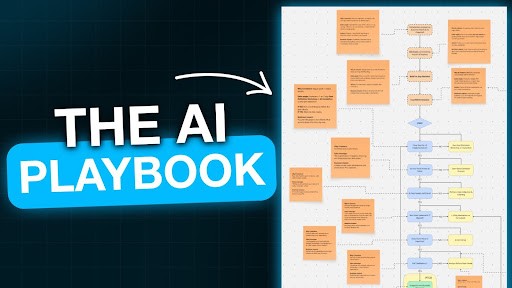

The APEX AI Playbook
When companies talk about AI, it often sounds like a fresh start. New tools, big visions, ambitious roadmaps. But a few months later, the enthusiasm is gone. No one really knows what became of it.
This is rarely due to the technology. It’s because execution is missing: clear goals, roles, processes, and responsibilities.
Without structure and focus, even the best idea loses momentum. What began as an innovation often ends as an expensive experiment.
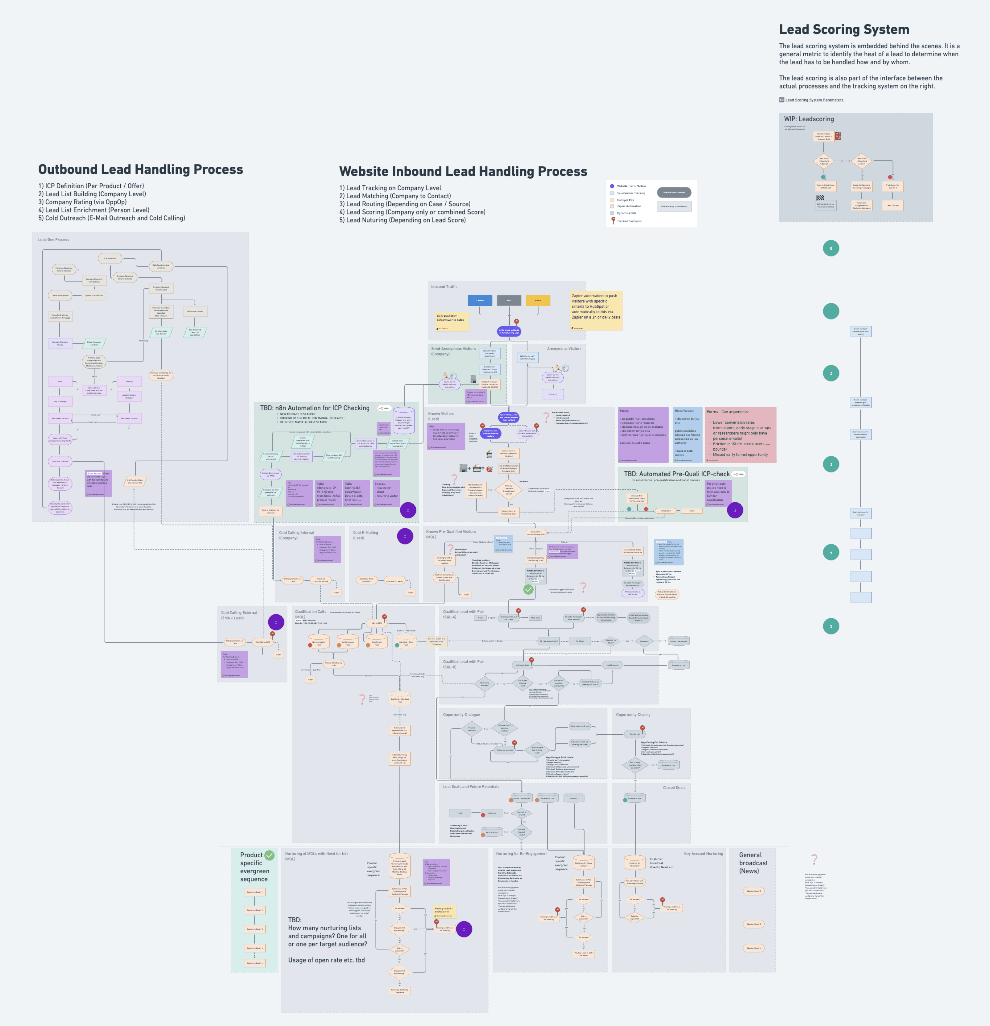
This diagram shows the complete lead-handling process that we developed at APEX together with a client – from outbound to website inbound – including lead scoring, automations, and decision logic. It visualizes how qualified leads are efficiently captured, evaluated, and handed over to sales teams in order to achieve maximum conversion.
When companies talk about AI, it often sounds like a fresh start.
New tools, big visions, ambitious roadmaps. But a few months later, the excitement is gone. No one really knows what came of it.
This is rarely due to the technology itself.
It’s because execution is missing: clear goals, defined roles, processes, and responsibilities.
Without structure and focus, even the best idea loses momentum.
To prevent this, what’s needed is not another AI tool, but a clear, structured path from the first idea to a real business case.
Here is a roadmap that works in practice, whether you’re an SME or a traditional agency.
1. Define a clear goal
Every successful AI project begins with a simple but often overlooked question:
What exactly do we want to achieve?
Too many companies start with a tool instead of a goal. They define what they think the problem might be based on gut feeling, without experiencing a concrete pain point.
They test, experiment, and hope for results… but without a clear focus, everything remains vague. An AI project without a clear objective almost always ends with unclear outcomes.
The first step is therefore to formulate the concrete “why”:
What specific problem should be solved?
Which metric (KPI) should be improved – time, costs, quality, conversion rate, error rate?
Who benefits directly – customers, employees, management, or a specific department?
Which manual task or decision should AI make faster, more accurate, or automated?
What does measurable “success” look like after 30, 60, or 90 days?
Which risks or bottlenecks disappear if the project succeeds?
Whether you want to increase efficiency, reduce costs, or unlock revenue potential, what matters is that you clearly define the value together with your team from the start.
A 1-2 day goal-definition workshop or a consulting session is often enough to create focus, responsibilities, and measurable success criteria.
2. Check your data before you start
AI without data is pure theory. Even the best AI model can’t deliver value if the data is missing, incomplete, or spread across ten different silos.
Before you even think about models or tools, check the following:
Do we have access to the relevant data?
Is it complete, up to date, and consistent?
Are we legally allowed to use this data?
A structured data audit is invaluable here: collect all sources, assess quality, identify gaps, and develop a plan early on to close them.
Only those who understand their data can successfully use AI.
Otherwise, the well-known rule applies: Garbage in = Garbage out.
3. Align IT and business teams early
One of the most common reasons AI projects fail is not technical complexity – but internal friction. When IT and business departments work past each other, blockages, misunderstandings, and endless coordination loops arise.
That’s why technical and organizational alignment should happen early. Define together which infrastructure the system will run on, how interfaces will be connected, and which security policies apply.
This prevents your project from being stopped or rebuilt by IT later on.
A clear architectural decision at the beginning saves months of delays at the end.
4. Enable the team
An AI system is only as strong as the team that uses it.
If the know-how is missing, the impact disappears – no matter how good the solution is.
Companies, therefore, need to decide early whether they want to build internal capabilities or work with external partners. In my experience with tech companies, the most effective solution is often a combination: internal employees are trained to understand and steer AI (“just enough to be dangerous”), while experts handle the complex implementation.
This creates a system that works – and a team that understands it.
The result: more ownership, less dependency, and sustainable growth of knowledge within the company.
5. Build in-house or use an existing solution?
At some point, every company faces the question: Do we build our AI system ourselves, or do we buy an existing solution?

The dilemma: build AI in-house or buy it?
In-house development offers full control and customization, but it requires time, money, and technical expertise. Purchasing a ready-made solution enables faster results but is less flexible.
The right approach depends on your goal: If you need speed, choose existing solutions. If you want long-term control, build it yourself - or start with a hybrid approach: use a ready-made tool as a foundation and expand it later.
What matters is making this decision consciously, rather than “drifting” into one direction.
6. Define the budget and calculate ROI
No business case, no implementation. Entrepreneurs need a clear view of the value AI delivers-whether through cost savings, efficiency gains, or revenue growth.
The benefits can often be quantified surprisingly easily, for example:
How many hours does an automated process save per month?
How many leads can be qualified faster with AI?
How many errors are avoided when decisions are made based on data?
Translate these effects into numbers to build trust and secure the budget.
7. Deliver the proof of concept
Now it’s time to prove that the idea works. The proof of concept (PoC) is where theory meets reality.
You should start small- with a clear objective, measurable KPIs, and a fixed timeframe of 30 to 90 days. The goal is not perfection, but a visible result that shows: AI works here, in our context, with our data.
A successful PoC builds trust and motivation. A weak one still delivers insights that help you improve. Both are progress.
8. Integration and scaling
Many AI projects get stuck in the pilot phase and therefore never generate real ROI. The difference between experimentation and success lies in integration.
If AI models are not embedded into real operational processes, they remain theoretical. That’s why PoC results must flow seamlessly into systems such as CRM, ERP, or marketing automation. This also includes training, clear ownership, and dashboards that make success and usage visible.
Only when AI is integrated into everyday operations does it begin to create real value.
9. Continuous improvement
AI is not a project you finish. It is an ongoing learning process. Once the first use case is running successfully, new ideas, new data points, and new opportunities emerge automatically.
The next step is therefore not “being done,” but thinking ahead:
Where else can AI create value?
Which other departments could benefit?
How can what we’ve learned be transferred to new processes?
Companies that stay consistent here build a system that continuously optimizes itself with every project and every iteration.
AI is not magic. But those who approach it in a structured way save money, time, and frustration - and create real, sustainable value.
The winners of the AI revolution are not those using the most advanced algorithm, but those who understand AI as a transformation process - as a new standard for efficiency, clarity, and data-driven decision-making.
So the real question is not: “Should we try AI?”
But: Where in your company can AI create measurable value within the next 30, 60, or 90 days?
Let’s find out in a free initial consultation.
About APEX Consulting
APEX Consulting is an AI automation and growth consulting firm supporting B2B organizations with intelligent workflows, AI agents, CRM automation, and scalable operating systems. The firm focuses on practical, implementation-driven solutions that reduce manual effort and enable sustainable growth.
More information: https://apex-consulting.ai/